



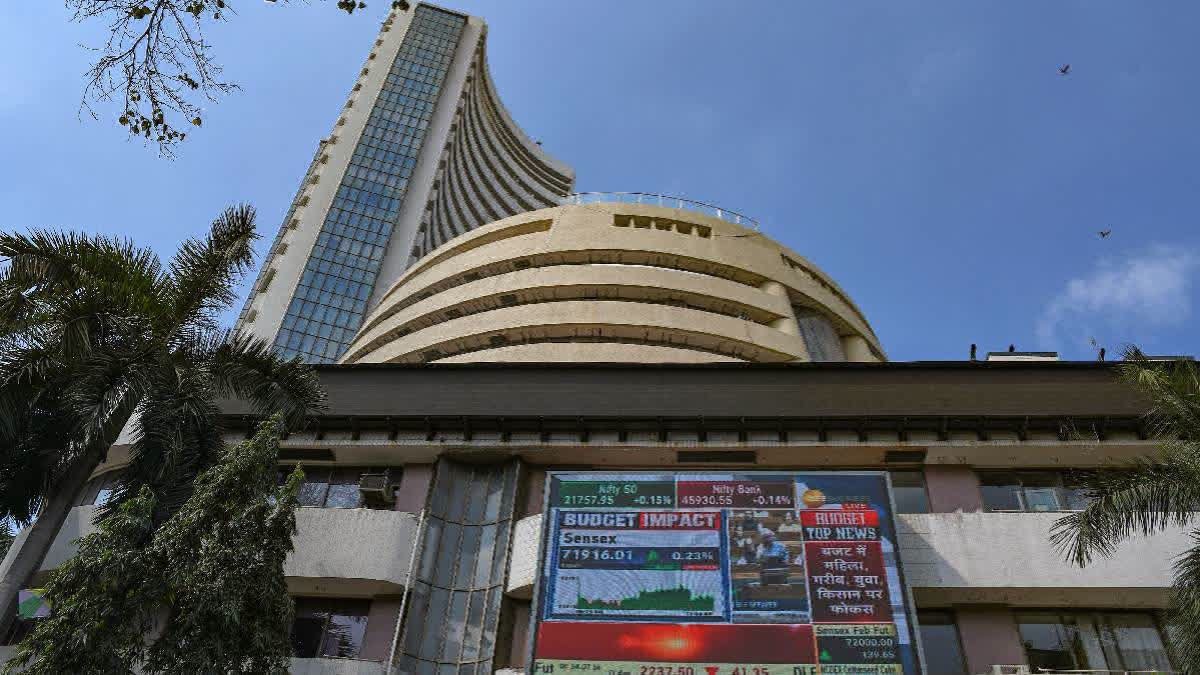
After a sharp sell-off on Wednesday, Indian equities staged a measured comeback on Tuesday, 23rd September.
At 3:31 pm IST, Nifty 50 was trading at 23,446.80, up 117.80 points or 0.50%. The index had opened at 23,352.15 against a previous close of 23,329.00, hit an intraday high of 23,466.90 and a low of 23,349.55. The day’s trajectory was a classic intraday recovery – an early dip, followed by a steady climb into noon, consolidation, and a final hour uptick that held the 23,400 mark.
At 3:32 pm IST, BSE Sensex was at 74,828.25, up 299.17 points or 0.40%. It opened higher at 74,648.32 versus previous close of 74,529.08, touched 74,973.74 at the day’s high and 74,599.88 at the low. The broader market breadth was positive, with over 2,000 advances against under 600 declines on NSE in early trade.
In context, both benchmarks remain well off their 52-week highs – Nifty’s high at 26,373.20 and Sensex’s at 86,159.02 – but comfortably above their 52-week lows of 22,182.55 and 71,545.81 respectively.
The Three Triggers: Why Bulls Returned Today
1. Crude Cools, Rupee Steadies
The biggest relief came from the energy complex. Brent crude slipped below $99 per barrel, down nearly 8% in the last ten days, as Saudi Arabia started restoring partial capacity on its East-West pipeline to the Red Sea after drone attacks last week. The Indian Rupee, which had been under pressure, opened stronger at 95.57 against the US dollar versus 95.59 previously, supported by RBI intervention.
Lower crude directly eases under-recovery fears for oil marketing companies, trims aviation turbine fuel costs, and caps input pressure for paints and chemicals.
2. Financials Do The Heavy Lifting
Leadership came from banks and NBFCs. Bajaj Finance surged over 2% to top the Sensex gainers list, Bajaj Finserv gained 1.4%, with Tata Steel, UltraTech Cement, Larsen & Toubro, Asian Paints and Titan also in the green. IT was the drag – TCS and Infosys traded marginally lower, reflecting lingering demand worries and weighing on Nifty’s upside.
3. Global Cues Turn Supportive
Asian markets were mixed to positive as investor focus shifted to scheduled talks between US President Donald Trump and Xi Jinping, and to UN-led de-escalation talks on the US-Iran standoff in New York. Gift Nifty signalled a positive open, helping sentiment after Tuesday’s rout.
As Equinomics’ G. Chokkalingam noted, “The domestic market is likely to recover as global crude oil prices continue to correct. Yesterday’s recovery in the rupee may also improve sentiment. Sensex trailing PE has fallen below 20, making valuations more reasonable.”
Business Buzz: PMI At 3-Month High, Primary Market On Fire
Domestic macros delivered a surprise today.
Growth Rebounds: HSBC Flash India Composite PMI jumped to 56.5 in September from 54.3 in August, its highest in three months and well above Reuters poll estimate of 54.4. Manufacturing PMI rose to 55.7, a seven-month high, on faster output and new orders, while Services PMI improved to 55.8. Input cost inflation eased to the lowest since January, offering margin relief, though export orders growth slowed to a 33-month low.
IPO Rush Of A Generation: September 2026 has turned into the biggest primary market month in nearly three decades, with 30 mainboard IPOs collectively raising over Rs 38,785 crore. The action was frenetic today – Hero Motors, which had seen 6.66x subscription, listed at Rs 82 against its IPO price of Rs 84, down 2.38%, but quickly hit a 20% upper circuit. SS Retail (103x subscribed) and Jindal Supreme (181x) debuted with strong grey market premia.
Boardroom & Policy: Persistent Systems announced a €1.27 billion acquisition of Nagarro SE, with majority acceptance secured. Engineers India won a $450 million contract from Dangote Group for a 700,000 BPD refinery in Kenya. Rating upgrades came for Hindustan Copper to ICRA AAA and Aadhar Housing Finance to AA+.
On the regulatory front, five Adani Group entities settled proceedings with SEBI for Rs 1.5 crore. The Centre is set to review Auto PLI applications involving Chinese investment after FDI clearance, paving the way for JVs like Tata and JSW MG. RBI flagged an estimated Rs 11 lakh crore liquidity surplus in the banking system and cautioned lenders against aggressive underwriting.
Geopolitics & The Energy Squeeze: The Hormuz Headache
If business news was upbeat, the geopolitical overhang explains why the rally was capped.
Crude supplies through the Strait of Hormuz, which carries about a fifth of the world’s oil and gas, have been disrupted since late February. Flows have dropped from 18 million bpd to around 11 million bpd. Saudi Arabia’s workaround, the East-West pipeline, was shut last week after drone strikes, hitting more than 400,000 bpd of flows to India alone. Riyadh is now bypassing the damaged section to restore about half the capacity in days.
For India, which imports 87% of its crude, the pinch is real:
- Import Bill Inflation: India imported 19 million tonnes of crude in August, down 3% year-on-year, but the bill jumped 18% to $11.7 billion from $9.9 billion a year ago as the Indian basket averaged $90.19 per barrel versus $69.11 last year. Net oil and gas import bill was flat at $9.3 billion only because product exports rose. Marketing margins on petrol and diesel are near negative, and LPG under-recoveries have widened to Rs 200 per cylinder.
- Supply Rewiring: To hedge, India has sharply diversified. Qatar supplied zero LNG in August; the US emerged as the top LNG supplier at 0.859 MMT, or 35% of intake, followed by Nigeria and Oman. Russian crude share rose to 40.9% in April-June 2026 from 33.7% a year ago.
- Washington Wildcard: The fresh risk is the Graham Sanctioning Russia and Iran Act, 2026, signed on September 18 after US Congress approval. It allows the US to levy tariffs up to 100% on the top five buyers of Russian crude and gas, including India and China, with the USTR to name targets within 30 days. State refiners say September-October requirements are secured, but November onwards looks uncertain, with Russian crude already commanding a premium.
Wood Mackenzie warns Asian oil demand may not return to pre-conflict levels until late 2027 after a 1.24 million bpd fall in 2026. A brief spike is manageable; a prolonged $100+ regime would dent GDP, push CPI toward 5.5%, and pressure the current account.
Road Ahead: Support At 23,300, Resistance At 23,500
Technical analysts remain cautious. “Near-term setup remains under pressure, with repeated supply at higher levels limiting recovery. Weak momentum readings suggest downside risks remain, although oversold conditions could trigger short-lived rebounds,” said Choice Broking’s Hitesh Tailor.
Immediate support for Nifty is pegged at 23,300-23,350 and for Sensex at 74,600, while today’s highs of 23,466 and 74,973 act as resistance. Bank Nifty, backed by record deposit and credit growth, will be crucial for any sustained breakout.
The takeaway: Today’s 0.5% rise is a relief rally built on cheaper crude and financial strength, not a decisive trend reversal. Until Hormuz stabilises and Washington’s tariff stance is clear, Dalal Street will stay headline-driven – buying dips, but quick to book profits on rips

