




Suroopa Chatterjee : Underneath the skin of the artworks, a soft glow of peace nestles within colours and textures, thriving in a quiet, almost happy solace as one encounters artist Sramana Mitra’s debut exhibition, Prithibi, which opened in Kolkata on 30 October.
A technology entrepreneur by profession, Sramana’s earliest visual vocabulary was shaped by the heady omnipresence of Tagore and frequent family visits to Santiniketan during her childhood. The cultural soil of Bengal and the artistic allure of the Bengal School slowly awakened her creative instincts. Coming from a family that valued the arts, theatre and music as much as education, she began learning under the tutelage of Ramananda Bandyopadhyay at the age of ten. Beyond technical proficiency, perhaps the most enduring philosophy she imbibed from him was the practice of restraint – the art of knowing when to stop.
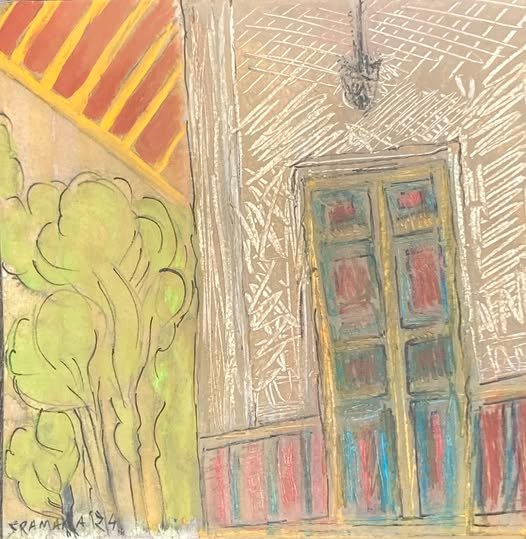
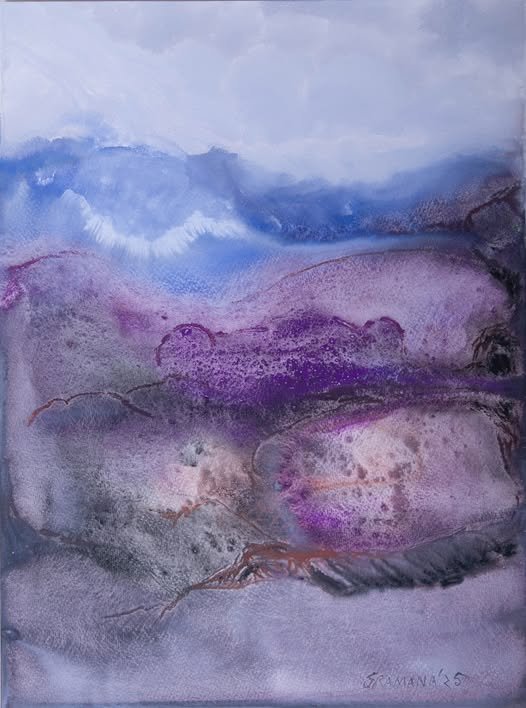
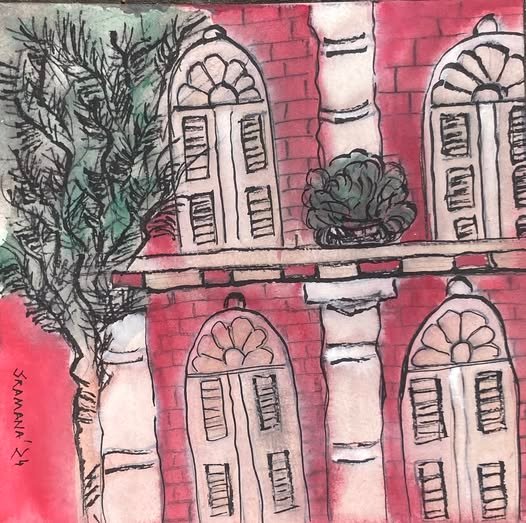
Confident, collected and warm, Sramana candidly admits to applying her mentor’s philosophy to almost every aspect of life. Her paintings bear little trace of excess or overworking. Whether in the soft highlands, wispy clouds hovering over hilltops, grassy expanses, vivid tropical houses or the vibrant abstractions that appear in her canvases, there is an understated eloquence at play. Working with watercolors, pastels and Sakura paints, she creates compositions that carry an air of serene minimalism.
Averse to the culture of excess, Sramana is less drawn to digital art and what she perceives as excessive experimentation and imitation in contemporary artistic practices. The advent of AI has inevitably touched the art world, altering its formats and modes of presentation. While opinions remain divided over this disruption, she believes art schools should provide a platform for individual self-expression that help young artists develop their own style.
“We live in an increasingly excess-driven world, where everything seems to demand more – more of this, more of that. Perhaps it is time to pause and question this incessant need for more. There must be a reason, a purpose behind what we seek; there must be a why.”
Interestingly, Sramana began developing an individual visual language quite early, with abstraction finding its way into her brushes by the age of sixteen. Her mastermoshai never expected her to follow in his footsteps. She draws a parallel with Nandalal Bose, Ramkinkar Baij and Benode Behari Mukherjee, whose artistic expressions remained distinctly individual despite their shared cultural and artistic inheritance. For her, unless an artist understands the importance of finding an independent voice, there can be no real artistic expression. The Bengal School, she believes, carries and will continue to carry an unapologetic, all-encompassing spirit of Tagore, wherever its artistic vocabulary travels. Tagore’s lines, she says, often rise spontaneously to her lips when she encounters new sensations and moments of beauty in her life abroad.
At eighteen, her move to Western Massachusetts for higher education brought a considerable visual and cultural shift. She encountered the heady romance of autumn foliage and the eloquent whites of winter, experiences that quickly transformed her palette and sensibilities. Her perception of landscape continued to evolve through intimate encounters with the American topography, from the vast and varied terrains of California, Montana, Wyoming, Utah and Colorado. Gradually, the lyrical and figurative sensibilities of her early Bengal School influences gave way to a more personal, abstract vocabulary. Her use of colour too underwent a transformation, opening up to new possibilities through her experiences in New England and subsequent travels across Europe.
After settling in America and building a successful career as a technology entrepreneur, Sramana put her brushes aside for several years. The pandemic eventually brought her back to the canvas, when time became an unexpected gift, opening the doors to a rediscovery of her long-held passion.
Her artistic sensibilities have drawn from an eclectic range of influences. She admires Chagall’s understanding of colour and the Impressionists, particularly Monet and Cézanne. Japanese aesthetics have also informed her visual compositions. Pierre Bonnard’s retrospective at Tate Modern left an indelible impression on her sensorial sensibilities, while her encounter with Pierre Soulages’ work transformed her understanding of the possibilities of black, a colour that has since found its way into her own paintings.
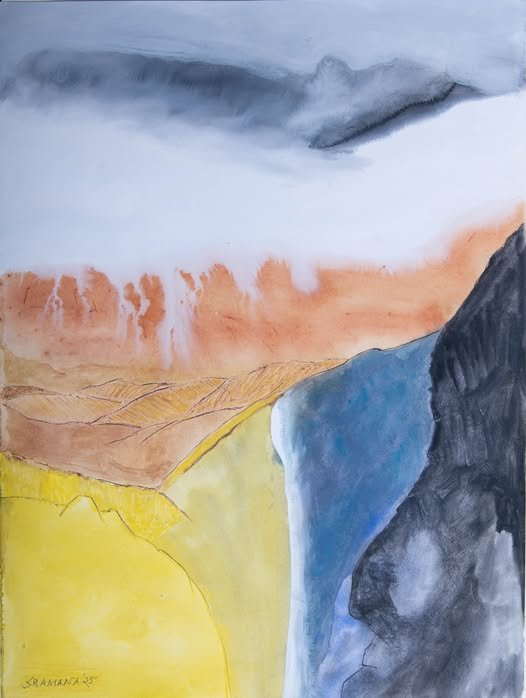
In a world unsettled by hatred, jealousy, war and geopolitical disharmony, Sramana feels an increasing need to perpetuate beauty through art rather than surrender to darker hues of revolt and protest. This is not to suggest an indifference to the world’s turmoil; rather, it reflects her conviction that aesthetics need not be sacrificed even when confronting difficult realities.
For her, art remains a soul call, a journey towards a place where beauty and aesthetics breathe an air of joy, love and enduring wonder. Art need not necessarily be intellectual, she believes; it should attract, speak and establish a quiet relatability with those who encounter it. Though she does not claim to be an art historian or critic, she acknowledges learning much through her frequent reading of Life with Picasso by Françoise Gilot.
Her years as a technology entrepreneur have perhaps also nurtured a certain appetite for risk. Sramana readily describes herself as something of a maverick. Standing before a blank canvas, she rarely begins with a fixed idea of where the work will lead. Instead, she allows the brush to find its own rhythm, letting the composition evolve before gradually guiding it towards resolution. There is an interplay of instinct and control, of allowing and knowing when to intervene – an approach that perhaps brings her back to the philosophy of restraint she learnt as a young student.
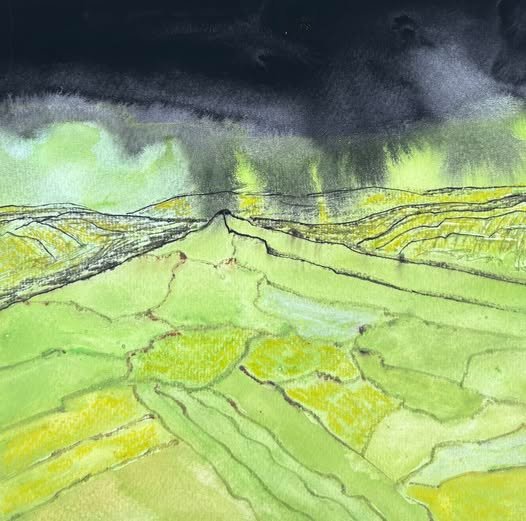
Although painting has occupied a deeply meaningful place in her life, she had never exhibited her works publicly before. A meeting with veteran gallerist and champion of Bengal art, Supriya Banerjee, eventually set the ball rolling, culminating in Prithibi this year.
The raison d’être of the exhibition lies in Sramana’s deep acknowledgement of all that life has bestowed upon her: the nurturing environment of her family, the guidance of her mentor, her Kathak teacher, her early piano lessons with Joseph Braganza, her serendipitous meeting with Supriya Banerjee and, above all, the culturally rich atmosphere in which she was fortunate to grow up. Prithibi, in many ways, becomes a gesture of gratitude and acceptance.
The sentiment finds an echo in the words:
“Today, accept my humble salutations, O Earth, as I bow down in a final farewell at the altar of the setting day.”
Looking ahead, Sramana envisages a thematic collection of around 35 works. Having explored village landscapes and abstractions, she is keen to experiment with what she calls ice-cube villages, inspired by the whitewashed villages of Andalusia in southern Spain. She also hopes to explore further possibilities in abstraction, retaining figurative and Impressionistic elements while moving away from rigid geometric interpretations. There is, evidently, much more to discover as she continues to follow the colours of cheer that define her artistic world.

