



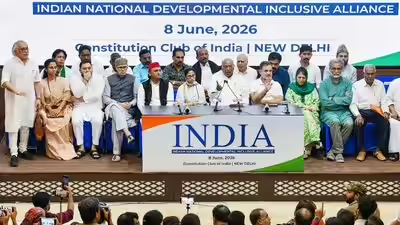
On June 30, 2026, twenty-three Opposition political parties and one Independent Member of Parliament sent a joint memorandum to the Chief Justice of India (CJI), Justice Surya Kant, in New Delhi to demand judicial intervention against the Election Commission of India’s (ECI) Special Intensive Revision (SIR) process. The joint submission follows a consensus reached during an INDIA bloc meeting earlier that month, where leaders flagged widespread concerns of “vote loot,” electoral irregularities, and alleged institutional bias favoring the ruling dispensation.
The collaborative petition marks a rare display of unified action among broad opposition factions. While the decision was initially conceptualized during an alliance meeting convened by West Bengal Chief Minister Mamata Banerjee, intense behind-the-scenes negotiations expanded the list of signatories. Notably, regional heavyweights like the DravidaMunnetraKazhagam (DMK) and the AamAadmi Party (AAP) added their names to the four-page memorandum, despite their complicated relationships with the core alliance.
According to senior alliance leaders, the formal complaint contains specific state-level case studies illustrating how the ECI’s Special Intensive Revision of electoral rolls has allegedly been weaponized to disenfranchise millions of genuine voters, particularly across states like West Bengal and Bihar. Opposition figures asserted that when standard democratic safeguards fail to maintain equilibrium, the country must look directly toward the highest levels of the judiciary to restore institutional accountability.
The legal pathway ahead remains intricate, given that a two-judge Supreme Court bench had previously upheld the constitutional validity of the SIR process in Bihar. Nonetheless, Congress General Secretary Jairam Ramesh publicly declared that the joint letter underscores the opposition’s unyielding commitment to what he termed “SURE”—Solidarity, Unity, and Resistance. Alliance leaders remain resolute that the petition will force a necessary constitutional scrutiny of ongoing administrative changes to local voter lists.

