



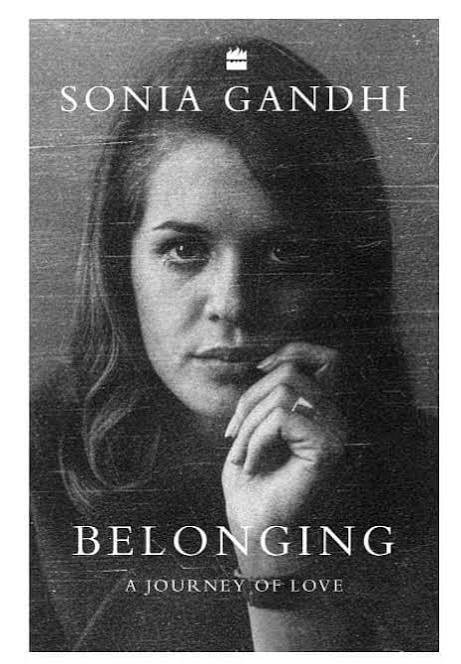
Few books are.released amidst such a curious mixture of curiosity, sympathy and political hostility as Sonia Gandhi’s memoir, Belonging:A Journry of Love. It is an exposure about the continuing difficulty which India has from separating a family’s historical legacy from the claims and credentials of its present generation.
The initial interest and disagreement with its contents extends beyond the Congress faithful. It is certainly more than a recital of the ebb and flow of the Nehru-Gandhi family’s political fortunes.
Here is the personal account of an Italian woman whose life changed dramatically after her marriage with Rajiv Gandhi, the eldest son of the then Indian prime minister, Indira Gandhi. It was certainly not roses all the way as she experienced the assasination of her mother-in-law and her husband which triggered her entry into public life.
But these incidents need not imply political endorsement. One can be moved by a personal tragedy of an influential family without supporting it’s ambition to retain its place in public life.
But this book cannot be dismissed as a private document. After all, it has been authored by a person who played such a consequential role in public life.
The author’ s take cannot be accepted as the last word on disputed public events such as the Emergency, 1984 anti-Sikh riots, Bofors and other controversies which remain part of the nation’s historical records. By the same token, the BJP’s charge that the book attempts to sanitize the legacy deserves examination..
Sharmistha Mukherjee, the daughter of the late President Pranab Mukherjee has made an interesting piece of criticism. The author was apparently surprised at her father prime ministerial ambition.
It raises a larger issue whether in a political culture shaped by dynastic influence, should ambition outside a particular political family be regarded as unusual. The question cuts both ways.
The Gandhi family cannot claim an inherited entitlement to leadership on the strength of its contribution to India’s past. But nor can Rahul Gandhi or Priyanka Gandhi Vadra be judged by the mistakes of Jawaharlal Nehru, Indira Gandhi and Rajiv Gandhi.
Their words, action and political steps will determine how they are assessed. This is not an argument for their return to power.
The response to the memoir does not yet establish an independent constituency favouring the author’s children. But one cannot wish away the fact that the family’s history continues to command attention beyond the immediate contest between the Congress and the BJP.
India needs neither political nostalgia nor inherited hostility. The burden of inheritance should be to learn and not claim.

