



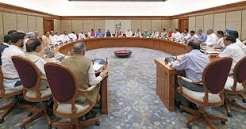
New Delhi, November 27, 2026: In a major legislative push ahead of next week’s special parliamentary sittings, the Union Cabinet chaired by Prime Minister Narendra Modi on Friday approved a revised delimitation-linked Women’s Reservation Bill proposing a uniform 50% increase in Lok Sabha seats across every state and extending the freeze on inter-state seat ratios until 2051.
According to government sources cited by The Indian Express and NDTV, the fresh constitutional amendment seeks to break the legislative deadlock that derailed an earlier version of the Bill in April 2026. By guaranteeing that every state receives an equal 50% expansion in its parliamentary strength while locking in the current inter-state proportion of seats—based on the 1971 Census—for another 25 years, the Centre aims to neutralize fierce opposition from southern states over potential loss of political representation.
Key Provisions of the Revised ‘50% Formula’ Bill
Government officials familiar with the Cabinet’s decision outlined several structural changes designed to enable the rollout of 33% reservation for women in the Lok Sabha and state legislative assemblies ahead of the 2029 general election:
- Uniform 50% Expansion Across States: Instead of reallocating seats purely on updated population figures—which southern states warned would disproportionately reward higher-population northern states—every state’s Lok Sabha tally will increase by a flat 50%, preserving each state’s exact percentage share in Parliament.
- Inter-State Freeze Extended to 2051: The existing inter-state ratio of constituencies in both Houses of Parliament will remain sealed until 2051, extending the constitutional freeze by 25 years.
- Redrawing Constituencies via 2011 Census: Rather than waiting for a fresh decennial Census, the Bill proposes using 2011 Census data to redraw constituency boundaries within each state to accommodate the expanded seats and carve out the 33% women’s quota.
Parliamentary Math: How the ‘50%’ Change Could Tilt the Balance
The revised formula arrives seven months after the Constitution (131st Amendment) Bill, 2026, was defeated in the Lok Sabha on April 17—securing 298 votes against 230 and falling 54 votes short of the constitutionally mandated two-thirds majority under Article 368.
With Parliament reconvening for a four-day extension of the Monsoon Session—November 30 and December 1 in the Lok Sabha, and December 2 and 3 in the Rajya Sabha—the 50% safeguard has altered floor calculations:
- Regional Parties Weigh Support: According to India Today and The Indian Express, the uniform 50% seat-increase formula directly addresses core demands raised by regional outfits. Sources indicated that the DMK (22 Lok Sabha MPs), Sharad Pawar’s NCP (SP) (8 MPs), and the YSR Congress Party (4 MPs) could reconsider their earlier opposition if state-level seat shares are fully protected. Combined with the NDA’s baseline strength, support from 20 rebel Trinamool Congress MPs, and the newly reunited Shiromani Akali Dal, backing from these regional parties could push the government close to the ~358–360 vote threshold required in the 539-member Lok Sabha.
- Opposition Criticism Continues: Meanwhile, Congress MP Gaurav Gogoi and CPI(M) MP John Brittas maintained that the 33% women’s quota should be implemented within the Lok Sabha’s existing 543-seat strength without delimitation, while Samajwadi Party chief Akhilesh Yadav accused the ruling party of attempting to redraw electoral boundaries for political advantage. Congress president Mallikarjun Kharge has convened a meeting of Opposition floor leaders on Saturday to finalize a joint parliamentary strategy.

