



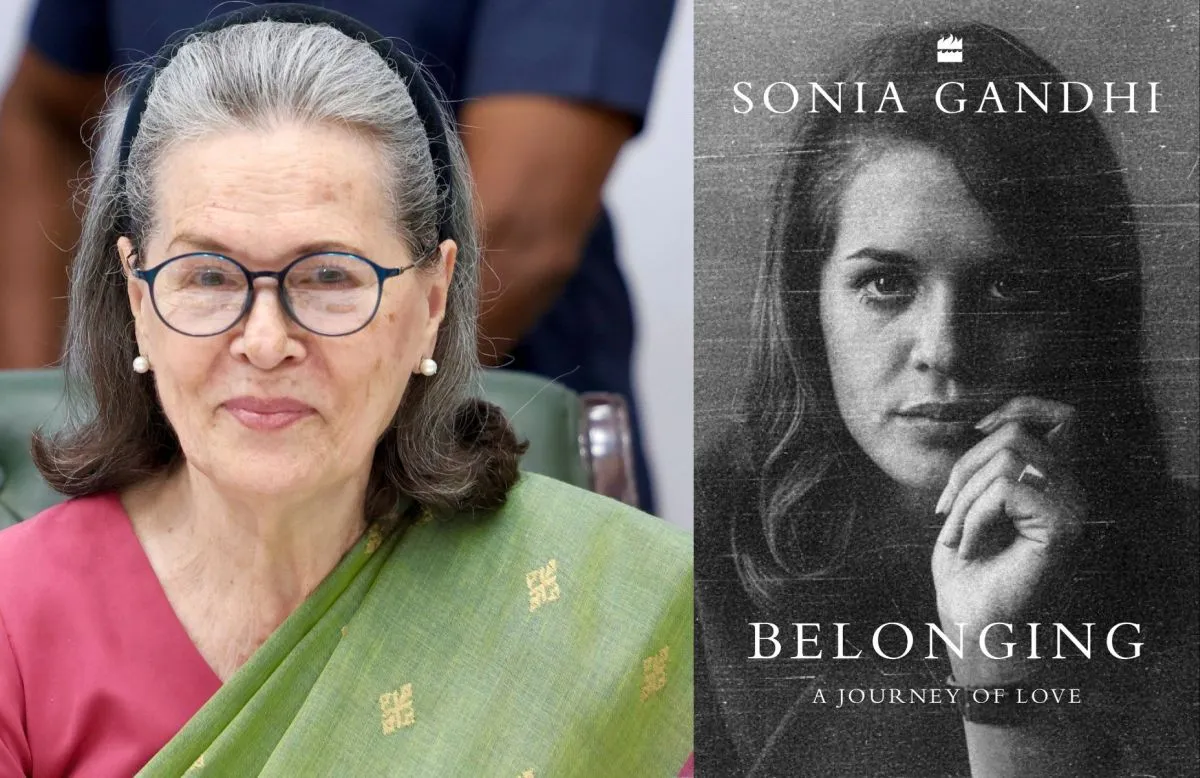
Sonia Gandhi has long occupied the centre of Indian politics while revealing little about herself. She has been most ubiquitous and elusive for three decades.
She is the matriarch of the most famous family of the country. At the same time, she has been the most influential figure during the years United Progressive Alliance was running the country.
Her forthcoming autobiography Belonging:A Journey of Love is much more than a memoir. It is a potential document of Indian history.
One wonders whether it offers history as an insider ‘s illumination or a carefully curated family remembrance. After all, she occupies a position no other Indian politician can claim.
She entered the Nehru-Gandhi family as an outsider. Later she witnessed the assasinations of Indira and Rajeev Gandhi.
She resisted politics for years. But later became the person who revived a declining Congress and led it back to power.
But there remain certain unanswered questions. Why did she enter politics after Rajeev Gandhi ‘s assasination?
What made her decline the prime ministership after having the numbers to claim it? How did the particular duality of authority between Congress president Sonia Gandhi and Prime Minister Manmohan Singh actually function?
How does she now access the decade of UPA government? What about the charges of corruption and administrative drift?
Her decision to decline prime ministership is arguably the most significant. It was projected as one of the most dramatic acts of political renunciation.
But it did not mean retirement. Sonia Gandhi headed the UPA alliance in which constitutional authority and political authority resided on different individuals.
A candid report on her part will clear the ambiguity. One looks forward to it in this book.
Contradictions in her life fascinate the people. She had once strongly opposed her husband Rajeev Gandhi ‘s entry into politics.
She had tried to protect her children from the consequences of her family’s inheritance. But the family’s political legacy passed on to her son Rahul Gandhi.
Her daughter Priyanka Gandhi Vadra entered politics much later. The autobiography’s revealing themes will be how she reconciled her maternal instincts with political inheritance.
All these make the memoir important at a point when Congress is struggling to define its future. The progress of BJP under Narendra Modi has subjected it to an unprecedented challenge.
There are topics she chooses to explain while there are she prefers to pass over. That is what memoirs are all about.
It remains to be seen whether it is judgement on a family and her political career.
Everything said and done, it will be an important chapter of Indian history. Those in support of her person and party as well as those opposing both are eager to know all about.

