



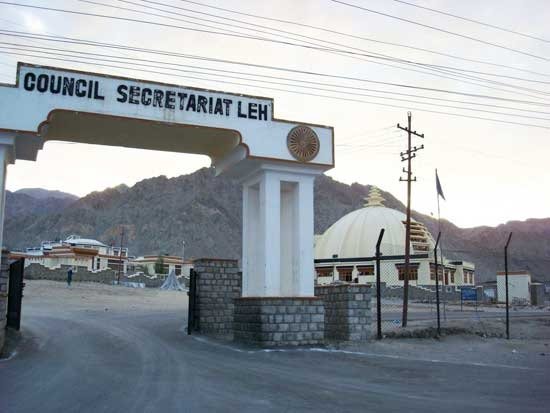
Ladakh’s newly created districts have finally received their own Autonomous Hill Development Councils—an institutional shift expected to bring governance and development closer to every remote corner of the Himalayan region. Until now, decentralised administration in Ladakh functioned only through the two principal councils based in Leh and Kargil. “With the extension of this framework to all seven districts, Ladakh enters a new phase of grassroots empowerment,” said an official.
Ladakh’s hill council system has been central to local governance for nearly three decades. The Ladakh Autonomous Hill Development Council Act, 1997, established elected councils in Leh and later in Kargil, granting them substantial authority over planning, development, land use, and local welfare schemes. These councils were designed to reflect Ladakh’s unique cultural, geographic and administrative needs, allowing residents to shape decisions that directly affected their mountainous and often isolated communities.
However, with Ladakh’s reorganisation as a Union Territory in 2019 and the subsequent creation of five new districts—Sham, Nubra, Changthang, Zanskar and Drass—the demand for similar decentralised bodies grew stronger.
That demand reached its culmination on Thursday when Lieutenant Governor Vinai Kumar Saxena approved the formal notification establishing seven Ladakh Autonomous Hill Development Councils (LAHDCs), “fulfilling the Central Government’s historic announcement made on July 13.” Saxena expressed gratitude to Prime Minister Narendra Modi and Union Home Minister Amit Shah, calling the move a transformative step that will strengthen participatory governance and ensure that district-level priorities are shaped by local aspirations rather than distant administrative centres.
With this approval, LAHDCs will now operate in all seven districts—Leh, Kargil, Sham, Nubra, Changthang, Zanskar and Drass. A statement issued in Leh said that this expansion extends the long-standing model of elected local self-governance beyond the two traditional hubs, giving the newly carved districts their own institutional mechanisms for planning, development and administration.
“The creation of these councils marks a significant milestone in Ladakh’s governance journey. It promises deeper decentralisation, greater accountability and more responsive development—particularly crucial in a region where geography often limits access to centralised services,” the statement said. It added that by empowering district-level bodies, Ladakh is expected to see more targeted infrastructure growth, improved public services and stronger representation of local cultural and socio-economic needs.

