



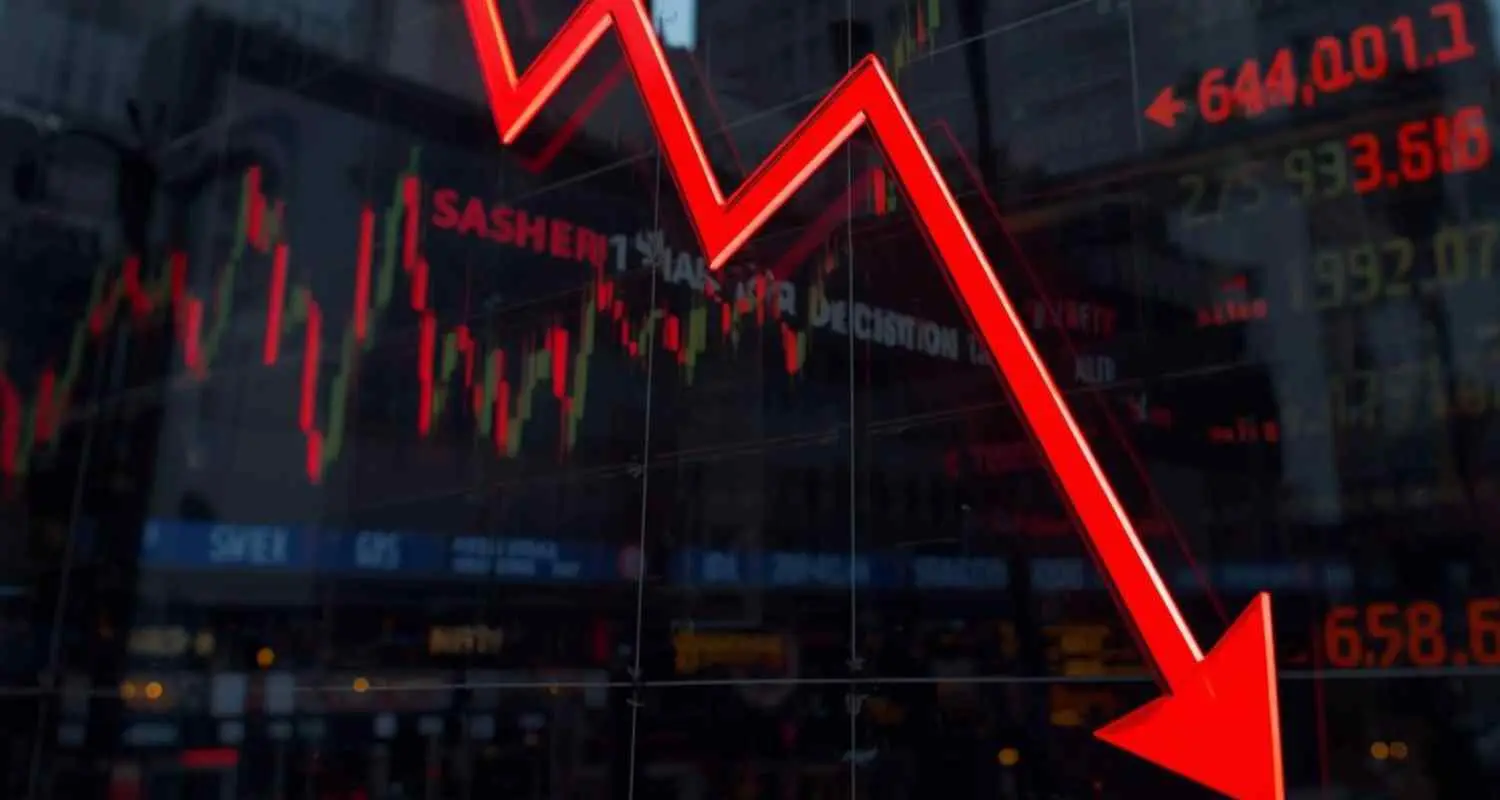
Dalal Street started September on a sour note. After a gap-down open, benchmark indices never recovered, ending deep in the red as a lethal mix of $95 crude, spiking US yields and fresh US-Iran missile exchanges sent global risk assets tumbling.
Your intraday charts tell the whole story.
At The Close: Bears In Full Control
– Nifty 50: 23,914.45 (-141.35, -0.59%) at 3:31 PM. The 50-stock index opened 198 points lower at 23,858.00, plunged to an intra-day low of 23,786.80 before a late-covering bounce to 23,914.45. Previous close: 24,055.80. The index now sits over 2,400 points below its 52-week high of 26,373.20.
– Sensex: 76,570.35 (-373.93, -0.49%) at 3:32 PM. The BSE flagship opened at 76,471.32, cracked over 700 points within minutes to 76,225.80, before recouping some losses. Day’s low: 76,135.72, high: 76,570.35. Previous close: 76,944.28.
It was not just the frontliners. Broader markets cracked too. Nifty Midcap 100 fell 0.5% and Smallcap 100 slipped 0.4%. Market breadth was decisively negative with 11 of 16 NSE sectoral indices in the red.
Top Losers & Gainers: Auto was the biggest drag. Hero MotoCorp crashed 4.6%, dragging Nifty Auto down 1.8% after the two-wheeler major reported a slump in August exports and market share. IT and Realty fell up to 2.5%. On the other side, Coal India emerged as the unlikely hero, rising 3.46% to become the top Nifty gainer, while Nifty Utilities was the only sectoral index in green, up 0.77%.
Delivery giant Swiggy lost 2.7% on buzz that a proposed foreign ownership cap could trigger forced selling by passive funds.
Business Beat: Why Dalal Street Tumbled Today
1. The $95 Oil Shock: Brent jumped 0.3% to $95 a barrel, after hitting a near six-month high near $97 earlier. The catalyst: renewed US-Iran strikes, described as the most intense in weeks. For India, which imports 87% of its oil, every $10 rise widens the current account deficit by ∼0.4% of GDP. “Market sentiment remains under pressure amid a sharp surge in crude, triggered by escalating geopolitical tensions in West Asia,” said Sudeep Shah of SBI Securities.
2. Global Bond Bloodbath: Oil pushed inflation fears back on the table, sparking a rout in global bonds. US Treasury yields surged to their highest since January 2025 on bets of a near-term Fed rate hike. When US yields rise, foreign money flees emerging markets. That’s exactly what we saw today.
3. Rupee On Edge, RBI On Guard: The rupee opened at 94.89 per dollar, just shy of the psychological 95 mark. It closed Monday at 94.95 after hitting a record low of 95.15 last week. Dealers confirm RBI sold dollars heavily before the open to prevent a free fall. The central bank’s war chest is huge at $729.3 billion, expected to top $750 billion by month-end thanks to record NRI deposits, which soared to $14.7 billion between April-July.
4. Strong Economy vs Weak Market – The Great Divergence: Here’s the irony. India just posted 7.8% Q1 GDP growth, its 12th straight beat, led by 11.9% growth in private capex. GST collections in August were up 6.5% YoY to Rs 1.86 lakh crore. Manufacturing PMI is still expansionary at 52.8, though it has cooled to a five-year low. August auto dispatches were robust – Maruti Suzuki up 21.3%, M&M up 42%, Tata Motors up 56% YoY. Yet foreign institutional investors are shunning India for cheaper tech-heavy markets elsewhere in Asia, creating what economists call a growth-market disconnect.
Geopolitical Chessboard: India’s Tightrope Walk Gets Tighter
Today’s sell-off is less about India and more about India’s neighbourhood.
Strait of Hormuz Flashpoint: With the US threatening to bomb Kharg Island – which handles 90% of Iran’s oil exports – the risk of a closure of the Strait of Hormuz is back. One disruption there and oil could spike to $110, analysts warn.
The Graham Bomb: The real Sword of Damocles is in Washington. The US Senate has passed the Lindsey Graham Act, 2026 with a thumping 86-11 majority. The bill gives the President powers to levy up to 100% tariffs on countries that are among the largest buyers of Russian crude and gas. India, which has emerged as a top buyer of discounted Russian crude since 2022, is directly in the crosshairs. Strategic autonomy was cheap earlier, now it has a price tag.
Diplomacy Marathon: India is navigating this with hyperactive diplomacy. PM Modi was in Bishkek for the SCO Summit on Aug 31-Sept 1, calling for dialogue and safeguarding of sea lanes. This week, Belgian PM Bart De Wever is in India for a three-day visit (Sept 2-4). And on Sept 12-13, New Delhi will host the 18th BRICS Summit, with PM Modi expected to pitch India as the bridge between Global North and South while quietly protecting energy interests.
Also in focus: NITI Aayog’s push for nuclear energy. India aims to raise nuclear capacity from 8.8 GW to 100 GW by 2047, needing $210 billion investment. The government think tank admitted today that green finance rules don’t yet cover nuclear and that India lacks nuclear courses from schools to universities.
The Road Ahead: 24,000 Is The New Battlefield
Technically, Nifty has slipped below its 20-day moving average and is staring at 23,700 support. Sensex needs to hold 76,000 to avoid a deeper 75,500 test.
Until Brent cools below $90 and the Iran war rhetoric dies down, expect choppy, stock-specific action. For long-term investors, the sharp correction after a 5% fall since the war started may be offering entry into domestic consumption plays that will benefit from GST rationalisation and income tax relief.
In short, India is blooming, but Dalal Street is bleeding – caught in a global oil war it didn’t start.

