



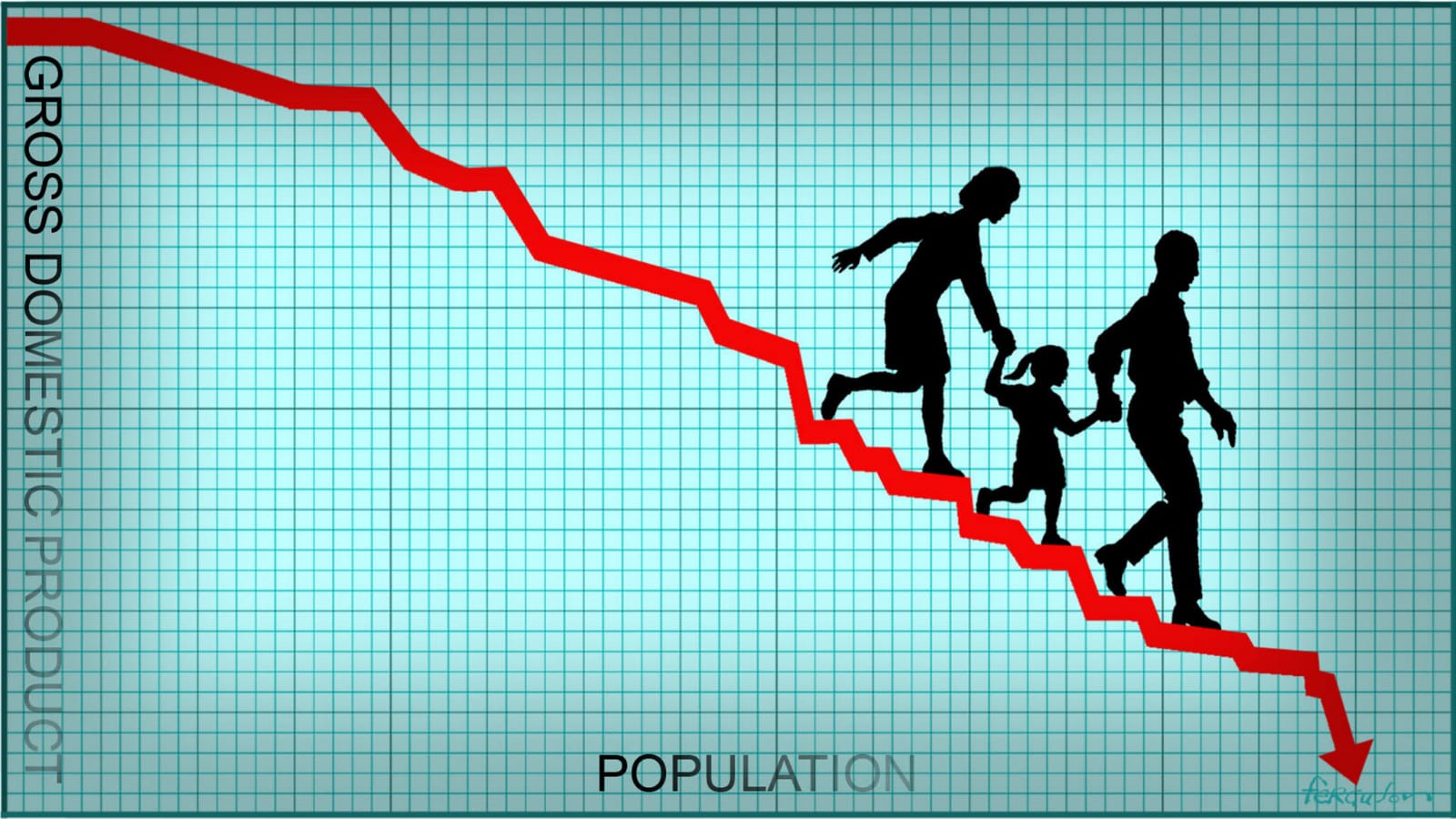
Kolkata, April 17, 2026: For decades, the global economy’s most reliable tailwind was demographic. More people meant more workers, more consumers, more taxpayers. That tailwind has turned. From Tokyo to Berlin to Shanghai, fertility rates are far below replacement level, migration is no longer bridging the gap, and working-age populations are shrinking in absolute terms. The next five years will be the first when population degrowth moves from UN charts to boardroom P&Ls.
This is not a population collapse. The world will keep adding people, thanks to South Asia and Africa. But the countries that generate 65% of global GDP are aging fast, and several are already losing workers year on year. What happens when the world’s biggest customers and factories start running out of people?
Where the Contraction Is Underway
The replacement rate is 2.1 children per woman. Below that, each generation is smaller than the last.
Country/Region Fertility Rate 2025 Working-Age Peak 2026-2031 Change in 15-64 Cohort
Japan 1.20 1995 -3.2 million
South Korea 0.72 2017 -1.9 million
China 1.02 2013 -35 million
Germany 1.46 2000 -1.1 million
Italy 1.24 1993 -0.9 million
Russia 1.41 2010 -4.5 million
Euro Area 1.48 2010 -4.8 million
Even India, now the world’s most populous nation, is at 1.98. Kerala, Tamil Nadu and Karnataka already report shrinking youth cohorts. The US is holding up only because of immigration, but net inflows have moderated and policy headwinds are building.
The UN’s 2024 update says 42 countries will see outright population decline between 2025 and 2030, up from 23 in the previous decade. For markets, the number that matters is working-age headcount. That peaked globally in 2023 and is now falling by about 5 million a year across OECD plus China.
Five Ways Degrowth Hits the Economy by 2031
Degrowth doesn’t wait for 2050. Pensions, capex plans and bond yields are priced on expectations. Here are the five transmission channels to watch over the next five years.
1. Labour shortages turn structural
Japan’s unemployment is 2.4%, Korea’s 2.8%, Germany’s 3.1%. This is not a booming job market. It is a missing workforce. With the 15-64 pool shrinking, wage pressure persists even when growth is tepid. Construction, elder care, logistics and hospitality are already short-staffed. Japan has 2.3 care jobs for every applicant. By 2029, it will need 5,70,000 more care workers it does not have.
Two implications: wage inflation decouples from joblessness, so central banks cannot cool it with rate hikes alone. And supply bottlenecks spread beyond China. German auto component makers are shifting plants not for costs, but for workers.
2. Consumption mix gets repriced
Older, smaller populations spend differently. Outlays shift from housing, education and durables to healthcare, pharma and services. Housing demand is already falling in Japan, Italy and rural China, creating localised gluts. The “silver economy” expands. IMF baseline sees global healthcare spend rising from 10.3% of GDP to 11.6% by 2031.
For exporters, the squeeze is immediate. China’s car market peaked at 26 million in 2017 and may struggle to hold 20 million by 2030 as first-time buyers dwindle. Korea’s domestic smartphone sales are down 18% since 2021. Firms built on youth demand, from fast fashion to edtech, must globalise faster or accept a smaller home market.
3. The fiscal equation cracks
Pay-as-you-go pensions assume a pyramid: many workers, fewer retirees. Degrowth flips it. Italy’s old-age dependency ratio hits 42% by 2031. One hundred workers will support 42 pensioners. In China, the ratio jumps from 21% to 30% in five years. Governments face a binary choice: cut benefits or raise taxes. Both hurt demand.
Debt math changes when GDP growth settles at 0-1% but age-linked spending rises 3-4% a year. Japan’s debt-to-GDP is 254%. It worked while rates were near zero. With labour-led inflation and a shrinking tax base, that balance frays. At least five large economies will face pressure to reform pensions by 2030 or risk ratings action.
4. Capital flows reverse
Aging countries become dis-savers. Households draw down assets to fund retirement. Japan’s household savings rate fell from 14% in 1995 to 2.1% in 2025. China’s turns negative before 2030. For decades, North Asia’s surplus savings funded US deficits and EM investment. That recycling is ending.
Result: higher real rates globally, even without central bank moves. Capital-importers like India, Indonesia and parts of Africa will chase a smaller pool of long-term money. The World Bank pegs EM climate and development needs at $2.4 trillion a year. Supply of patient capital is shrinking just as demand peaks.
5. Innovation hits a paradox
Peak entrepreneurship is in the 25-44 age band, the cohort now shrinking fastest. Korea filed 12% fewer patents in 2025 than in 2020. Yet degrowth forces automation. Japan’s robot density is 631 per 10,000 manufacturing workers, three times the global average.
The next five years will test if automation can offset labour loss. Evidence is mixed. Productivity growth in Germany and Japan is still below 1% despite heavy robotics spend. AI and software help, but adoption lags in care, construction and services, where shortages are worst.
Who Gains, Who Loses by 2031
Under pressure:
– Property-heavy economies: China’s real estate, 25% of GDP, faces structural demand decline as household formation slows. Estimates of empty apartments exceed 60 million.
– Youth-focused exporters: Korea’s cosmetics, Japan’s consumer electronics and Europe’s mass-market autos must pivot to older buyers or new geographies.
– High-debt, low-fertility states: Italy, Greece and parts of Eastern Europe face a fiscal squeeze as growth slows and social spend rises.
Better placed:
– Immigration pragmatists: Canada and Australia target 1% population growth via migration and are pulling in skilled workers.
– Automation suppliers: Robotics, elder-care tech and AI logistics stand to gain. Global robot installations may top 7,00,000 a year by 2028, from 5,53,000 in 2024.
– Dividend economies: India, Philippines, Egypt and Nigeria still have growing workforces. If they create jobs, they take global share. If not, the dividend turns into a liability.
Policy and Market Response
Governments are pulling three levers. First, pronatalist sops: cash transfers, childcare, housing aid. Results are modest. Hungary’s push lifted fertility from 1.23 to 1.59, still below replacement. Second, raising retirement ages: France to 64, China piloting 65. Third, immigration: Japan issued a record 8,20,000 work visas in 2025 while keeping its rhetoric tight.
Markets are adjusting. Insurers are reworking products for longer lifespans. Equity desks are overweight healthcare, automation and India/ASEAN. Bond investors are debating a “depopulation premium” on long-end sovereigns.
The Five-Year View: Slower, Older, Pricier
The world economy will not implode by 2031. It will downshift. Trend GDP growth in degrowing economies could be 0.4-0.8 percentage points lower due to labour alone. Inflation stays sticky because supply is capped by people, not policy. Rates settle higher as savers become spenders. Asset prices diverge: Tokyo suburban flats soften while nursing-home REITs firm up.
The bigger risk is asynchronous decline. If China, Europe and Japan slow together while the US slows less and India grows, trade, currencies and geopolitics take the strain. Fewer workers also means fewer soldiers, taxpayers and founders.
Degrowth was a 2100 problem in textbooks. It is a 2026 problem in data. The next five years will show whether large economies can shrink gracefully, or stumble under their own demographics.
Disclaimer: This article is for informational purposes only and does not constitute investment advice. Demographic projections are subject to revision. Economic outcomes will depend on policy and global conditions.

