



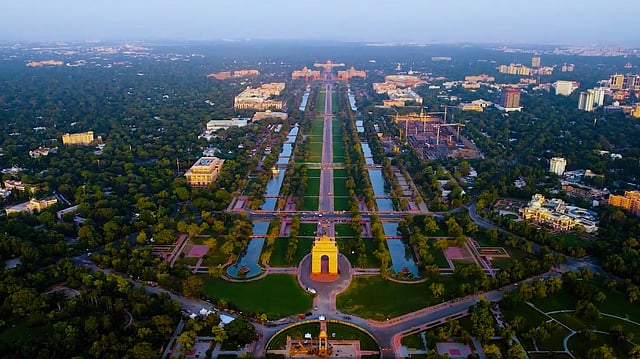
The Union government’s ambitious ₹20,000-crore Central Vista redevelopment project has
hit a significant environmental setback, with nearly half of its transplanted trees failing to
survive.
In a written response to a question by Trinamool Congress (TMC) MP Mahua
Moitra, the Ministry of Housing and Urban Affairs informed the Lok Sabha on Thursday, April
2, 2026, that 43% of the trees moved for the project have perished. Out of the 3,609 trees
that were transplanted to various locations across Delhi, 1,545 did not survive the transition,
raising serious questions about the effectiveness of large-scale tree transplantation in urban
development.
The data reveals that the highest number of transplantations took place at the sites of the
Common Central Secretariat buildings—recently renamed as Kartavya Bhawans—where
1,734 trees were shifted. Other major sites included the new Parliament building, which saw
402 trees moved, and the Vice President’s Enclave, where 390 trees were relocated. Most of
these trees were sent to the NTPC Eco Park in Badarpur.
Despite the government spending approximately ₹5.29 crore over the last three financial years on these activities, environmentalists argue that the high mortality rate highlights the “greenwashing” of infrastructure projects, where transplantation is often used as a convenient alternative to preservation.
To counter the loss, Minister of State for Housing and Urban Affairs Tokhan Sahu stated that
the government has undertaken extensive “compensatory plantation.” Over 24,000 new
saplings have been planted at the NTPC Eco Park and another 1,730 in Ghitorni. However,
critics point out that young saplings cannot immediately replace the ecological value, shade,
and air purification provided by the mature, decades-old trees that were lost.\
As the Central
Vista project enters its final stages, the 43% mortality rate stands as a stark reminder of the
difficult balance between modernizing the nation’s power corridor and protecting its dwindling
urban forest.

