



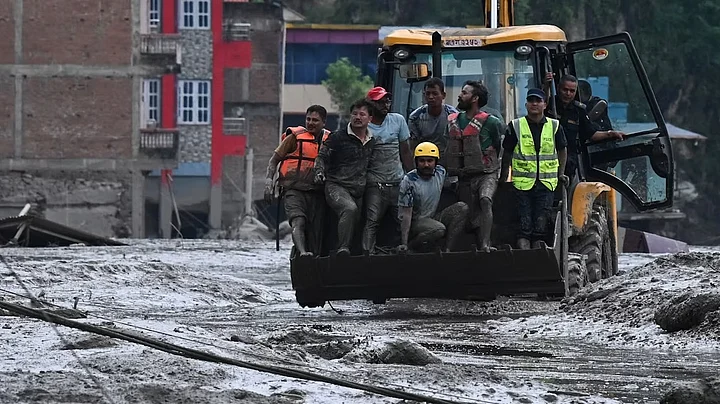
An area stretching far beyond Nepal and Tibet, both engulfed in a devastating flood is feeling the fallout of the disaster in which 350 people have died and toll is set to rise. Citizens from a number of countries have lost their lives hence the global impact.
The catastrophic flood in Nepal was triggered by the breaking away of a gigantic mass of ice and rock from a mountain in Tibet. It sent enormous volume of water into tributaries and vallies downstream.
The source of the flood water together with the size and volume of ice is yet to be determined. A satellite imagery suggests that an ice pack avalanche led to a temporary river blockage.
This was followed by a sudden release of impounded water and debris, National Remote Sensing Centre, Hyderabad stated. The speed of muddy water in hot pursuit of some of the survivors trying to run away to safety affirms the presence of the debris in the river water.
Some of the experts feel that the catastrophe was initially linked to an earthquake. Loosening of melting ice or even exceptional rainfall could shift the centre of gravity of a large ice mass and create an instability, it was also opined.
Central Nepal is pulverized. There is concern that rising lake waters may lead to a second flood.
Two lakes which have developed on either side of the border of China and Nepal threaten to burst in the area still grappling with the fatal flood. The footage of the formation of a barrier lake showed accumulation of masses of brown water accumulated in a basin with no visible outlet.
One of the lakes has formed near the confluence of Chhochen Khola and Purepu Tsangpo rivers in Nepal. Both the rivers originate in Tibet and flow into Nepal forming a part of the Bhote Koshi river system.
The natural beauty of Nepal and its significance as a religious and spiritual spot make it a big draw for tourists. Indians form the largest share of the dead and several from Kolkata are missing.
There are worries for India. Both Bihar and Uttar Pradesh are located downstream from Nepal.
An interconnected river system in spate does not obey borders. This has put the administration of both states on their toes.
The flood is not novel in this part of the world. Three years ago Sikkim suffered a glacial lake outburst; so did Chamoli in 2021.
There are risks in this Himalayan region which can turn into calamities. Many glacial lakes are located within this stretch.
Greater investments need to be made when it comes to tracking glacial lakes. Early warning systems need to be installed.
Several countries have been adversely affected by floods. A transnational template can be conceived of.
Land use patterns inimical to the local ecology need to change. Here arises a moot question
The region is buzzing with “development work”. Given the geo- strategic imperatives, thoughts should be given to minimise “developmental work”.
After all, this is a fragile Himalayan region. Geostrategic measures cannot be brushed aside.
Climate changes are intensifying. In this backdrop, such disasters can become more frequent.
The countries in this region have to put a stop to rogue developmental activity. This is a must.

