



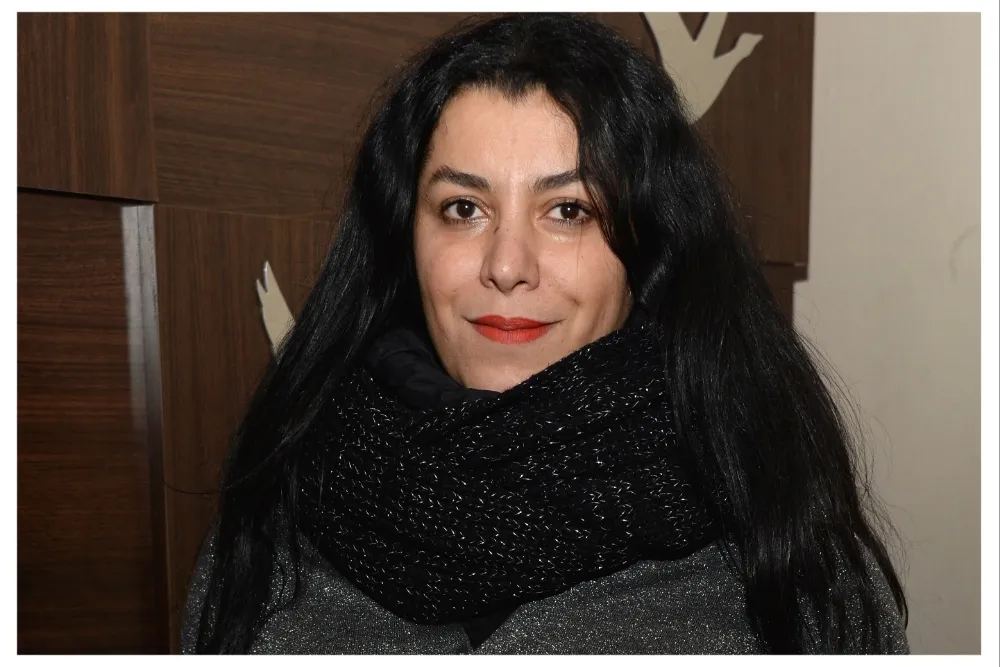
In the 2000s, a debate over banning veil raged in France. But Marjan Satrapi refused to be drawn in polarised media environment.
The level of discussion was too low,she said. And her position was not a simple one.
“For me, prohibiting the veil or forcing it is the same” Satrapi had said In an interview. She would be critical of Western forms of feminism and secularism, and their uncritical undercivilisation.
She was an Iranian And she knew what she was saying.
And she was just as critical of the Islamic Republic of Iran and its morality police. Satrapi stuck to her guns.
Years later, during the “Woman, Life, Freedom” protests in Iran, she coordinated a collective effort to produce a book telling the story of Masha Amini’s death in custody and the subsequent uprising.
Satrapi was 56 when she passed away recently. Despite the novel that catapulted her to fame, she refused to be drawn in black and white.
The world of Satrapi’s childhood in upper middle class mileu in would be shattered by 1979 Islamic Revolution. She grew up in this new, dangerous Iran and witnessed the execution of a favourite uncle.
Born of left wing parents who opposed the Shah, Satrapi had to navigate a new morality. All this shaped the autobiographical work for which she is best known, Persepolis.
In the later volumes, the curious little girl, Marji grows up through exile in Europe, a return to Iran and exile again. Her goal, as she once put it, was partly “pedagogical”.
It sought to corrects misconception about Iran and tell Westerners that no, ” the whole people of the country” were not “crazy’.The work went on to sell millions of copy worldwide.
In addition to writing novels, Satrapi directed and co-directed several films. They include the 2007 version of Persepolis and a. biopic of Marie Curie in 2019-Radioactive.
She remained engaged in political activism in Iran throughout. Satrapi praised the 2022 protests as “feminist revolution”.
Today Iran is in the grip of a transformation whose contours are still being defined. As it develops, the clarity of Satrapi’s perceptions will be missed.

