



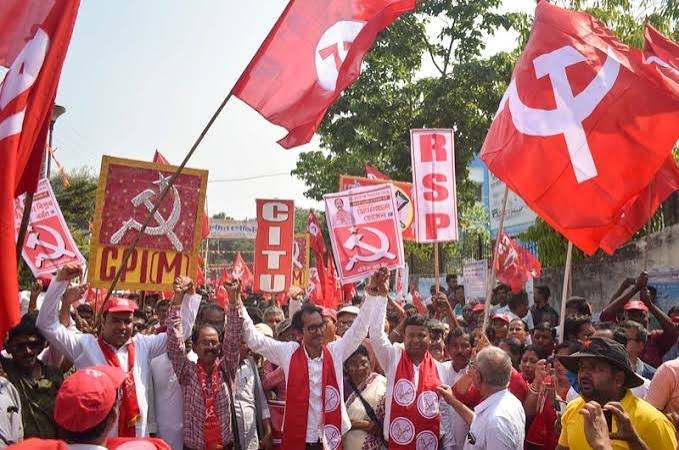
The Left parties are going to put up a fight together to the BJP in the coming Kolkata Municipal Corporation elections likely to be held this year. And in it, they are going to be together on board though some of them may not be partners of the Left Front.
With the BJP in power in West Bengal, the saffron camp is intensifying it’s attack on Left organisations of all hues. It need not necessarily be CPI(M) though the saffron supporters faced a far more stiffer resistance when they tried to pull down the book stalls selling Left literature and other books sold activists of the biggest Left Front partner.
But the idea of the left forces coming together against their age-old ideological opponent can be traced to a cause not quite connected with politics. The number of wards of Kolkata Municipal Corporation have shot up from 144 to 209.
A delimitation has led to this spurt. The Left sees an opportunity of making its presence felt in this changed scenario.
No longer can CPI(M) play the big brother in the Left Front. Nor can it maintain an ideological distance which boiled down to shunning the SUCI and CPI(M-L).
The electoral debacle of 2011 Assembly election marked the beginning of the dominance of the CPI(M) in the Left Front. The next 15 years, the time span of Trinamool Congress regime marked humbling of the CPI (M)’s high and mighty attitude.
Gone are the days when Left Front partners like Forward Bloc, RSP and CPI members got a taste of this Big Brother mindset. Be it in administrative matters at Writers Buildings, the then state secretariat or at front meetings, the smaller front partners were snubbed whenever they raised a dissenting voice.
Arguably matters came to a head when state PWD minister, Jatin Chakraborty who was a senior RSP leader resigned from the Cabinet after a difference with chief minister Jyoti Basu over a contract for lamps which involved the chief minister’s son. RSP retained the PWD department at the cost of Chakraborty leaving the party.
Clashes between activists of CPI(M) and other front partners broke out in which the initial provocation often came from the former. The smaller partner found its grievances going either unattended or quashed at the front meeting.
But the onset of the saffron regime kickstarted a change of heart. The ideological attack on one and all led to closing of ranks.
But the rise in the number of wards has cemented the newfound cohesion. The CPI (M) leadership finds that it lacks sufficient number of nominees to be fielded from all the wards.
Meanwhile, the ideological assault on the left is mounting. Sans an administrative cushion to fall back on and a depleting organisation, the Left read CPI(M) is visited by an existential crisis in the state.
Hence the tactical move on the part of the CPI(M) to allot more seats to its front partners. The matter has been discussed in the party.
Both the SUCI and CPI(M-L) representatives have of late shared the dias with front read CPI(M) leaders. The stand-off mindset stated to have originated from ideological reasons have ceased to exist.
Small wonder, allotting seats to both SUCI and CPI(M-L) have appeared in the CPI(M) agenda. In the event of fraternal left organisation representatives not winning in the seats, a message of Left solidarity will be conveyed.
Already the CPI(M-L) has contested 10 seats in this year’s Assembly poll with LF support. The SUCI is yet to be in this league.
Sending such a message and it being favourably received is important to the CPI(M) leadership. For a wider spectrum of ideological foundation will help it to spread its base.
Indeed it would be a better launching pad for an anti-BJP agitation in West Bengal. The show of unity of the Opposition forces at Ramlila grounds have put fresh wind in the Left sails.
It seeks to replicate it in West Bengal. The front of resistance against the saffron camp will be stretched further which the Left to utilise to increase and strengthen the ground beneath it’s feet.

