



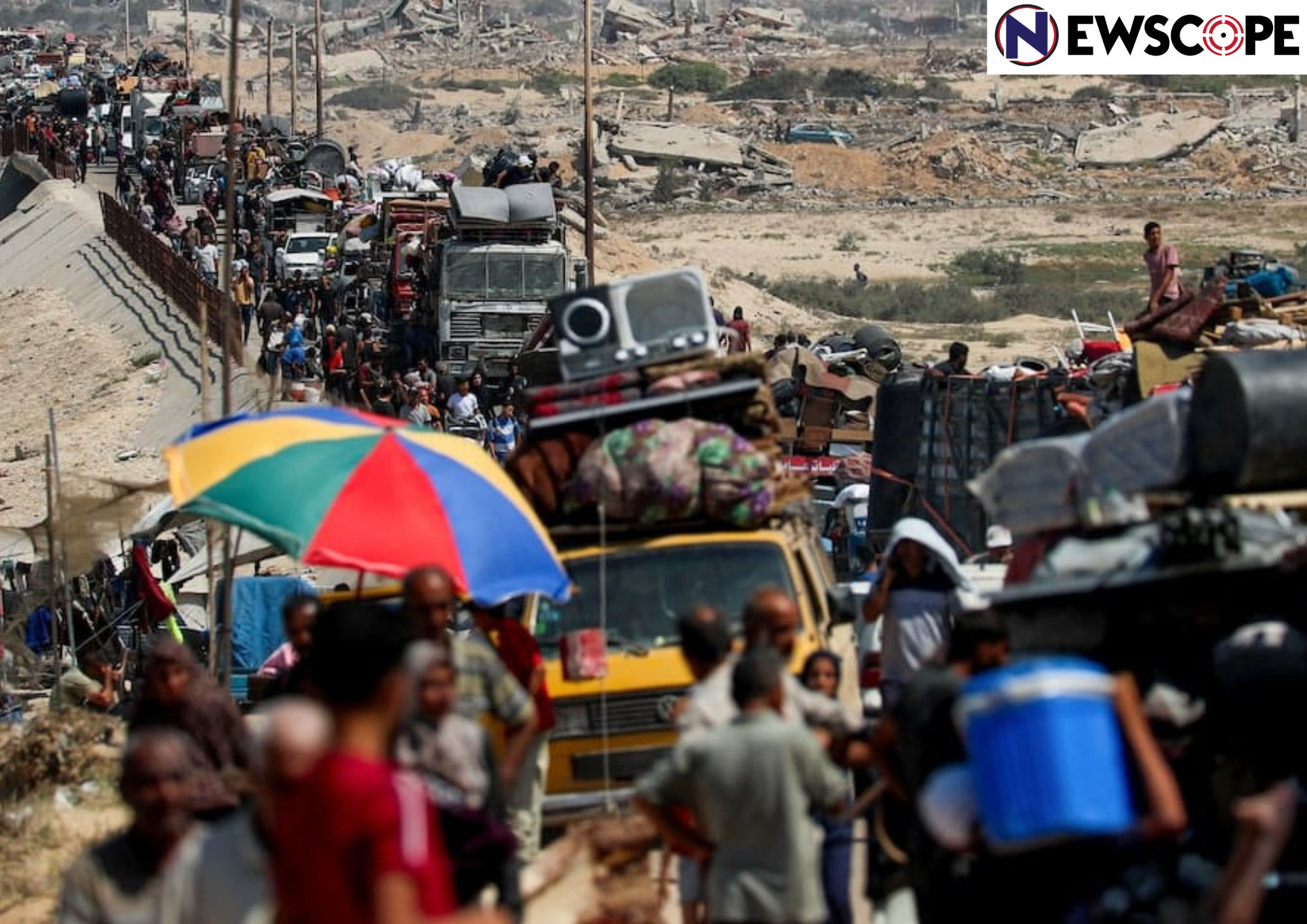
The grating of tank tracks on the pavements rings through Gaza City. Every strike brings dust and above all, a voice in the sky–leaflets drifting down–proclaims to civil people to run away. Israel has also opened a new evacuation route to Gaza City, a 48-hour movement of people to move south along Salahudin Road. For many, it is a lifeline. It is a sad decision between the unknown and the unbearable to other people.
The Israeli military claims that the corridor is to secure the civilians as the soldiers proceed against Hamas. The path they say presents them with secure transportation before the attack increases. But, even safe passage, in Gaza, has no guarantee. On the same day that the route was announced dozens of people were killed. Ambulances were not able to make their way up through rubble-filled roads, sirens intermingling with the roar of guns.
Fear is mixed with hesitation in the city. Families are seated in the homes in darkness, pondering over their choices. To the south, there is hunger, tent camping and vagancy. To remain is to be in danger of being bombed. Even in case we would like to get out of Gaza City, are we sure that we could come back? one man asked. There was a defiant and heart-breaking crack in his voice. “That’s why I prefer to die here.”
The figures tell a part of the story. Israel boasts of the fact that close to 400,000 have already evacuated Gaza City almost 40 percent of its population. The authorities in Gaza, however, believe that it has been nearer to 190,000 who have relocated but many of them are moving towards the west or even towards the center as opposed to the overcrowded southern regions. Behind every statistic is a trail of footsteps: there are women holding children, old men on sticks, boys dragging carts over which is what is left of their homes.
But the fugitives talk of the south as being a place that is already at breaking point. There is a lack of food, polluted water and unavailable medicines. The aid organizations caution that this exodus cannot be supported by southern Gaza. The United Nations explains the looming famine in the north that has been aggravated by the closing of important crossings by Israel. A UN official said that people are being crowded into areas that are not habitable.
The human cost is inexplicable in the streets of Gaza City. Parents attempt to calm down panicked children with blasts of fire illuminating the moonless sky. Italians eat bread in dark staircases. A woman throws a scarf over her baby to cover him against the dust, her eyes are fixed southwards and her feet are not moving. To abandon the city is to give up a generation-bearing city. Surviving would be to gamble with life.
To Israel, the exit strategy is the tactical one–a means of clearing the civilians so that the battle can be against the Hamas fighters. The authorities acknowledge the operation to seize the Gaza City might take months, maybe even longer. Tanks are already pushing further into the eastern neighborhoods and it is intended to push into the core of the city. But the drama of humanity passing on its streets cannot be gauged in military terms.
The new track can be open, yet in the case of thousands of people there is no real escape. There is to walk into uncertainty, to remain, to live under the shadow of death. Amid the deafing sound of tanks and silence of unanswered prayers the people of Gaza are caught in the dilemma no one can ever be caught in.

