


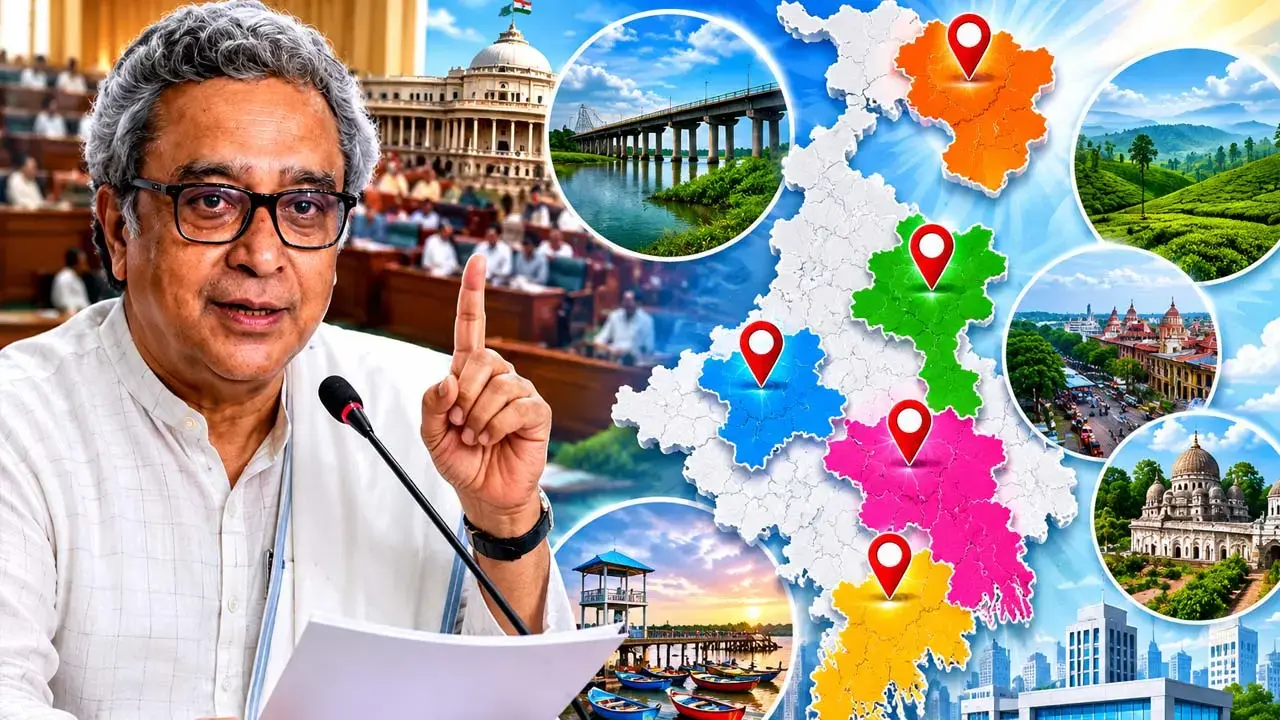
In a major move to decentralize authority and bring civic administration closer to the people, the West Bengal government has announced the creation of five new districts and several urban civic bodies. Tabling the state budget for the upcoming fiscal year in the Legislative Assembly, State Finance Minister Swapan Dasgupta unveiled this extensive restructuring plan designed to accelerate public service delivery and streamline internal security.
Once formally finalized, the state’s total district count will jump from 23 to 28. Under the new proposal, Kolkata will be established as a fully independent administrative district, doing away with long-standing jurisdictional overlaps with its neighboring urban fringes. The other four proposed districts—Basirhat, Sundarban, Jangipur, and Arambagh—will be strategically carved out of the heavily populated North 24 Parganas, South 24 Parganas, Murshidabad, and Hooghly districts, respectively.
Government officials noted that these regions have grown intensely dense, presenting specific governance and ecological challenges. For instance, the creation of the Sundarban district will optimize coastal management and environmental protection, while the carving out of Arambagh will ensure rapid, localized disaster response during seasonal monsoon flooding.
Simultaneously, the state budget has proposed a sweeping expansion of urban civic amenities. To cater to rapid urbanization and the growing public demand for localized infrastructure, the government plans to institute nine new municipalities. These will include key regional hubs such as Shiv Mandir in Darjeeling, Gazole and Chanchal in Malda, Belda in West Midnapore, and Kolaghat in East Midnapore. Additionally, the plan includes creating a new police district in Kanthi and an independent subdivision at Gopiballabpur to improve local safety coordination.
“The fundamental purpose behind these administrative reforms is decentralization,” the Finance Minister stated during his address. By making administrative boundaries smaller and establishing more localized municipal authorities, the state aims to ensure that healthcare, emergency services, and civic amenities remain directly accessible to every resident.