



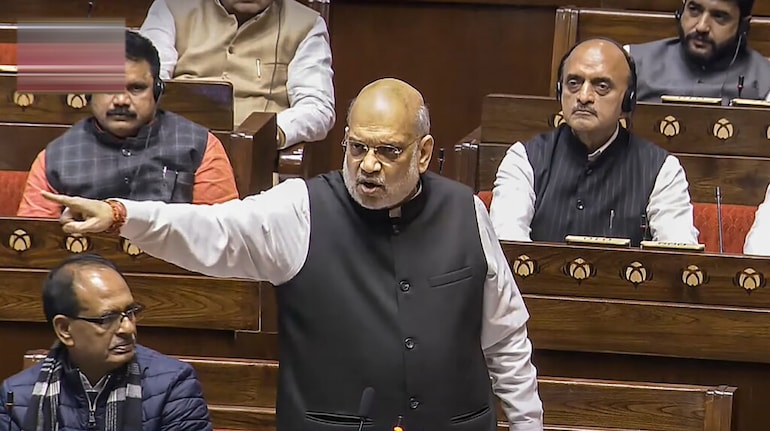
In a landmark session of the Lok Sabha on March 30, 2026, Union Home
Minister Amit Shah officially declared that Maoist extremism has been “eradicated” from the
country. The announcement comes exactly one day before the March 31 deadline set by the
government two years ago to dismantle the decade-long insurgency.
Addressing the House during a high-stakes debate titled “Efforts to free the country from leftwing extremism,” Shah stated that the once-feared “Red Corridor”—which previously spanned
12 states—has been dismantled. He credited the success to a “zero-tolerance” policy and the
bravery of the Central Armed Police Forces (CAPF), particularly the CoBRA and CRPF units.
Key Success Metrics Shared in Parliament:
- Neutralized Leadership: The Home Minister revealed that the CPI (Maoist)
Politburo and Central Committee, which had 21 members in early 2024, have been
completely neutralized through surrenders or targeted operations. - Casualty Reduction: Over the last decade, violence claimed approximately 20,000
lives. However, Shah noted that recent years saw a 70% drop in incidents, with the
Bastar region now transitioning toward development. - Operation Statistics: In the final push (2024–2026), 706 Maoists were killed and
over 4,800 surrendered.
The debate, however, saw sharp exchanges. Opposition leaders, including members of the
Congress and CPI(M), accused the government of “politicizing” national security. Critics argued
that while armed resistance has dwindled, the socio-economic “root causes”—such as tribal land
rights and Dalit discrimination—remain unaddressed.
“The ideology cannot be defeated by bullets alone,” remarked opposition MPs, urging the
government to ensure the rehabilitation of the 12 crore people previously living under Maoist
influence.
Despite the friction, the government maintained its stance: “Talks will only be held with those
who lay down arms; those who use bullets will be answered with bullets,” Shah concluded,
marking the end of an era for India’s internal security challenges