



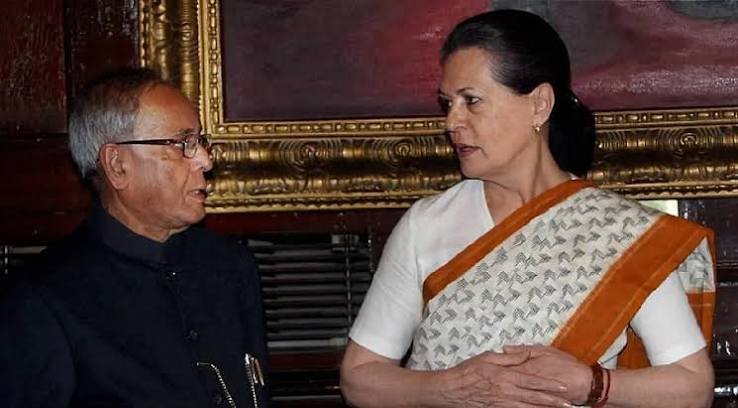
Congress leader Pranab Mukherjee hinted at his “long-held desire” to become prime minister during a 2010 conversation with then party chief Sonia Gandhi when he shocked her with the suggestion that perhaps “it was time for a change at the top”, according to her memoir.
In the candid “Belonging: A Journey of Love“, Gandhi rejects criticism that she was a “back seat driver” during the UPA years. At one point, she writes, she was clear that Manmohan Singh was the prime minister now and, while she could give him her opinion or suggestions as party president, or differ with him, it was her duty to defer to him.
“Further. I was determined not to be under any circumstance the cause of a misunderstanding that could give our opponents occasion to rejoice and weaken our government,” she says in the book that hit the stands on Tuesday.
The 526-page book begins with an inscription from the Rig Veda: “Move together, speak together, let your minds be in concord. United be your purpose, harmonious be your hearts, Collected be your thoughts, so that you dwell in togetherness, in wholeness.”
According to Gandhi, there was an “unspoken division of responsibility” between the prime minister and her, one that worked smoothly — “the government under Dr. Manmohan Singh, and the party under me”.
While pointing out the separation of powers between the party and government, Gandhi also narrates an anecdote of how Pranab Mukherjee once hinted at his desire to be PM.
“A core group met weekly with the prime minister to ensure coordination between the two. Its other members were Pranab Mukheriee, who had been a minister in Indira Gandhi’s cabinet in the 70s; the politically insightful Arjun Singh, a former chief minister of Madhya Pradesh; A K. Anthony, a former chief minister of Kerala: and Ahmed Patel.
“We also met regularly as members of the Strategy Group, set up to discuss issues to be taken up in Parliament. Sometimes Pranab ji, as I always called him, would stay back for a chat,” she says.
“He (Pranab) had developed serious differences with the Finance Minister P Chidambaram, and on one occasion, in 2010, I think after expressing his frustration, he shocked me with the suggestion that perhaps it was time for a change at the top, which I understood as a hint of his long-held desire to become prime minister,” Gandhi says,.
“I gently changed the subject, and though he may have been disappointed, he never made me feel he held it against me,” she adds.
Gandhi goes on to point out that the Congress did nominate Mukherjee in 2012 as the UPA candidate for president, the highest office in the republic, and he was elected.
“I often called on him, mostly just to converse with the erudite and knowledgeable politician that he always remained.”
On allegations that she was wielding the real power during the UPA years — Manmohan Singh was prime minister from 2004-2014 — Gandhi writes about the “rash of stories” that appeared in the media, some fed by people around the prime minister.
“A decade later, a book was published by one of his former aides, reaffirming the malicious and totally false allegations spread all along by my opponents: that I sent for files from the prime minister’s office (PMO), interfered with administrative matters, and made key appointments,” she says, rebutting the BJP’s oft-repeated charge.
“Though I had been the subject of worse accusations over the years, the fabrication that distressed me most was that I was looking into official files something improper for anyone outside the government. I had always been particular about adhering to rules, all the more so during this period,” she says.
The PMO issued a statement categorically denying that official files had ever been shown to me, she says.
“Dr. Manmohan Singh’s daughter Upinder Singh in an interview called the book ‘nothing but a stab in the back. . . a huge betrayal of trust’ and ‘a mischievous, unethical exercise’. She affirmed that her father’s relationship with me was one of ‘mutual trust and respect’. However, the opposition and the media looked for every opportunity to spin the narrative that I was the government’s ‘back-seat driver’,” Gandhi says.

