



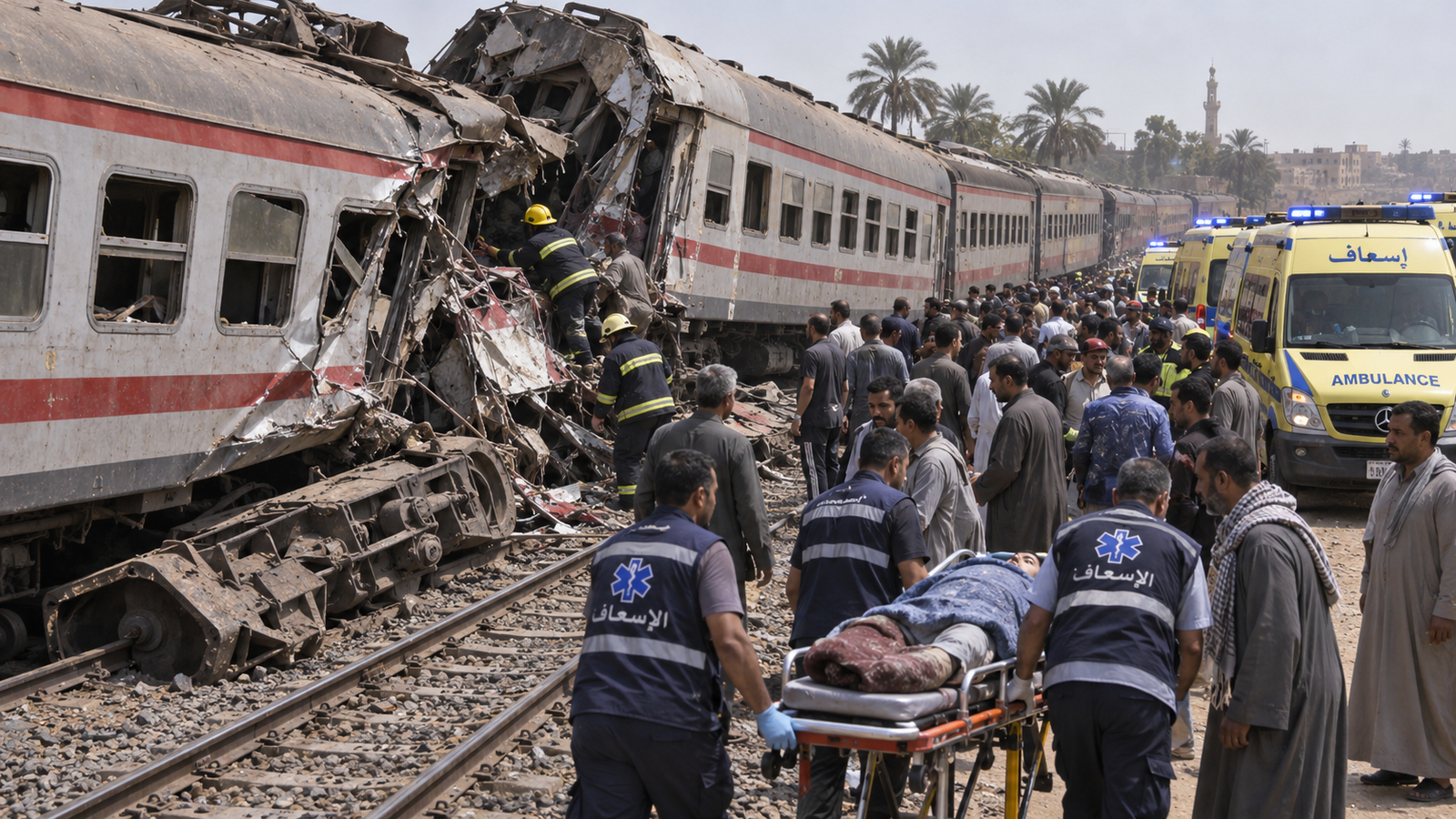
Cairo, November 8, 2026: At least seven people have been killed and more than 100 others injured after two passenger trains collided in Egypt’s Giza province on Sunday, triggering carriage derailments and a massive emergency response along the busy Cairo-Aswan rail corridor.
According to statements from Egypt’s Health Ministry and the Chief Prosecutor’s Office, the disaster occurred in the al-Ayyat district, roughly 52 kilometers south of Cairo. The collision took place when a passenger train traveling from Giza to the southwestern province of Fayoum rammed into the rear of a Cairo-to-Aswan train that had come to a halt on the tracks.
The violent impact derailed multiple carriages, flipping several onto their sides and trapping passengers inside the crushed metal. Officials confirmed that at least one train driver was among the fatalities, while the number of injured climbed past 112, with many transported to nearby regional hospitals.
Massive Emergency Operation at al-Ayyat
Authorities mobilized swiftly to the crash site as emergency sirens echoed across the rural district:
- Ambulance Fleet Deployed: The Health Ministry dispatched a fleet of 52 ambulances to the collision zone to stabilize victims and transfer those with severe trauma and fractures to nearby medical centers.
- Cranes and Heavy Equipment: The Egyptian Railway Authority rushed heavy rescue teams, cutting gear, and rail cranes to the scene to hoist overturned bogies off the tracks, search for survivors, and restore rail traffic along the vital southern corridor.
- Hospital Readiness: Health facilities across Giza and southern Cairo were placed on maximum alert, with surgical teams and blood banks mobilized to care for the influx of wounded passengers.
President Orders Thorough Probe; Vows Accountability
Following the disaster, Egyptian President Abdel-Fattah el-Sisi issued a statement expressing condolences to the victims’ families and ordering an immediate, high-level inquiry into the operational and technical failures that led to the crash.
President el-Sisi directed state investigative bodies to determine the exact sequence of events—including signaling protocols, emergency stop procedures, and track communication—and instructed authorities to “hold accountable anyone found to have been negligent.”
The Public Prosecution Office confirmed that a specialized team of investigators has inspected the crash site, seized the trains’ black box event recorders, and begun questioning railway dispatchers, signaling staff, and surviving crew members.
A Grim History on Egypt’s Southern Rails
The disaster in al-Ayyat has revived painful memories and renewed scrutiny over the safety record of Egypt’s railway network:
- Site of Deadliest Disaster: The al-Ayyat district was the scene of Egypt’s worst rail tragedy in February 2002, when an overcrowded passenger train caught fire, killing more than 370 people. The area also witnessed fatal collisions in 2009 that claimed dozens of lives.
- Aging Infrastructure vs. Modernization: While Egypt has invested billions of dollars in recent years to build modern express highways, regional monorails, and high-speed electric rail lines, the country’s legacy network continues to struggle with decades-old rolling stock, outdated signaling apparatus, and operational vulnerabilities.
Sunday’s collision underscores the ongoing urgency to overhaul track safety automation and train collision-avoidance systems across Egypt’s traditional rail lines to prevent recurring mass-casualty accidents.

