



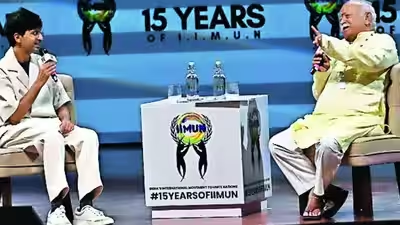
RSS chief Mohan Bhagwat has said that the concerns raised by Generation Z are genuine and should not be ignored. Speaking at a public event, he stressed that young people protesting for their rights should not be labelled as “anti-national.” Instead, he said their voices deserve to be heard in a democracy.
Bhagwat described protest as a legitimate democratic tool that helps citizens communicate with those in power. According to him, disagreements are natural in a democracy and should lead to dialogue rather than conflict. He urged governments and institutions to engage with young people through discussion and understanding.
His remarks come at a time when students and young citizens across the country have been protesting over issues such as examination irregularities, education, unemployment and governance. Bhagwat acknowledged that these concerns are real and reflect the aspirations of a generation seeking fairness and accountability.
He also noted that today’s youth think differently from previous generations. Gen Z, he said, prefers asking questions and understanding the reasons behind decisions instead of accepting everything without discussion. He encouraged elders to guide young people with patience rather than dismissing their opinions.
Bhagwat’s statement has drawn attention because it highlights the importance of youth participation in democracy. Many see his remarks as a reminder that peaceful protests are a constitutional right and an essential part of a healthy democratic system. Others believe that the focus should now shift from recognising these concerns to addressing them through concrete action.
His comments have sparked conversations across political and social circles. Supporters have welcomed his call for dialogue, while critics say the real challenge lies in ensuring that institutions respond to the demands of young people.
As India’s youth continue to play a larger role in shaping public opinion, Bhagwat’s message underlines the need for open communication between citizens and those in authority. Listening to young voices, he suggested, is not a sign of weakness but a step towards a stronger and more inclusive democracy.

