



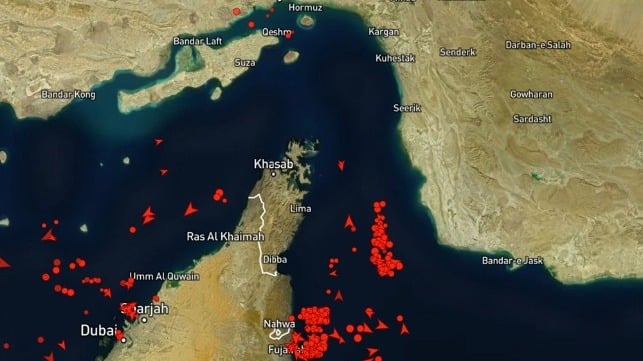
For years, experts have warned that the Strait of Hormuz could become the flashpoint that shakes global oil markets. This week, that fear suddenly feels real. After joint US and Israeli strikes on Iran on February 28 reportedly killed Supreme Leader Ali Khamenei, tensions escalated sharply. Iran’s Islamic Revolutionary Guard Corps issued a warning that vessels should not attempt to pass through the Strait of Hormuz. By March 1, shipping traffic had almost collapsed. Only three tankers reportedly crossed the strait that day, an extraordinary fall from the usual daily movement. More than 700 vessels are now waiting, many of them idling in Gulf waters.
An IRGC commander went as far as declaring the strait “closed,” threatening to set any passing vessel “ablaze.” Whether that warning translates into sustained military enforcement remains to be seen. But the immediate effect is visible: crude and LNG carriers have dropped anchor near the UAE, Saudi Arabia and Qatar, waiting for clarity.
For India, this is not an abstract geopolitical standoff. About half of India’s crude oil and nearly 60 percent of its LNG imports pass through Hormuz, much of it sourced from Iraq, Saudi Arabia, the UAE and Kuwait. Any prolonged disruption could push prices up quickly. There is already unease on the ground. Transport operators worry about diesel costs. Households are anxious about LPG prices. Even the possibility of rationing is being discussed in some quarters, though officials insist there is no immediate cause for panic.
Oil Minister Hardeep Singh Puri has said India’s reserves can cover roughly 74 days of demand, factoring in strategic storage and supplies held by refineries. That cushion provides breathing space, but it is not indefinite. Economist Kirit Parekh has cautioned that every one dollar increase in crude prices adds roughly 1.4 billion dollars to India’s import bill, putting pressure on inflation and public finances.New Delhi is also exploring alternatives. Russian cargoes already near Indian waters could offer short term relief if supply through Hormuz remains blocked.
Globally, analysts warn that a full closure of the strait would disrupt nearly a fifth of the world’s traded oil. Prices could surge sharply on fear alone, tightening financial conditions and straining fragile economies.India is not facing fuel queues yet. But if the standoff continues, the ripple effects will not take long to reach ordinary consumers.

