



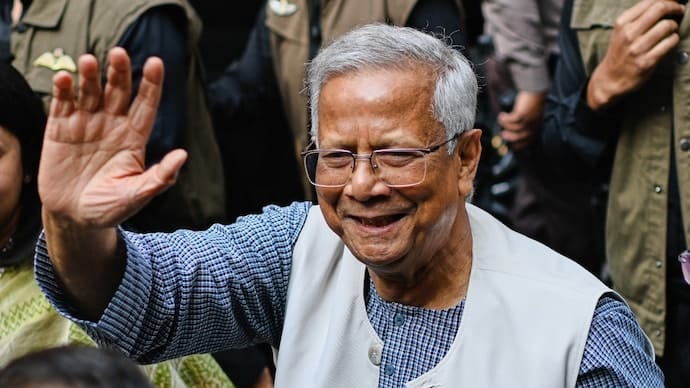
In his farewell address, he also stressed Bangladesh’s strong connections to India’s ‘Seven Sisters’, the Northeastern states, but skipped any direct mention of India itself.
In his speech, he also emphasised protecting women’s rights, curbing violence and trafficking, and tackling child marriages.
Mentioning the Interim government, he said, it championed human rights, youth-led reforms for fair elections, economic recovery through global trade ties like the EU and China, IMF aid, and justice via tribunals. The focus was on building a democratic future with Bangladesh thriving in the global tech and digital economy.
Hostile India stance
In his farewell address, Yunus leaned heavily on nationalist rhetoric, stressing repeatedly that Bangladesh has reclaimed its ‘sovereignty, dignity, and independence’ in foreign policy and is ‘no longer guided by others’ directives.
What seemed like a generic statement and directed towards New Delhi, Dhaka is one of the closest and most influential neighbours. Yunus envisioned future economic ties with Nepal, Bhutan, and the “Seven Sisters”, India’s northeastern states.
“Our open seas aren’t mere borders; they’re gateways to the global economy. Teaming with Nepal, Bhutan, and the Seven Sisters unlocks vast potential through economic zones, trade pacts, and duty-free access to make us a global manufacturing powerhouse,” he stated.
Combining India’s northeastern states, which are fully integral to India, with sovereign neighbour’s like Nepal and Bhutan in one economic vision, Yunus seemed to blur clear political lines, potentially provoking New Delhi and complicating the India-Bangladesh reset under the new government.
China Tie-up
Bangladesh’s outgoing leader sharpened Yunus’s tone, stressing “strategic balance” while spotlighting deepening ties with China, Japan, the US, and Europe.
He highlighted progress on Chinese-backed projects like the Teesta River initiative, near India’s sensitive Siliguri Corridor, which New Delhi has long eyed warily.
“We’ve deepened ties with China, making strong progress on the Teesta River project and a 1,000-bed hospital in Nilphamari,” added Yunus.
Rather than calming regional partners, his words seemed designed to signal Bangladesh would no longer prioritize India’s security sensitivities.
Ignoring the Minority persecution
Throughout his address, Yunus framed his 18-month tenure as a tale of reform and recovery, but strikingly skipped any reflection on the interim government’s mishandling of communal violence or failures to protect minorities like Hindus amid post-uprising attacks on temples and citizens.

