


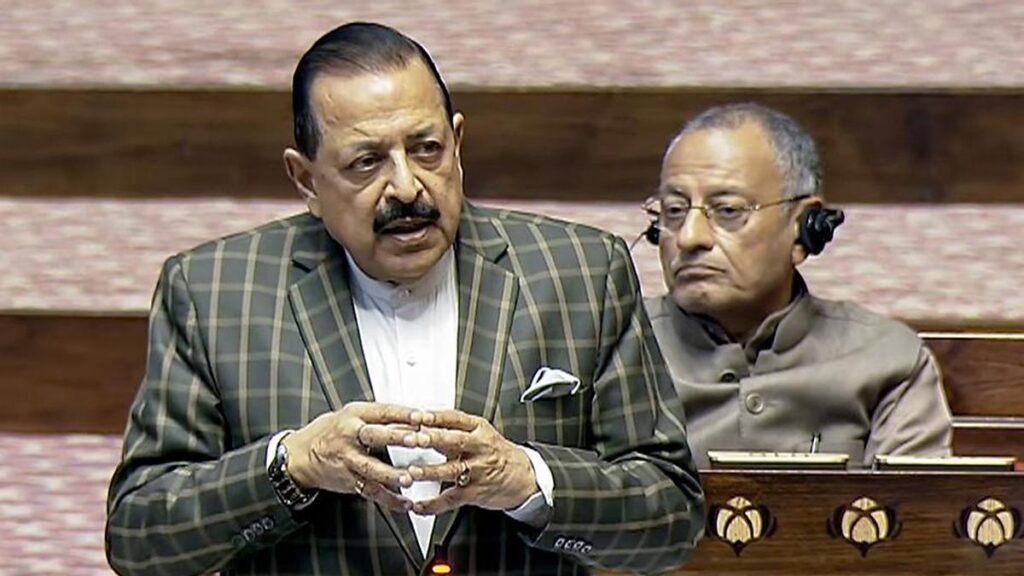
With the Rajya Sabha also clearing the Sustainable Harnessing and Advancement of Nuclear Energy for Transforming India (SHANTI) Bill on Thursday (December 18, 2025), the Union Government said the Bill seeks to reduce the dependency on fossil fuels and increase the capacity of India’s atomic energy sector.
Senior Congress MP Jairam Ramesh, who initiated the debate, claimed that the Bill was brought with the intention of increasing the contribution of private companies in the nuclear sector. Mr. Ramesh warned the Centre against any relaxation in liability norms and cited the example of France, where all nuclear reactors are under the Government control.
The amendments to the Bill and the proposal to send the Bill to a Select Committee, moved by Opposition members, too, were defeated in a voice vote.
Countering the Opposition charges, Minister of State for Department of Atomic Energy Jitendra Singh said that nuclear power is a reliable source of energy, unlike other renewable energy options. He said there will be no compromise with safety, and as the Atomic Energy Act prescribes, safety will be ensured first before starting power generation. Mr. Singh said there has been no report of any radiation-related hazards to the public from any Indian reactors.
“Vendor-driven Bill”
Mr. Ramesh said, “The Narendra Modi government has the habit of ignoring the milestones achieved by past Governments. The first Atomic Energy Bill of independent India was passed on April 6, 1948,” adding that on 18 August 1950, the Government of India established Indian Rare Earths Limited, whose name is discussed a lot at present.
“The country’s first reactor was commissioned in Tarapur on October 28, 1969. Then, reactors were installed at many places, including Rawatbhata, Kalpakkam, Narora, Tarapur, Kakrapar, and Kudankulam. It takes eight years to commission one reactor in the country. Before 2014, steps related to nuclear energy were taken at various places in the country,” he said, adding that even former Prime Minister Atal Bihari Vajpayee had acknowledged what the country achieved in the past 50 years before the second nuclear experiment in Pokhran in 1998.
He said the BJP opposed the nuclear deal between India and America in 2008. “The BJP had then said that there is not much future in nuclear energy. It is because of the nuclear deal that happened in 2008 that now the BJP can think of such a Bill,” he said. And added that the Nuclear Safety Regulatory Authority Bill of 2011 was drafted with the help of then Opposition leader in Rajya Sabha Arun Jaitley, and its main points have been included in the new SHANTI Bill.
“Our country has the capacity—we have installed plants of 220 megawatts and 540 megawatts. Utilise that capacity. Similarly, the government had brought farm laws to benefit the private sector, which had to be withdrawn. This Bill should not be vendor-driven. We are self-reliant in the matter of nuclear power. So, promote indigenous technology,” Mr. Ramesh said. The former Minister said the private sector will bring capital, not technology. “Therefore, tell private sector companies to install India’s technology. Tell the companies to take 700 megawatt technology from Nuclear Power Corporation of India Ltd. and install the plant,” he said.
Nominated MP Harsh Vardhan Shringla said the country stands at a decisive juncture in its energy journey and the SHANTI Bill will shape the civil nuclear sector for generations, ending fragmented governance and creating an investment-ready framework. “The vision of PM Modi is to take the nuclear power sector to 100 GW by 2047. Today, we are close to 9 GW. The increase will make India a leading global player in the segment, and for that, we need an investment of over ₹19 lakh crore, and that is not clearly possible in the realm of the public sector. We must open up to the private sector,” Mr. Shringla said. “This is not privatisation; this is partnership with accountability,” he added.
Trinamool Congress MP Sagarika Ghose said the Bill is fundamentally dangerous. “This Bill brings neither Shanti nor security… we are not debating whether India should pursue nuclear energy, India has always pursued nuclear energy responsibly for decades…” she said. “But as a country, are we now prepared to abdicate our sovereign responsibility, gamble with public safety and place one of the most sensitive sectors of the nation at the mercy of crony capitalism and government-friendly oligarchs as well as foreign pressure? This Bill is not reform, it is recklessness. This Bill is not for the public; it’s for profit,” she added.
DMK MP P. Wilson termed the Bill as a “nuclear bomb which threatens the country’s peace and security”.
“The Bill seeks to remove the nuclear supply chain from sovereign functions and the Union Government’s active oversight. There is nothing peaceful, nothing sustainable, nothing transformative about this legislation. On the contrary, it is a reckless, dangerous and deeply flawed attempt to privatise one of the most sensitive and high-risk sectors of a nation—the nuclear energy sector,” he said.

