



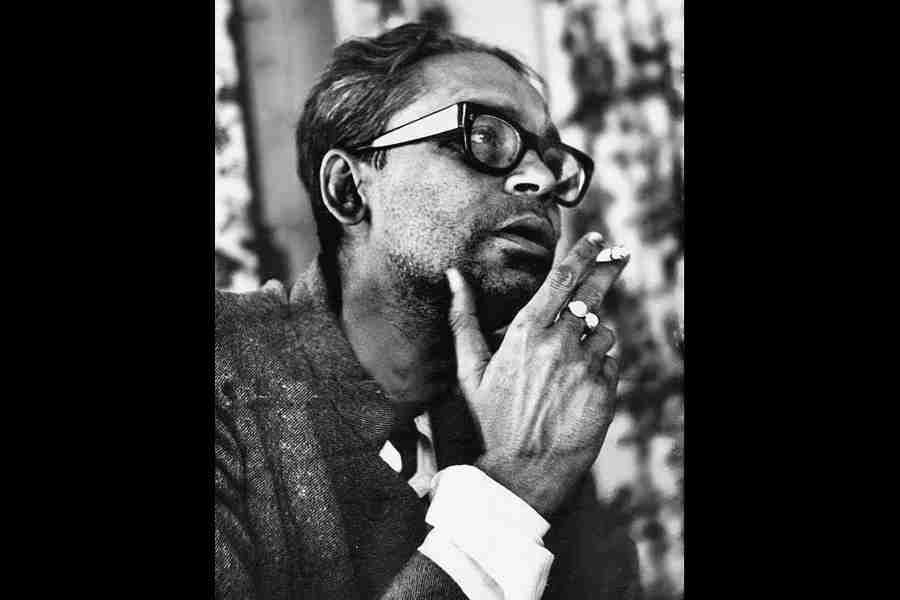
Neglected and misunderstood during his lifetime, feted and acclaimed thereafter, a strange irony imbued the life and works of Ritwik Kumar Ghatak. Even as his memory and works are being drowned in accolades after he turned 100 this year, it is time to focus on the themes and questions which Ghatak’s films raised.
Immigrant and fleeing populations the world over mirror the concerns and highlight the questions which Ghatak’s films raised over and over again. There remains no clear answer when asked where is home and how it is established that one specific place is home.
An undercurrent of a fear of losing home run through many of Ghatak’s films. Refugeed from erstwhile East Bengal, he knew what he was portraying on celluloid.
The characters which we come across in Ritwik’s films are often uprooted from their homes. And they are on the lookout for new ones as in Nagarik and Bari Theke Paliye.
It is a great pity that Nagarik which happens to be Ghatak ‘s maiden venture made way back in 1952 was released in 1977, a year after his death. It would have heralded s new kind of cinema in the country if it was released on its own time.
Ghatak made eight feature films and 10 documentaries though his fame rests on his partition trilogy. Meghe Dhaka Tara, Komol Gandhar and Subarnarekha reflecting the anger and agony of partition which was embeded with Ghatak ‘s mindset.
Partition was an issue settled by politicians and not the people. Ghatak gave voice to poodtoo trauma of the masses in his films.
His films on partition cemented the acting capability of Supriya Choudhuri and Madhabi Mukherjee,
Though Madhabi more than proved her mettle in several films of Satyajit Ray, .Meghe Dhaka Tara and Komal Gandhar remain Choudhuri’s twin finest performance in her long acting career where her acting parameter were rated between good and indifferent but hardly great.
Great filmmaker that he was, partition’s physical and material aspects was never the principal focus of his films. The audience did not leave the theatre happy after seeing Ghatak’s films.
A sense of loss, radical uncertainty, uprooting, homelessness weighed them down as they trudged back home. Small wonder, Ghatak emerged to be a director on whom the film producers would not put a tidy sum on.
Discipline was never Ghatak’s strongpoint. Shooting his films in
a topsy turvy fashion which was worsened by alcholism, financial trouble and professional disappointnent dogged him throughout his life
Art and life coexisted closely in his films. But complexity of design did not ensure a packed house.
Yet there was an unprecedented outpouring of grief all over what was then known as Calcutta on February 7, 1976 after the news of his passing spread like a wildfire. If fans hitherto unknown and scattered flocked to his funeral procession, the scene was ironical.
.
It was in sharp contrast to the neglect and indifference the great director endured during his lifetime. Yet Ghatak would have ignored the adulation just as he was impervious to brickbats.
Ghatak was an odd man out in every walk of his life. He refused to be complian.
His films were misunderstood. His politics was unfashionable having been expelled by Communist Party in 1958.
Yet he continued to produce films which inspired a generation of directors like Mani Kaul, Safdar Hashmi and Adoor Gopalkrishnan. He had taught them when he was the director of Pune Film Institute and in a way became a directors’ director.
Ghatak’s directorial style was marked by melodrama as a stylistic tool and social commentary. “His style and approach are different from mine. Therefore unique” none other than Satyajit Ray said.
The. belated tribute to Ghatak is an acknowledgement of his belief that filmmaking was an art firm. It was a means to end the suffering of the people.
He was a man who refused to bow down to mainstream. An odd ball who felt Bengal has no division rubbed friends and critics the wrong way.
Unlike many of his contempraries, Ritwik Ghatak did not want to please his audience. His films were his endeavour to express his anger at the sorrows and sufferings of his people; let this be his epitaph on his birth centenary.

