



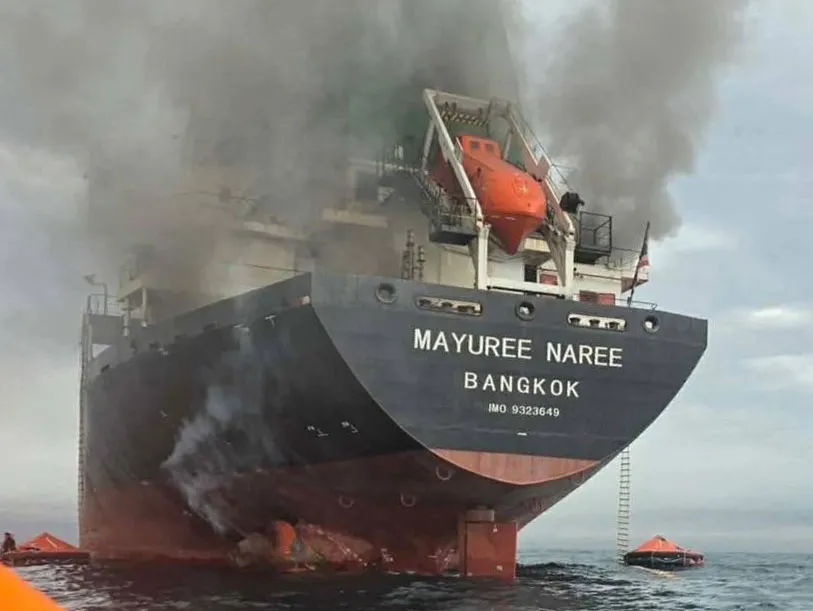
A Thai flagged cargo ship bound for India caught fire today after what authorities say was an armed attack near the Strait of Hormuz, one of the world’s most sensitive shipping routes. The vessel, the Mayuree Naree, had left a port in the United Arab Emirates earlier in the day and was heading toward Kandla on India’s western coast. On board were 23 crew members when the ship was struck shortly after entering waters of Oman.
According to naval officials, the attack took place at around 11:10 local time. Two impacts hit the vessel above the waterline, triggering explosions near the stern and close to the engine room. Images later released by the Royal Thai Navy showed thick smoke rising from the rear of the ship. The stern appeared charred, and the superstructure was partially blackened by the fire. Maritime safety authorities said the explosion occurred in the same section where three crew members had been working at the time.
Rescue teams moved in quickly. Within hours, Omani naval boats had pulled 20 sailors from the damaged vessel and taken them to shore.Three crew members, however, are still missing.
Officials in Thailand said investigators are still trying to determine exactly what weapon was used and how the attack unfolded. “The specific details and cause of the incident are under investigation,” the navy said in a brief statement.
Later in the day, Iran’s Revolutionary Guards claimed responsibility for firing on the vessel, according to the semiofficial Tasnim News Agency. The attack unfolded during an already tense period in the Gulf. Shipping traffic through the Strait of Hormuz has slowed dramatically since airstrikes by the United States and Israel on Iranian targets late last month.
Maritime security experts warn the situation could worsen. One senior official monitoring the region said attacks like this show that commercial shipping remains vulnerable.
Families of seafarers voiced concern on social media, while traders in India worried about delays and higher freight costs. The Strait of Hormuz carries roughly a fifth of the world’s oil and gas. When trouble erupts there, the impact rarely stays confined to the region.

