



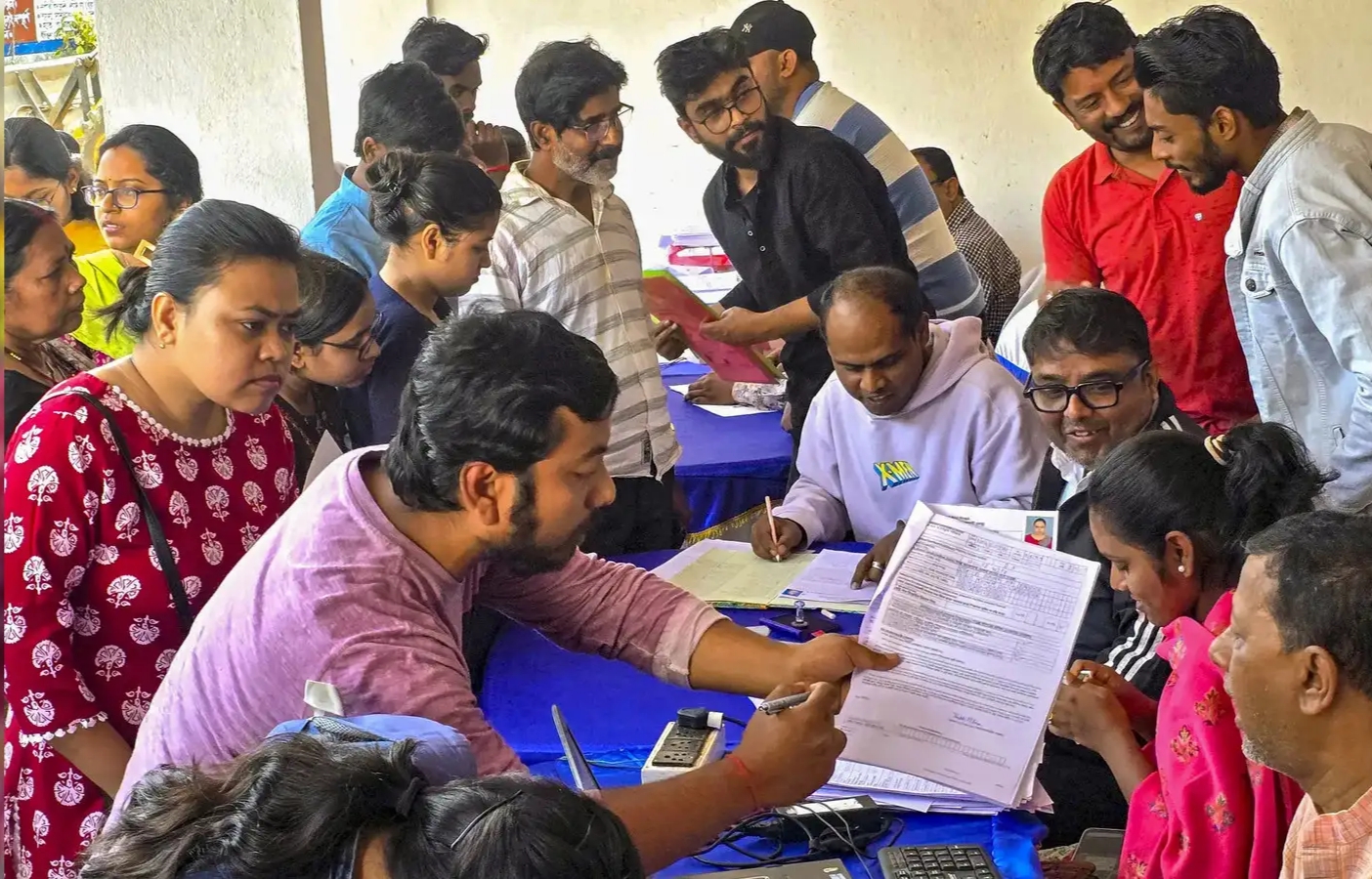
West Bengal is seeing something unusual at its Duare Sarkar camps. Young people are showing up in massive numbers, not for awareness, nor out of curiosity, but, to register for the Banglar Yuva Sathi scheme, and the turnout is telling a story the government may not want to hear.
The scheme promises a monthly allowance of ₹1,500 to educated but unemployed youth. On paper, it looks like a compassionate safety netin reality, it is a band-aid on a wound that goes much deeper. Since the registration camps opened on February 15, officials have been stunned by the scale of the response. “The response is overwhelming,” noted State Industries Minister Shashi Panja while supervising a camp in North Kolkata. “By the time I reached the site, people had started queuing as early as 8:30 AM.” The Duare Sarkar camps, originally designed to bring services to the people’s doorsteps, have become mirrors. Every long queue of young faces reflects a labor market that has failed them. These are not children, these are graduates, school-passouts, and postgraduate scholars who should be contributing to the economy. Subir Mitra, a 28-year-old commerce graduate standing in one such line, puts the reality bluntly, “It won’t solve everything, but at least I won’t have to depend on my parents for every small expense while I keep preparing for competitive exams.”
There is a political angle too, that cannot be ignored. Critics argue that launching a direct benefit transfer for youth just as an election cycle approaches is no coincidence. While the opposition calls it “vote buying” and supporters call it “welfare,” the youth in those queues aren’t debating politics. They are looking for a lifeline. A 24-year-old, Debayan Sarkar said while clutching his folder of certificates, “People can call this politics or welfare. For us, it simply means a little support until work finally comes.”
It’s a fact that Bengal’s industrial investment has lagged behind states like Gujarat, Tamil Nadu, and Telangana for years. Skilled youth migrate in waves to Chennai, Bengaluru, or Delhi. Those who stay behind find a landscape where a “stipend” is the only growth industry. Not everyone in line is a believer, though. Sabyasachi Dey, a B.Ed graduate, said he registered reluctantly, “What can ₹1,500 do today? We want jobs, not token support. But when opportunities are scarce, you take whatever help you can get.”
The massive turnout at Yuva Sathi camps, with over 15 lakh applications in the first few days, should be read as a distress signal. It shows a hunger, not just for a stipend, but for opportunity, for dignity, and for a future that the state has not yet managed to build for its young people.

