



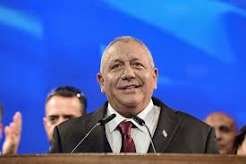
Jerusalem, November 8, 2026: In a major political blow to veteran Prime Minister Benjamin Netanyahu, Israeli President Isaac Herzog on Saturday officially tasked opposition leader and former military chief Gadi Eisenkot with forming the country’s next government. The decision grants Netanyahu’s fiercest challenger the first mandate to assemble a governing coalition following the inconclusive October 27 general election, which left the 120-seat Knesset fractured without a clear parliamentary majority.
Eisenkot, who heads the centrist Yashar party, secured formal endorsements from faction representatives accounting for 67 lawmakers during mandatory consultations at the President’s Residence. In contrast, Netanyahu—whose right-wing Likud party emerged as the single largest faction with 27 seats—garnered recommendations from parties representing only 46 lawmakers.
While Netanyahu’s traditional nationalist and religious bloc controls 53 seats compared to 48 held by Eisenkot’s core opposition bloc, Eisenkot’s ability to pull broader recommendations across the aisle persuaded President Herzog to grant him the initial 28-day window to negotiate a working majority.
Netanyahu’s Unity Plea Rebuffed: ‘A Government of Salvation and Change’
President Herzog’s announcement arrived shortly after Netanyahu released a televised address calling for a broad “national unity government” comprising Zionist political factions. Framing his appeal around national security and the regional confrontation with Tehran, Netanyahu argued that an emergency coalition was vital to “permanently remove the nuclear threat from Iran, preserve Israel as a Jewish state, and bring unity among us”.
At the same time, the caretaker prime minister mounted a sharp offensive against his rivals, cautioning against “hastily swearing in a government with terrorist supporters”—an explicit attack on the Arab-led parties whose votes could prove decisive in unseating him.
The opposition swiftly dismissed Netanyahu’s overtures as a survival tactic. Rejecting any pact with Likud under Netanyahu’s leadership, Democratic Party chairman Yair Golan declared on social media platform X:
“Netanyahu’s government must be replaced, and a government of salvation and change must be formed to safeguard Israel’s democracy, security, and future. We are committed to making every effort to make this happen.”
The Coalition Math: The Narrow and Complex Paths Before Eisenkot
Despite winning the first mandate from the presidency, the road to reaching the mandatory 61-seat Knesset threshold remains fraught with formidable ideological obstacles for the former Israel Defense Forces (IDF) Chief of Staff:
- The Arab Faction Equation: One potential route is establishing a minority administration relying on external parliamentary backing from the two Arab-led parties, Ra’am and the Joint List, which together command 19 seats. While both factions have expressed openness to supporting an alternative government to end Netanyahu’s tenure, several right-of-center parties within Eisenkot’s potential alliance have repeatedly ruled out relying on Arab parties for governance.
- The Ultra-Orthodox Conundrum: Another alternative entails courting the ultra-Orthodox (Haredi) factions, which control 13 seats. However, this route would require high-wire compromises on the contentious issue of mandatory military conscription exemptions for Yeshiva seminary students—a status quo Eisenkot and his key secular partners have publicly pledged to overhaul.
- Grand Coalition with Likud: A formal unity pact between Yashar and Likud remains mathematically possible, but would demand deep ideological compromises, notably surrounding judicial reforms and Netanyahu’s ongoing leadership.
A 28-Day Clock: Looming Deadlock or Historic Realignment
Under Israeli basic law, Eisenkot has 28 days to conclude negotiations and present a viable government to the Knesset, with the possibility of a two-week extension if substantial progress is demonstrated.
Should Eisenkot fail to stitch together a majority, President Herzog could transfer the mandate to Netanyahu. If both leaders fall short of 61 seats, Israel could be forced into yet another round of snap elections, prolonging the political deadlock that has gripped the country amid intense geopolitical turbulence across the Middle East.

