



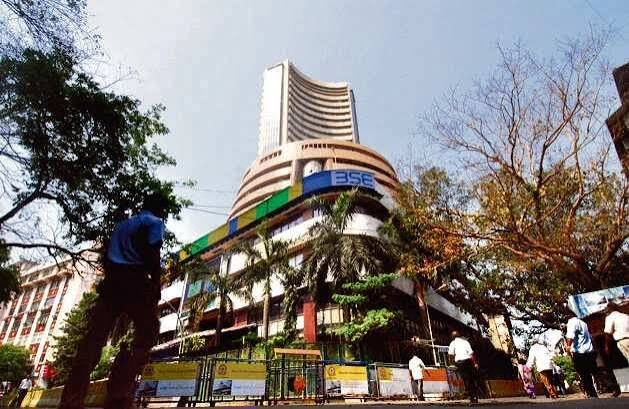
Tuesday delivered a decisive day of redemption for Dalal Street as benchmark indices shook off early morning jitters, mounting an aggressive second-half rally to close at the day’s highs. The sharp turnaround effectively wiped out Monday’s losses in a single session, driven by blowout quarterly numbers from HCL Technologies, a strengthening rupee, and cooling sovereign bond yields.
The 30-share BSE Sensex settled at 73,033.78, up 1,109.10 points or 1.54% at 3:32 PM IST. After opening virtually flat at 71,951.73 (just 27 points above Monday’s close) and dipping to an early low of 71,703.56 amid profit booking, the index staged a relentless climb past noon to finish near its intraday peak of 73,045.67.
The NSE Nifty 50 surged 358.60 points or 1.60% to settle at 22,721.95. Opening at 22,364.15 against the previous close of 22,363.35, the index touched a morning low of 22,288.45 before climbing steadily through the afternoon, breaking out near its session high of 22,721.95.
The intraday charts illustrated a textbook institutional accumulation pattern: a range-bound morning followed by an unbroken vertical expansion after 12:00 PM. The market capitalization of BSE-listed firms expanded by more than ₹4 lakh crore, while the India VIX cooled 8% to settle around 14.20, retracing Monday’s spike.
HCLTech Q2 Spark Triggers Sector-Wide 5% IT Rally
The Information Technology pack spearheaded the day’s turnaround, with the Nifty IT index surging nearly 5% to lead all sectoral gauges, followed by Nifty Realty (up over 2%).
Noida-based HCLTech served as the primary catalyst following its stellar Q2 FY27 earnings beat released on Monday post-market. Shares of HCLTech leaped between 6% and 7.47% to close at ₹1,314.40 after touching an intraday high of ₹1,316.40.
HCLTech Q2 FY27 Highlights:
- Bottom-Line Growth: Consolidated net profit rose 21.2% YoY and 11.0% QoQ to ₹5,132 crore (beating the consensus poll of ₹4,861 crore).
- Top-Line Performance: Consolidated revenue grew 11.5% YoY and 3.01% QoQ to ₹35,620 crore (vs. estimates of ₹35,597 crore), translating to USD revenue of $3.7 billion (up 2.2% YoY and 2.6% YoY in constant currency).
- Operating Margins: EBIT expanded 10.9% QoQ to ₹6,465 crore, with EBIT margins expanding by 131 basis points QoQ to 18.2%—a 20-quarter high.
- Deal Momentum & Bookings: Total new contract bookings climbed 27% YoY to $3.3 billion, taking H1 bookings to record highs.
- AI Trajectory: Advanced AI revenues reached $219 million in Q2 (up 28.4% QoQ and 78% YoY), scaling to an annualized run rate of $876 million (complementing TCS’s previously reported $3.1 billion annualized AI base).
- Strategic Partnerships: The company announced a Global Premier Partnership with Anthropic to develop enterprise agentic AI architectures powered by Claude.
- Guidance Upgrade & Payout: Management narrowed its FY27 constant-currency revenue growth band upward to 2.5%–4.0% (from 1.0%–4.0%), projecting Services growth at 3%–4% with EBIT margins at 17.5%–18.5%. The board declared an interim dividend of ₹12 per share (record date October 16, payment October 26).
The blowout performance generated positive rub-off across large-cap tech, with TCS, Infosys, Tech Mahindra, Coforge, and Persistent Systems climbing 2% to 4%. Outside tech, Tata Elxsi gained 3% ahead of earnings, Prestige Estates rallied after reporting a 20% YoY jump in Q2 sales bookings to ₹7,225 crore, and festive commerce prints showed Meesho logging a 75% YoY surge in Day 1 orders.
Domestic Ballast: Rupee Strengthening, Tax Review Hints, and Yield Softening
Three key domestic macro levers provided structural support to Tuesday’s rally:
- Rupee Climbs to 95.28 on RBI Dollar Window: The Indian rupee strengthened by 0.5% to close at 95.28 against the US dollar, extending Monday’s 1% gain from Friday’s record low of 96.73. The recovery was driven by the Reserve Bank of India’s operationalization of a specialized off-market dollar liquidity window starting October 12 for state-run refiners (IOC, BPCL, HPCL), successfully isolating high-volume commercial oil import demand from the spot foreign exchange market.
- Finance Ministry’s Tax Review Remarks: Sentiment was buoyed by comments from Union Finance Minister Nirmala Sitharaman indicating that the government is evaluating industry representations regarding Long-Term Capital Gains (LTCG) tax rates and the Securities Transaction Tax (STT) to preserve market depth and international competitiveness.
- Yield Curve Retracement: Benchmark 10-year Indian government bond yields eased from Monday’s three-year peak, while the US 10-year Treasury yield held near 5.23% (cooling from last week’s 24-year high of 5.33%). The moderation in domestic yields triggered sharp short-covering across rate-sensitive sectors, including Realty, Financial Services, Consumer Durables, and Cement, though Pharma and Healthcare remained relatively muted.
While foreign institutional investors (FIIs) remained net sellers on Friday (offloading ₹3,568 crore), sustained counter-buying by domestic institutional investors (DIIs), who absorbed ₹4,743 crore, continued to provide a sturdy floor.
Crude Volatility: Russian Diesel Waivers Contend with Red Sea Risk Premia
International energy benchmarks remained volatile but eased from Monday’s highs, granting temporary breathing room to importing economies:
- Price Movements: Brent crude futures hovered at $105.90 per barrel (easing 0.6% to 1.0% intraday from Monday’s close of $106.65), while US WTI slipped 1.0% to $92.80–$93.00. Crude remains up over 70% year-to-date amid ongoing Middle East hostilities.
- Supply Offsets: US President Donald Trump stated that Russia would immediately dispatch 300,000 metric tons of diesel, scaling to 500,000 tons in November and 1 million tons thereafter, backed by a targeted US Treasury sanctions waiver on Russian diesel through April 2027. Trump also claimed an understanding with Moscow and Kyiv to halt reciprocal strikes on energy infrastructure, though Ukrainian President Volodymyr Zelenskyy noted he learned of the proposal via social media and reiterated continued defensive operations, with Moscow issuing no formal confirmation.
- Geopolitical Chokepoints: Upward pressure persisted following a Houthi missile and drone strike on Riyadh International Airport over the weekend that caused 14 to 16 fatalities (including a US national) and hundreds of injuries, leaving the airport at a standstill and prompting Washington to weigh joint retaliatory strikes with Riyadh. In the maritime corridor, the UKMTO logged a drone strike near Oman’s Sohar anchorage alongside another damaged tanker in the Strait of Hormuz, where freight and insurance surcharges now constitute roughly one-third of the delivered commodity value. Goldman Sachs updated its scenario projections, modeling oil at $80 should Gulf shipping stabilize, versus $120 if transit disruptions persist.
Global Divergence: Dalal Street Defies Pan-Asian Tech Selloff
Indian equities sharply decoupled from broader Asian peers on Tuesday:
- Asian Bourses Slide: The MSCI Asia Pacific ex-Japan index declined 2%, dragged by a 6% plunge in South Korea’s Kospi and a 2.6% slide in Japan’s Nikkei 225 following a public holiday. Regional selling tracked overnight weakness on Wall Street, where the Nasdaq fell 0.5% amid escalating US-China semiconductor export restrictions and elevated technology valuations.
- Analytical Take: “Markets are rediscovering that geopolitics matters most when it feeds directly into structural inflation,” observed Saxo strategist Charu Chanana. “The stubborn elevated floor in crude keeps persistent pressure on sovereign yields and chips away at expensive growth multiples.”
Technical Outlook: Approaching the 22,850 Breakout Threshold
Following nine consecutive sessions confined to the 22,180–22,850 consolidation corridor, the Nifty’s decisive settlement above 22,700 positions it at a crucial technical pivot:
- Nifty 50 Levels: Immediate structural resistance is pegged at 22,850. A sustained daily close above 22,850 could trigger an extended short-covering breakout toward 23,100. On the downside, 22,400 has established itself as the primary baseline support.
- BSE Sensex Levels: Resistance is placed at 73,100–73,200, with support moving up to 72,400 and 71,900.
“The nearly 5% surge in Nifty IT indicates that institutional capital is rotating specifically into spaces with clear earnings visibility rather than engaging in broad-based market buying,” noted Vikram Kasat of PL Capital. “While the cooling VIX signals receding short-term panic, elevated crude prices and domestic September CPI at 5.54% leave little room for monetary loosening. Investors should remain anchored in fundamentally sound, high cash-flow large caps.”
With major private banking bellwethers—including Axis Bank, HDFC Bank, and ICICI Bank—scheduled to report on October 17, market participants will be closely watching whether the IT-led rebound broadens across the financial sector.

