



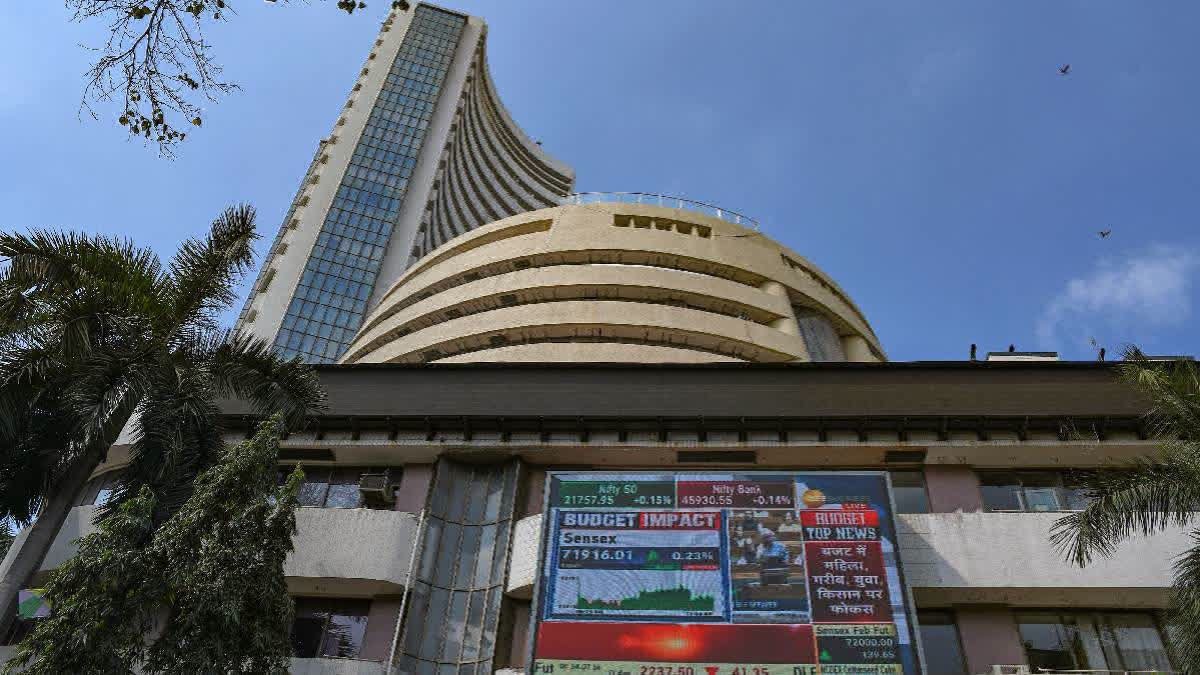
The September curse followed Dalal Street into October. Indian benchmarks crashed sharply on Thursday, 1st October, extending losses to the fourth straight session and locking in an eighth consecutive weekly decline—the longest losing streak recorded on domestic bourses in 25 years.
The Nifty 50 settled at 22,421.95, down 198.50 points or 0.88% at 3:31 pm IST. The index opened at 22,543.70 versus its previous close of 22,620.45, staged a feeble 15-minute bounce to 22,610.60, and then dropped steadily to an intraday trough of 22,217.30 around 2:30 pm. A late 200-point short-covering rebound trimmed losses before the close. At current levels, the 50-share benchmark trades just 239 points above its 52-week low of 22,182.55 and over 3,950 points off its record peak of 26,373.20.
The 30-share BSE Sensex tumbled 570.59 points or 0.79% to finish at 71,909.70. After opening at 72,192.89 against Wednesday’s close of 72,480.29, the barometer touched an intraday high of 72,572.90 before collapsing to a fresh 52-week low of 71,292.88 by 2:30 pm, taking out its prior yearly trough of 71,545.81. From its 52-week high of 86,159.02, the Sensex has shed more than 14,200 points.
Broader markets suffered acute damage: the Nifty Midcap 100 and Smallcap 100 slid roughly 2% each, while India VIX jumped over 12% to 15.15, signaling escalating hedging activity and fear. Market breadth was heavily skewed toward sellers, with the NSE clocking 594 advances against 2,789 declines. The morning plunge wiped out an estimated ₹9.5 lakh crore in investor wealth within 60 minutes, driving total BSE-listed market capitalization down from ₹473.09 lakh crore to ₹463.65 lakh crore.
Five Key Drivers Behind Thursday’s Market Bloodbath
- Relentless FII Outflows Cross $27.8 Billion: Foreign Institutional Investors (FIIs) net sold ₹10,148 crore (~$1.06 billion) on September 30, following disposals of ₹9,980.22 crore on Tuesday and ₹5,353.22 crore on Monday. Cumulative foreign outflows over the last five sessions reached approximately $3.6 billion, taking year-to-date FII selling to $27.8 billion. FIIs were net sellers on 15 of 20 sessions in September alone, withdrawing roughly ₹44,013 crore from secondary markets while building extensive short positions in index futures. While Domestic Institutional Investors (DIIs) injected ₹11,272 crore on Tuesday, institutional absorption fell short of checking the downside momentum.
- US 10-Year Treasury Yields Breach 24-Year Highs: The benchmark US 10-year Treasury yield surged past 5.342% on Wednesday—its highest level since early 2002—eclipsing the 2007 peak of 5.17%. The 30-year yield crossed 5.6%, tightening global financial conditions and pulling capital out of risk assets.
- Auto Gauge Cracks 4% Despite Robust Volume Prints: The Nifty Auto index plunged over 4% to lead sectoral declines, pressured by Bajaj Auto, Mahindra & Mahindra (down 1.95%), and Maruti Suzuki. Heavy selling persisted despite strong operational numbers from commercial vehicle manufacturers—Ashok Leyland reported a 28% YoY increase in September sales to 24,409 units, with medium and heavy commercial vehicle sales rising 37% to 16,188 units.
- Currency Under Strain Near 96: On the interbank forex market, the rupee opened at 95.95 and drifted to 95.97 per dollar, lingering near its two-month trough of 96.1450 hit earlier in the week. Persisting oil import payables and continuous institutional flight kept the local currency on the back foot.
- Technical Breakdown and Algorithmic Selling: The breach of the 22,500 Nifty threshold and the 72,000 Sensex handle activated stop-loss triggers across algorithmic trading desks. More than half of the Nifty 500 universe is now trading 30% below their respective 52-week highs, compounded by primary market issuances draining secondary liquidity.
Sectoral Scorecard: IT Holds Green Outpost Amid Broad Selloff
- IT Counters Stand Alone: The IT index gained 1.8% to 2%, providing the sole defensive shelter. TCS, Infosys, HCLTech, Tech Mahindra, Persistent Systems, Coforge, Mphasis, and Oracle Financial closed in positive territory. Select private lenders including Kotak Mahindra Bank, ICICI Bank, and Axis Bank witnessed early selective buying before succumbing to broader pressure.
- Heavyweights Drag: Titan, Adani Ports, Adani Enterprises, Tata Steel, UltraTech Cement, Bharat Electronics, and Reliance Industries were prominent drags. Metal, Realty, and Consumer Durables dropped between 2% and 3% each.
Corporate Radar: Phase-3 Green Energy Corridor Approved
- ₹1.86 Lakh Crore Green Grid Push: The Union Cabinet approved a ₹1.86 lakh crore capital outlay for the Green Energy Corridor (GEC) Phase-3. The project aims to facilitate the evacuation of up to 135 GW of renewable energy capacity and deploy 50 GWh of Battery Energy Storage Systems (BESS) by FY33 through high-voltage transmission lines, advanced switchgears, transformers, and reactive power compensation equipment. Analysts noted the outlay provides multi-year revenue visibility for equipment suppliers such as Power Grid Corporation of India (PGCIL), Hitachi Energy, Siemens Energy, and CG Power.
Technical Outlook: Key Support Levels for October 5
Technically, the Nifty’s late-session recovery from 22,217.30 preserved the crucial 52-week low of 22,182.55 as immediate structural support. A sustained breach below 22,180 could trigger further downside toward the 22,000 mark. Immediate resistance is positioned at 22,550–22,600.
For the Sensex, the fresh 52-week low of 71,292.88 serves as the pivotal base, with resistance near 72,500. With Indian equity bourses scheduled to remain closed on Friday, October 2, in observance of Mahatma Gandhi Jayanti, market participants head into the extended weekend watching global bond yields and West Asian developments for directional cues.

