



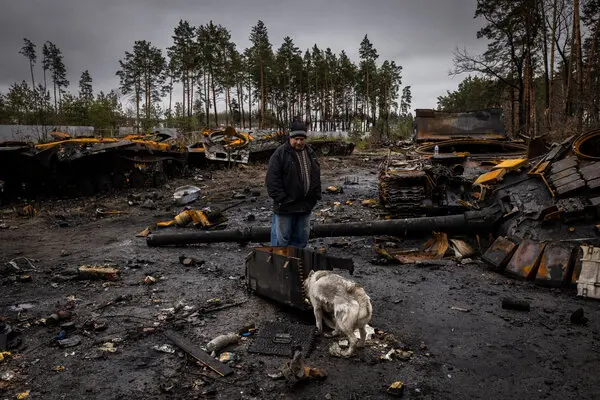
Imprint of conflict on environment continues to deepen as increasing number of countries go to war. Environment being depraded by war is nothing new.
Many a nation have a record of negatively impacting the environment when they engage in battle with countries far and near. There are transborder adverse effects.
Marginalized communities suffer disproportionately. Warfare disrupts the delicate balance of nature.
Buildings, roads and other infrastructure is destroyed in war generating millions of tons of debris. Some of which are contaminated with unexploded ordnance, asbestos and other hazardous substances.
Armies often clear vegetation disrupting ecological system to remove cover for enemy combatants. It results in areas becoming inhabitable.
Forests are cleared for military purposes.It leads to contamination of fertile land and vital water resources.
The United States of America’s defoliation of Vietnam ‘s forests is one of the earliest examples of such incidents. Such tactics were deployed in Sudan’s civil war and Iraq where wetlands were drained.
At least, 11,000 instances of environmental damage have taken place at war ravaged Ukraine. This is going by a report compiled by Initiative of Green House Gas Accounting of War.
The methodological challenges of such complication are numerous. But the fact remains that four years of war have led to a generation of estimated 311 tonnes of additional Green House Gases
This is the largest record of environmental losses in the history of modern Europe. But there are more sufferers than Ukraine as there are transborder effects.
There are others too. Israel following “his master’s voice” faces the charge of perpetrating ecocide against Palestine.
In Gaza, there has been completed degradation of the soil, water, land and agriculture. Sewage waste water and solid waste management system has collapsed.
One indicator is the increasing number of communicable diseases in Gaza. In the three months, following the escalation of conflict, the World Health Organisation reported 179,000 cases of acute respiratory infection and 136,000 cases of diarrhoea among children under five.
Meanwhile, abundance of natural resources in some countries have fuelled armed conflicts. Mining cobalt and coltan in the Democratic Republic of Congo for rechargeable batteries continues to fuel conflict.
In 1991, hundreds of oil wells burned uncontrollably in Kuwait post Iraq invasion. It affected air quality on a global scale.
This is a world fighting an almost existential battle in the form of climate change. It does not have the wherewithal to accomodate such transgressions on the environment.
Yet international law is yet to take action. International Criminal Court is yet to prosecute any nation. Only a handful of nations recognise the terrible fallout of war on the environment
Ironically, Russia is one of them. Some legal and diplomatic momentum has been generated in recent times. In all, 30 nations are considering recognition of ecocide.
But very few aggressors are ready to honour the stipulations. And they are under no compulsion to do so.
Even if rules are applied, they are done selectively. Environmental fissures are turning into cracks which are dangerously widening.
Contaminated lands and polluted waterways release toxic substances. Recognising this impact is the first step towards mitigating ecological harm.

