



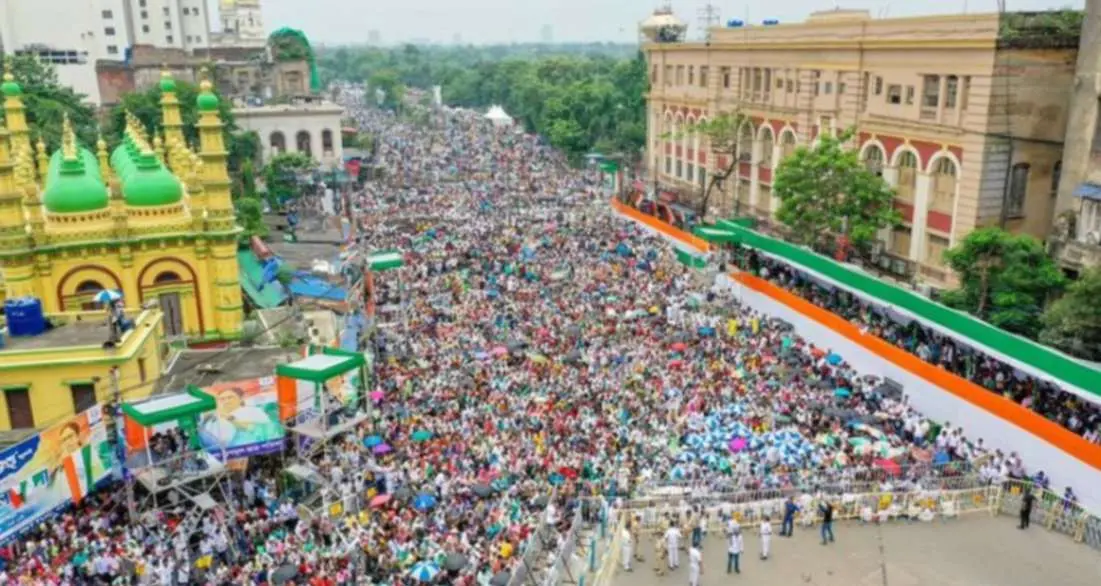
For years, the Trinamool Congress (TMC) marked July 21 as ‘Shahid Diwas’ (Martyrs’ Day) with a display of political dominance that few rivals in West Bengal could match. The rally in Kolkata’s Dharmatala neighbourhood drew vast crowds, showcased defections from opposition parties and often served as a stage for Mamata Banerjee, the party’s founder, to sketch the contours of the next political battle.
This year, party leaders and political observers say, the rally is taking on a more defensive purpose: demonstrating that the organisation still exists as a coherent force after a rebellion that has torn through its ranks.
TMC, founded in 1998 after Banerjee broke away from the Congress party, is facing what many within the organisation describe as the gravest crisis in its history. After losing power in West Bengal, it has watched a stream of MPs, MLAs and senior leaders defect to a rival faction led by the state’s opposition leader, Ritabrata Banerjee.
In response, the faction led by Mamata and her nephew Abhishek Banerjee has adopted a new slogan ahead of the annual gathering: ‘Amra Beiman Noi’ (We are not traitors). The message was prominently displayed at a preparatory meeting organised on Thursday by Kunal Ghosh, the party’s North Kolkata district president.
Speaking to workers by phone, Mamata urged loyalists to remain united. “Those who still have good sense should return. Those who have left are neither here nor there. We cannot sell the party for money,” she said.
“Even if only five workers remain with us, we will go to Dharmatala on July 21,” the former chief minister added.
To many in the state’s political class, the remark captured how sharply the party’s circumstances have changed.
Earlier July 21 rallies often resembled political carnivals, with celebrity appearances, cultural programmes, fleets of buses bringing supporters from across the state and a steady parade of leaders crossing over from rival parties.
The event commemorates the 13 Youth Congress activists killed in police firing during a protest in Kolkata in 1993. Over time, it evolved into the Trinamool’s largest annual political showcase.
Now, party insiders acknowledge an uncomfortable irony: the culture of defections that once helped build the TMC’s dominance has become a source of vulnerability.
“The challenge before us is different this time. The focus is on those workers and leaders who stood by the party during difficult times but perhaps never received the recognition they deserved,” Ghosh told party workers.

