



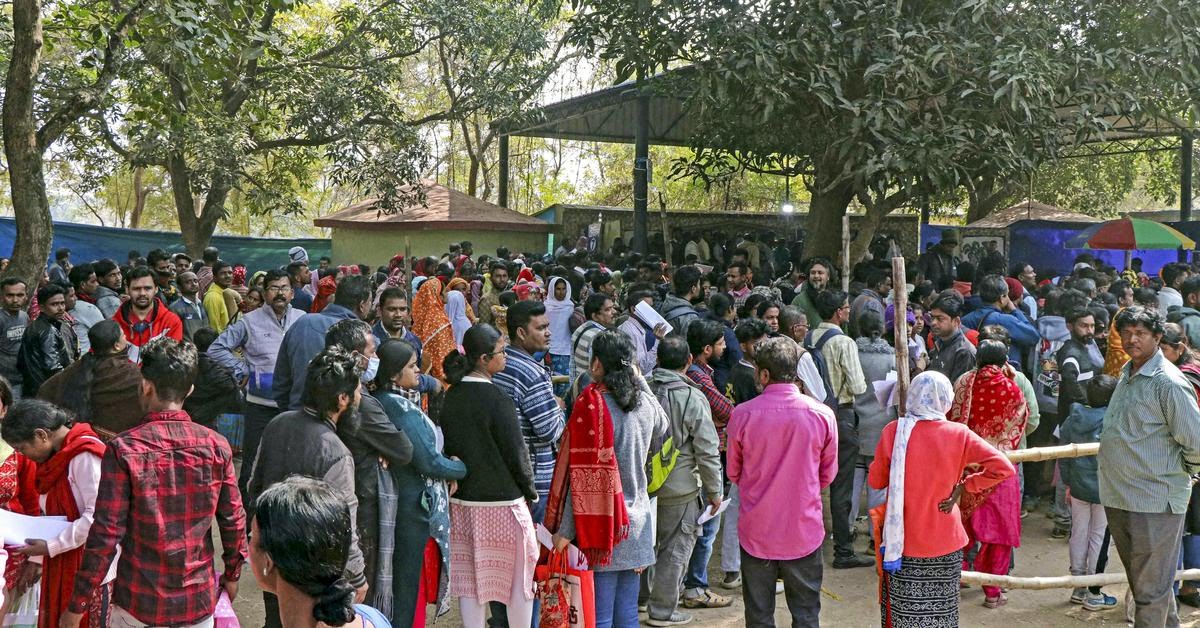
The Supreme Court on Monday (January 19, 2026) criticised the Election Commission for the “stress and strain” caused, through its ongoing Special Intensive Revision (SIR) exercise, to the ordinary people of the State of West Bengal, where 1.36 crore people, almost 20% of the population, have received notices from the poll body to explain “logical discrepancies” in their names and family backgrounds
The “logical discrepancies” include having more than six “progenies”, a mismatch in the spelling of names like ‘Ganguly’ and ‘Datta’, only a 15-year age gap between children and parents and a difference in age with grandparents being less than 40 years.
“Look at the strain and stress being caused to ordinary people. Over one crore people have been issued notice,” Justice JoymalyaBagchi, a member of the three-judge Bench headed by Chief Justice of India Surya Kant, addressed the Election Commission, represented by senior advocate Rakesh Dwivedi.
Senior advocate Shyam Divan, appearing for the petitioners who include ruling Trinamool Congress MPs, asked what was the need for the EC to know “how many progenies my parents had”.
“In one district alone, over 2.31 lakh people got notices to explain ‘logical discrepancies’ found against them. In the ‘progenies’ category, 2.12% of the population have been issued notice… Where do all these criteria come from? This kind of profiling on a criterion which you [EC] just invented is undesirable. Where is the statutory sanction? What has the electoral roll got to do with progeny? Can it even be a relevant consideration for the EC?. I believe not! Do they have a statute to back all this? I believe not. How could they act on such criteria?” Mr. Divan asked the court.
Mr. Dwivedi said seven persons were found with 100 children, two with 50 children.
Justice Bagchi asked how a 15-year gap between a parent and child would defy logic, asking whether “we live in a country where there is no child marriage”.
Senior advocate KapilSibal said the largest number of notices to file objections or submit records for verification were sent to people caught under the ‘logical discrepancies’ category. He said the EC had only 500 venues for conducting the hearing for these 1.36 crore people, when over 1900 venues were required.
Thirty-two lakh people were found ‘unmapped’ (those whose names or their family members’ names do not figure in the electoral rolls prepared in the earlier 2002 SIR in West Bengal) and sent notices to produce documents and file objections. The third category are those who were able to be ‘mapped’.
Mr. Sibal submitted that people of West Bengal were losing time, and probably a place in the electoral roll, amid the chaos following the publication of the draft rolls. Only 27 days remain for the final publication of the electoral rolls.
He said that only 15 lakh hearings had been held so far since December 16. “That is at the rate of 40,000 per day. There are only 20 days left for completion of the hearing,” Mr. Sibal submitted.
Mr. Divan said the EC was sending instructions on WhatsApp. “There is no transparency,” he submitted.
Mr. Sibal submitted that Booth-Level Agents of political parties were not allowed to attend the verification hearings. “There is no question of running everything through WhatsApp. Instructions have to go out as circulars,” Chief Justice Kant observed.
In a series of directions to ameliorate the sufferings of the people of the State, the court ordered that the names of persons coming under the ‘logical discrepancies’ category be displayed at grampanchayatbhavans and block offices in rural areas and ward offices in the urban centres.
The court extended by 10 days the time for people to submit objections and records following the publication of this list. The EC authorities have to give people receipts detailing the documents submitted before them by applicants during the verification hearing.
Applicants having objections to the exclusion of their names from the draft list would be permitted to file their records and pleas either themselves or through their authorised representatives, which would include BLAs. The authorising letter should be signed or thumb-marked to avoid foul play.
The State Government and the State Election Commission have been directed to provide the EC with the necessary human resources for the smooth functioning of the objections phase of the SIR. The Director General of Police of West Bengal was directed to ensure that there would be no law and order situation which would hamper the EC work.
Senior advocate KalyanBandhopadhyay, representing the petitioners, said the EC was not accepting admit cards issued by the State school and secondary school boards as documents of proof during verification. He said the cards show the date of birth of the person concerned.
“These are statutory documents. There is no way the EC cannot accept them,” Justice Bagchi reacted.
Mr. Dwivedi said there was a lack of trust in the EC, a Constitutional authority. “If the EC is to be distrusted, let the EC not conduct elections,” he voiced his exasperation at one point.
Noting that sitting MPs and MLAs and even Nobel laureate Amartya Sen were issued notices, Mr. Bandhopadhyay asked the EC, “is it that only you are above doubt, and others are not?”

