


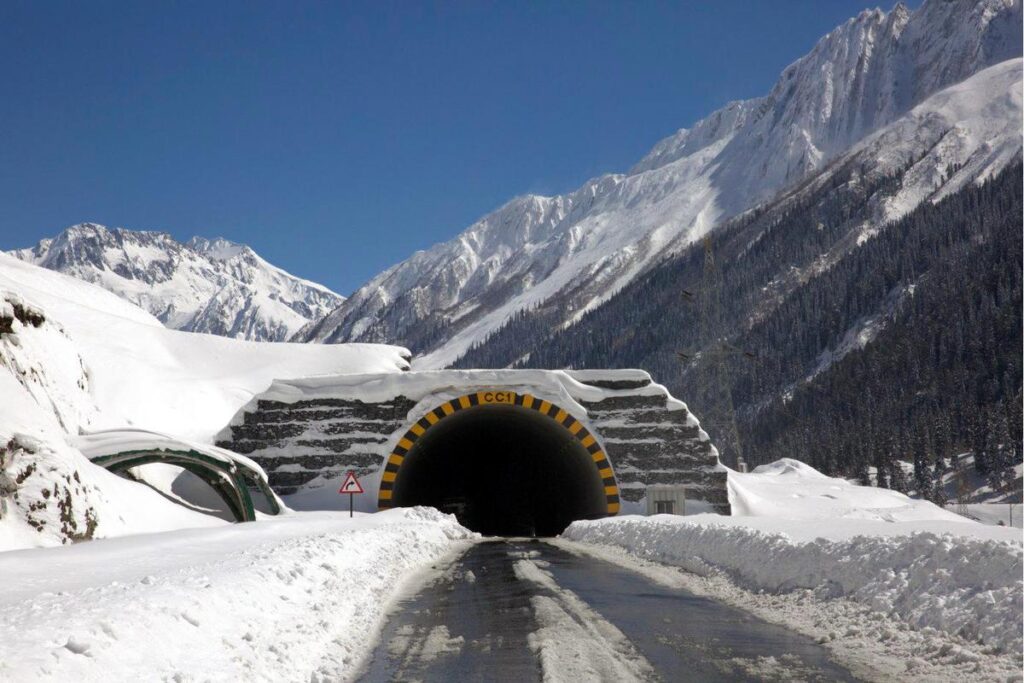
On June 9, 2026, India’s National Highways and Infrastructure Development Corporation Limited (NHIDCL) along with executing agency Megha Engineering & Infrastructures Limited (MEIL) successfully achieved the final excavation breakthrough of the strategic 13.15-kilometer Zojila Tunnel. The milestone was marked by a controlled final blast triggered remotely by Union Minister for Road Transport and Highways Nitin Gadkari at the Minimarg site in Ladakh. Attended by Jammu and Kashmir Chief Minister Omar Abdullah and Lieutenant Governor Manoj Sinha, this crucial excavation breakthrough physically connects the Kashmir Valley with the cold-desert region of Ladakh. Engineers utilized the advanced New Austrian Tunnelling Method (NATM) to safely pierce through the highly fragile and unstable Himalayan rock layers beneath the treacherous Zojila Pass.
Situated at an extraordinary altitude of 11,578 feet above sea level on the Srinagar-Leh National Highway (NH-1), the engineering marvel stands as Asia’s longest single-tube, bi-directional road tunnel. The breakthrough was remarkably achieved six months ahead of its excavation schedule, bringing the decades-old dream of uninterrupted regional integration closer to reality.
Currently, the hazardous Zojila Pass is forced to shut down for three to four months every winter due to heavy snowfall, severe avalanches, and landslides, completely isolating Ladakh from the rest of the country. Once the entire project is completed and fully thrown open to the public—expected by February 2028—it will revolutionize regional transit. The tunnel will slash travel times across the pass from over three hours to a mere 15 to 20 minutes, bypassing accident-prone stretches and providing a safe, all-weather lifeline.
Beyond transforming the socioeconomic landscape for civilian inhabitants by boosting tourism, trade, and access to healthcare, the Zojila Tunnel holds massive geostrategic value for national security. Year-round, weather-proof connectivity will ensure that the Indian Army can seamlessly move troops, heavy military hardware, fuel, and essential logistics to high-altitude border bases along the Line of Actual Control (LAC) even during peak winter. With 85% of the overall project work now complete, focus transitions to finishing civil lining, ventilation, and advanced automated safety installations.

