


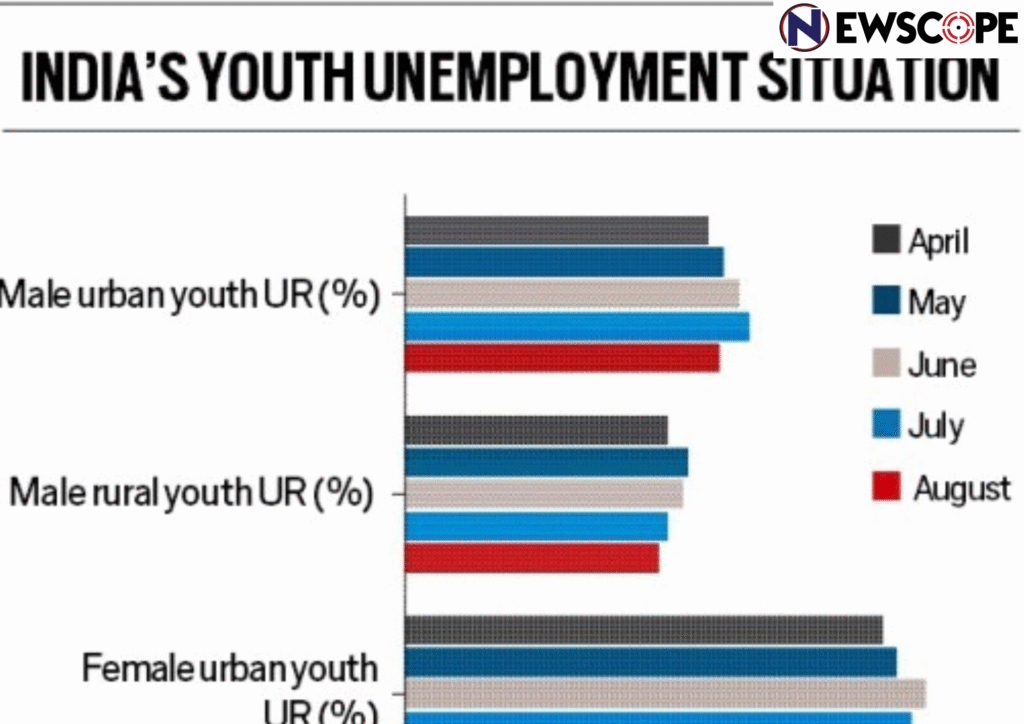
India on the surface appeared to take a small stride in terms of its job market in August. The general level of unemployment went down to 5.1 per cent at the lowest level in five months. Howbeit, behind the encouraging title is a disturbing fact that to young women, and more particularly, those between 15 and 29 years, it has been made even more difficult to find work.
The most recent Periodic Labour Force Survey (PLFS) that was published by the Ministry of Statistics and Programme Implementation (MoSPI) tells a grim picture. Almost every fourth young woman seeking employment in the cities was unemployed and the unemployment rate reached 25.7 per cent. This was an increase of over ten per cent above the rate of young men in the urban areas which dropped to 15.6 per cent. The gender gap was observed in the villages as well. Whereas the level of unemployment among young rural men dropped to 12.6 per cent, unemployment by young ladies in the rural areas increased to 14.3 per cent.
The poll also Indicates that it is not a one time event. As a matter of fact, the rate of unemployment among youths, in the female category has increased thrice within the past four months. It is not because the young women are not entering into the job market. Quite on the contrary, increasingly more are going to work. Labor Force Participation rate among young women increased slightly up to 21.4 per cent in August. Nevertheless, their Worker Population Ratio (WPR), which is the percentage of them who were successfully able to secure a job, was at 17.6 per cent. In a nutshell, there are more women in the race but very few are finishing the race.
MoSPI has attempted to spin the numbers in a positive way, and the labour market in August is characterized as registering a positive momentum. It also cautioned that monthly data ought to be taken with a pinch of salt. The ministry said that changes could be short-term, depended on seasonal work, academic schedules, or the redesigned survey method of PLFS that has replaced the initial multiple household visit. Nevertheless, the bigger issue of young women having problems in finding a job cannot be swept under the carpet.
The situation of women is even more concerning, when compared to April when the initial set of monthly statistics was released. At the time, women were making up 34.2 per cent of the labour force and their WPR was 32.5 per cent. The figures have since declined and participation dropped to 33.7 per cent and the WPR to 32 per cent. Even the total employment rate in population has decreased slightly.
The trends In the region point to the unequal nature of the challenge. In Himachal Pradesh, unemployment rates among the youth hit nearly 30 per cent in the period between April and June, which is twice the national figure. In the meantime, Gujarat achieved only 5.6 per cent, which demonstrates how much opportunity is determined by geography. Quarterly data, which involves July to September, will be released in November, and will indicate whether these gaps have been decreasing or increasing.
Whereas the policymakers in New Delhi are deliberating over the figures, Beijing has not spoken out. China that usually keeps quiet over internal statistics of other nations, has not responded to the recent PLFS data of India. It is no wonder that analysts remain silent. Having economic concerns of its own back home, China is hardly going to meddle in the employment predicament in India.
In the case of India, though, the message is not toned down by the silence. An increase in unemployment among young women is a cause of concern. It does not only show the unemployment, but the obstacles women encounter, not only in terms of lack of opportunities, but also in terms of skills and social constraints. The issue may only be exacerbated, despite the overall unemployment rates appearing improved on paper, unless specific training programmes are implemented to improve the situation, the problem, and lack thereof, in high-level jobs and supportive structures.
In the meantime, the August statistics reminds us as well as calls us to action: India is developing momentum in its economy, but, unless its young women acquire a decent work place, the history of development will not be complete.

