


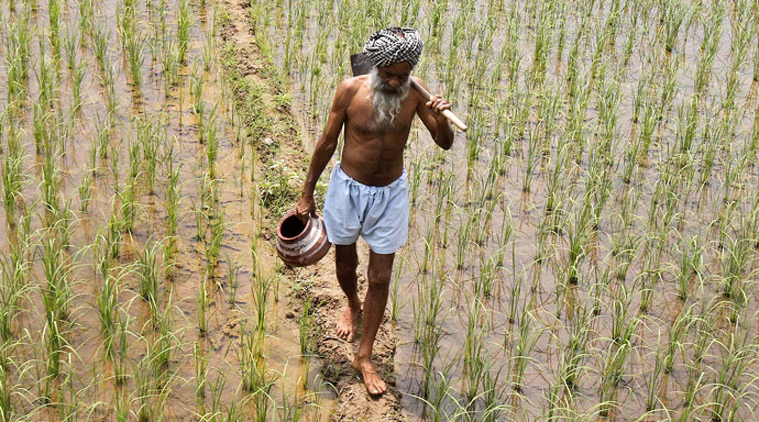
India seems to be heading for a structural crisis in agricultural succession. The average Indian farmer is ageing while the younger rural populace is migrating towards the cities.
Logistics network, service industries and digital employment seems to be a better draw than working the plots their forefathers tilled. Even agricultural education graduates instead of applying the techniques they learnt in their classes are preferring other avenues than applying them to their crop lands.
These agricultural university passouts would rather join agri-business. The call of government service, food technology or corporate supply chain is stronger to them.
Agriculture is increasingly being studied without being practised. It exposes a contradiction at the heart of government policy.
Government celebrate the farmers rhetorically. But the rural economy signals that farming
offers diminishing returns and security.
Farming is losing its place as a respectable profession. The change of mindset and the scene was brought about by a image of upward mobility.
Parents work the land so that their children could have a better life. It did not matter if they had to leave the land.
An IT career in Hyderabad or a nursing post in the Gulf offers an escape. After all, a farming career in India is uncertain.
It was a long time when farming was a career. It is no longer so.
Farming now involves the risks of entrepreneurship. It is coupled with the insecurity of the informal labour.
Income from agriculture depends on monsoon, input costs, global commodity movements. One must not forget transport disruption and the cut of middlemen.
The shift is not merely cultural.It is economic..
The farmers are no entrepreneurs. They lack capital buffer, insurance protection and pricing power.
These shortcomings of a farmer makes him aspire for a different career for his son. Salaried employment is much sought after as even if it’s income may be restricted, so are its risks.
Rajasthan and Maharashtra farmers find agriculture a risky occupation . Unpredictable monsoons, severe heat waves and receding groundwater tables combine to add to their woes.
The land holding patterns chip in to make farming an uneconomic occupation..Not only do small fragmented plots generate low and stagnant incomes, they push the farmers into debt traps.
Punjab and Haryana farmers are relocating to Chattisgarh and Jharkhand for larger and cheaper holdings. This is triggering an exodus from the states once known as veritable granaries of the country.
Politics especially electoral one is dominated by loan waivers and subsidies. But these do not address the aspirational aspect of the journey of the young from the village to the cities.
The men moving in from the green fields to the concrete jungle seek things apart from higher income. These are predictability, mobility and social recognition.
Reverting to the original problem, the situation is leading to a loss in generational continuity. Unless arrested, it would increase the dependence on corporate food and increase regional inequalities between urban corridors and stagnant agarian districts.
A fundamental change is needed in the farming sector to check the rural exodus. To be a socially respected sector of the economy, the farming sector has to be technologically modern and thereafter becoming economically viable.
It breaks down to investment in irrigation, storage and logistics. Digital connectivity and stable market access is not to be lost sight of.
The powers that be have to face the fact that ingratitude is not at all the factor which make the rural youth shun farming. They do not feel their predecessors source of earning is no longer worth inheriting.

