


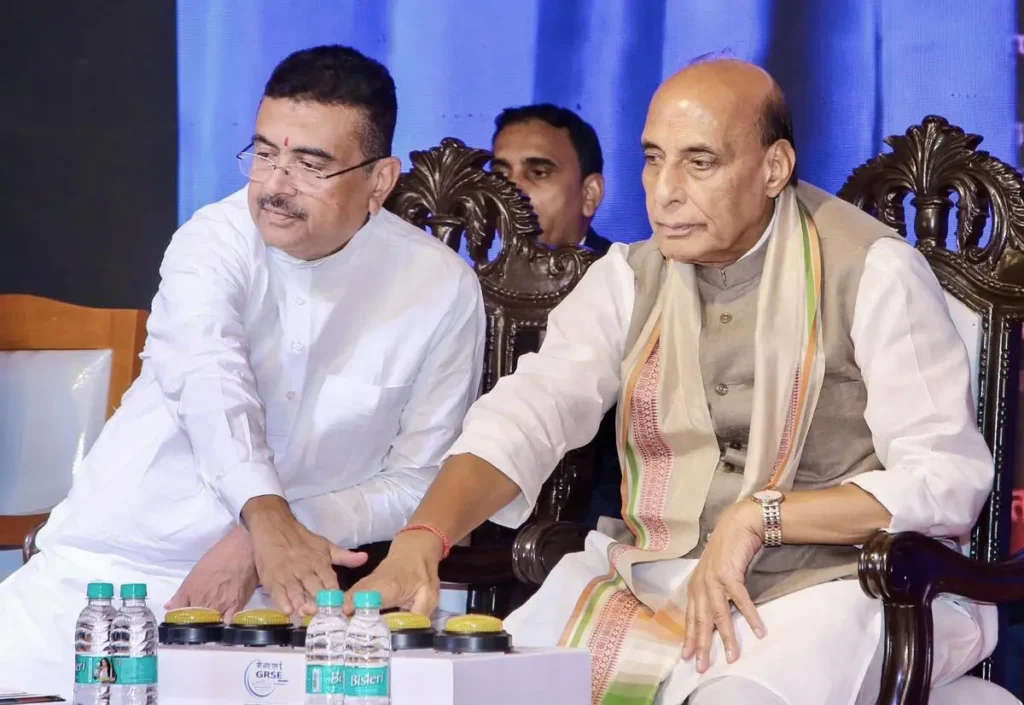
A new Radial Forging Plant at Yantra India Ltd’s Metal and Steel Factory (MSF) in Ishapore will expand Bengal’s defence manufacturing capacity, including production of hollow tubes for aerial bombs, as Defence Minister Rajnath Singh on Sunday laid the foundation stones for five expansion projects worth around Rs 3,500 crore.
Singh, in the presence of Chief Minister Suvendu Adhikari at Garden Reach Shipbuilders and Engineers (GRSE), said a new investment climate was emerging in Bengal in the industrial and defence sectors.
The five projects — three of GRSE and two of YIL — will strengthen shipbuilding, ship repair, metallurgical and defence production capabilities while generating jobs and opportunities for ancillary industries and MSMEs.
“There is a new fragrance in the air of Bengal. This is not merely a political change, but a change towards development,” Singh said, claiming that the narrative had shifted from industries shutting down to investments and new industrial projects.
The two YIL projects at MSF Ishapore involve more than Rs 750 crore. Singh said the new facilities would help secure the critical supply chain for advanced weapons and strategic components.
The Rs 473.84-crore Radial Forging Plant will introduce advanced radial forging technology and expand YIL’s capability to produce super-alloy forgings, hollow tubes for aerial bombs, critical hardware for future ordnance systems, high-strength railway axles and nuclear reactor components. The plant is scheduled to be completed in 30 months and will incorporate Industry 4.0 standards. It is projected to generate an annual profit of around Rs 69 crore, with a payback period of about six years, while reducing import dependence for strategic forgings and other critical components.
The other YIL project is a 3,000-tonne Heavy Duty Hydraulic Open Die Forging Press, which will replace the ageing 2,650-tonne press operational since 1976. It will enable high-precision production of critical gun barrels, ammunition components and heavy defence forgings.
Singh said Operation Sindoor had demonstrated the importance of indigenous weapons and platforms, calling self-reliance a “force multiplier for battlefield capability”.
He said GRSE had constructed more than 800 vessels and that its next-generation offshore patrol vessels under construction would have more than 80 per cent indigenous content. The new Raichak facility will be capable of building warships up to 200 metres long and enable GRSE to bid for next-generation destroyers.
Singh also said Bengal’s contribution to India’s political and cultural awakening — including giving the country the mantra of Vande Mataram and witnessing the Bengal Renaissance — could now be followed by an “industrial renaissance”. He said around 1,100 acres of land had been provided after the change of government to strengthen border security.
Meanwhile, Adhikari announced the formation of the ‘Arjun Bahini’, a new disaster-response force that will begin functioning across Bengal from September.
The force will initially have 200 personnel recruited through the Sainik Board — 100 in Kolkata, 50 in Darjeeling and 50 in Sagar or Kakdwip. Modelled on the NDRF, it will have modern equipment and trained personnel.
Adhikari said Agniveers would not be available before January next year, so 200 skilled personnel would initially be recruited through the Sainik Board. The force will subsequently provide a platform for Agniveers, with 20 per cent reservation earmarked for them.
He said the force was conceived after the Taratala building collapse, during which NDRF personnel rescued 22 people alive. Land, buildings and a campus have been identified, with specialised training and advanced equipment planned.
Adhikari also alleged that the previous government had failed to utilise Centre-provided disaster-management funds and said the present government would use available funds to strengthen the state’s disaster-response infrastructure

