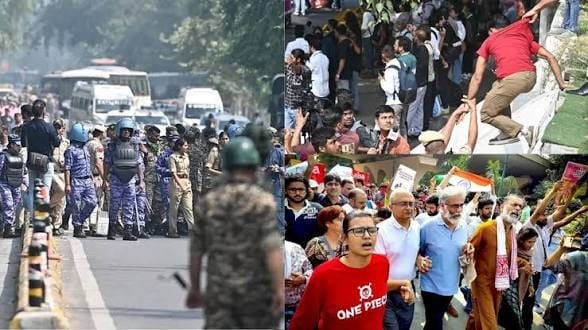
Pabitra Banerjee : In a stark display of strategic adaptability, thousands of political activists and student groups turned scattered pockets of the national capital into improvised demonstration sites after heavy law enforcement crackdowns blocked access to central assembly zones.
Following the high-profile detention of Cockroach Janta Party founders, including Abhijeet Dipke and co-conveners, security forces enforced blanket prohibitory orders around Jantar Mantar and key administrative corridors. However, instead of dispersing, decentralized cohorts of protesters executed swift tactical pivots, staging impromptu sit-ins and rallies across Connaught Place, Patel Chowk, Mandi House, and near the historic Gurdwara Bangla Sahib. Activists engaged in constant cat-and-mouse maneuvers with mobile police units, raising anti-CEC slogans and assembling pop-up gathering points faster than law enforcement could deploy barricades. Even within temporary detention complexes, held demonstrators initiated secondary protests, declaring that every street intersection had effectively transformed into a new epicenter of agitation.
Law enforcement agencies responded with heavy personnel deployments and thousands of additional preventive detentions, filling transit buses to transport detainees toward outer-city stadiums. Despite the administrative clampdown, the emergence of multi-focal protest hubs across central and North Delhi underscored the movement’s decentralized resilience, leaving security networks stretched as the confrontation over electoral reforms extends into another high-stakes day.
Protests spread across Delhi despite crackdown, detentions