


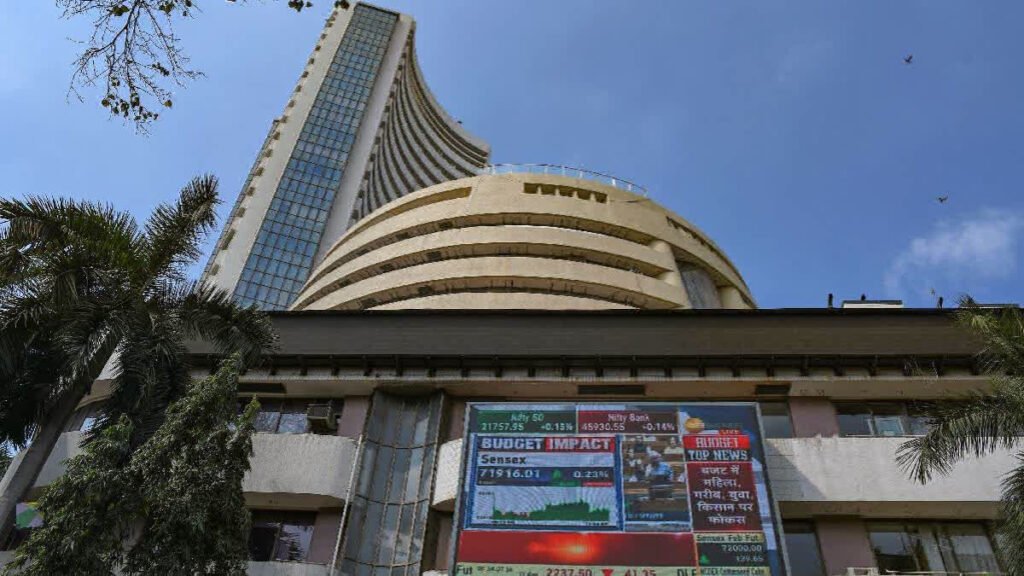
For the second consecutive trading session, Dalal Street followed a volatile script: opening with a steep gap-down and tumbling into the red before pulling off a sharp second-half recovery to pare the bulk of its intraday losses.
The Nifty 50 settled at 22,716.20, down 64.05 points or 0.28% at 3:31 pm IST, staging a resilient comeback after plunging to an intraday trough of 22,569.65. The index opened at 22,732.45 against its previous close of 22,780.25, touched an early peak of 22,753.25, and then cracked over 210 points within the first 45 minutes of trade. The intraday chart traced a textbook ‘V-shaped’ recovery—a steep vertical drop until 10:30 am to near 22,580 levels, followed by a steady rebound toward 22,740 by midday, a brief consolidation dip before 2 pm, and a final push into the green zone before closing just shy of the previous session’s resistance.
Meanwhile, the 30-share BSE Sensex ended at 72,529.07, down 242.65 points or 0.33% at 3:32 pm IST. Having opened at 72,633.68 against the previous finish of 72,771.72, the barometer touched an intraday high of 72,684.90 before collapsing to 72,064.00 in morning trade—representing a sharp 465-point recovery from the day’s nadir. While the intraday low remained 518 points clear of the 52-week low of 71,545.81, the settlement marked the lowest closing level for the Sensex since March 30, 2026.
The morning selloff wiped out nearly ₹4 lakh crore in investor wealth, reducing total BSE market capitalization to around ₹474 lakh crore before bottom-fishing emerged. At 2:45 pm, market breadth remained titled in favor of sellers with 1,783 advancing shares against 2,173 declining on the BSE, showing that bears maintained structural control despite the late-stage pullback.
Five Key Catalysts Driving Dalal Street’s Volatility
- Brent Surges Past $107 on West Asia Deadlock: The biggest global overhang remained international energy markets. Brent crude spiked 1.74% to hit $107.10 per barrel on Tuesday, while WTI rose 1.26% to $93.77. On the MCX, crude oil futures advanced to ₹8,926. For an economy that imports over 85% of its crude requirements, every $10-per-barrel price increase inflates India’s net import bill by an estimated $13–14 billion.
- Rejection of Iran Peace Plan Stalls Diplomatic Relief: The crude spike gathered momentum after US President Donald Trump rejected a peace proposal submitted by Iran via Qatari mediators at the UN General Assembly in New York. While indirect talks reportedly continue through third-party intermediaries, the hardening diplomatic posture raised concerns of an extended conflict over the Strait of Hormuz. “Indian markets are expected to remain under pressure as elevated crude and persistent uncertainty over US-Iran conflict weigh on sentiment,” noted Ponmudi R, CEO of Enrich Money.
- Massive Institutional Tug-of-War: Foreign Institutional Investors (FIIs) remained aggressive sellers, pulling out ₹5,353.22 crore on Monday on the back of Friday’s ₹3,693.93 crore outflow, taking the two-day institutional exit to ₹9,046 crore. However, Domestic Institutional Investors (DIIs) mounted a counter-offensive, injecting ₹5,189.02 crore to prevent an all-out breakdown below intermediate support levels.
- US Treasury Yields Hit July 2007 Highs: The benchmark US 10-year Treasury yield surged above 5.23%—its highest reading in over 19 years—while the 30-year yield held above 5.56%. The yield spike accelerated capital rotation out of emerging equities into safe-haven dollar assets, dragging Asian peers like the Nikkei 225, KOSPI, and Hang Seng lower.
- Rupee Breaches the 96 Per Dollar Mark: The Indian rupee weakened past the psychological 96 threshold, slipping to a two-month intraday low of 96.1450 against the US dollar compared to Monday’s close of 95.98. Elevated oil import payments and continuous FII outflows sustained intense pressure on the local currency.
Sectoral Rotation: Pharma and Metals Anchor Late Recovery
The morning drubbing was led by index heavyweights, including HDFC Bank, Bajaj Finance, Kotak Mahindra Bank, Reliance Industries, Asian Paints, and Infosys. Bajaj Finance remained particularly volatile following regulatory scrutiny surrounding insurance distribution and commission caps.
However, the afternoon turnaround was steered by defensive and export-oriented baskets:
- Pharma & Healthcare: Nifty Pharma and Healthcare indices climbed nearly 1%, boosted significantly by news that the United States has exempted Indian pharmaceutical manufacturers from a proposed 100% tariff on specialty drug imports. Torrent Pharma surged 1.46% to ₹4,940 on heavy volumes, while Sun Pharma logged solid gains.
- Metals & Logistics: Metal counters and select export plays saw value-buying off morning lows, with Adani Ports and InterGlobe Aviation providing vital support to the headline index.
- Laggards: Consumption, Auto, FMCG, and Real Estate closed with modest losses, while banking gauges pared the bulk of their early 2% drop.
Corporate Radar: Major Deals, Clean Chits, and Fundraises
- Essar’s $15-Billion US Green Steel Move: Essar Group unveiled plans for a massive $15-billion investment to set up the largest green steel manufacturing complex in Iowa, marking one of the largest outbound manufacturing commitments by an Indian conglomerate.
- SEBI Closes Adani Probe: Markets regulator SEBI concluded its regulatory proceedings against Gautam Adani and flagship group companies regarding Minimum Public Shareholding (MPS) compliance rules, clearing the group of violations and lifting a major regulatory overhang.
- Ola Electric Capital Infusion: The board of Ola Electric Mobility approved a ₹1,000-crore rights issue to strengthen liquidity and fund ongoing expansion.
- TRAI Telecom Data: Reliance Jio led wireless subscriber additions in August with 2.4 million net additions, followed closely by Bharti Airtel with 2.1 million additions.
- Index Rebalancing & Primary Markets: BSE shares gained 1.6% ahead of the bourse operator replacing Wipro in the Nifty 50. In primary markets, the German Green Steel IPO was subscribed an overwhelming 20.88 times, while Acevector reached 3.18 times on Day 3.
Geopolitics & Energy: Chokepoint at Hormuz Strains Refiners
The global supply equation remains acutely strained around the Strait of Hormuz, where daily oil transit remains constrained at approximately 11 million barrels per day (bpd), down from its normal throughput of 18 million bpd, following persistent drone threats, naval mines, and cross-border missile intercepts by the Saudi-led coalition.
The supply bottleneck is causing domestic retail margins to bleed:
- OMC Losses Mounting: While retail fuel rates remained frozen across metro cities (petrol at ₹102.12 in Delhi and ₹113.51 in Kolkata; diesel at ₹95.20 in Delhi and ₹99.82 in Kolkata), state-run Oil Marketing Companies (OMCs) are absorbing under-recoveries of ₹5 per litre on petrol, ₹23 per litre on diesel, and ₹200 per commercial LPG cylinder, according to ICRA estimates.
- Supply Rerouting: With Indian refiners actively curtailing Russian oil shipments amid scrutiny under the Graham Sanctioning Russia and Iran Act, 2026, buyers are turning to spot alternatives via ADNOC’s Fujairah bypass and direct Gulf term supplies.
Technical Outlook: 22,569 Stands as the Critical Line in the Sand
Market technicians noted that Tuesday’s intraday low of 22,569.65 now serves as the primary floor defending the index against a fall toward its 52-week low of 22,182.55. On the upside, immediate resistance is positioned at 22,753–22,780, with a decisive recovery requiring a breakout past 22,950–23,000.
“Bears remained firmly in control as the market breached key psychological supports early on, reflecting growing investor caution amid deteriorating global macro conditions,” said Vinod Nair, Head of Research at Geojit Financial Services. “The rejection of the ceasefire framework has heightened concerns of prolonged regional conflict, keeping upside strictly capped.”
Until Brent drops back below $100 and US 10-year yields soften below the 5% mark, market strategists maintain that Dalal Street remains in a structural ‘sell-on-rise’ regime, with defensive sectors offering the only viable temporary refuge.

