


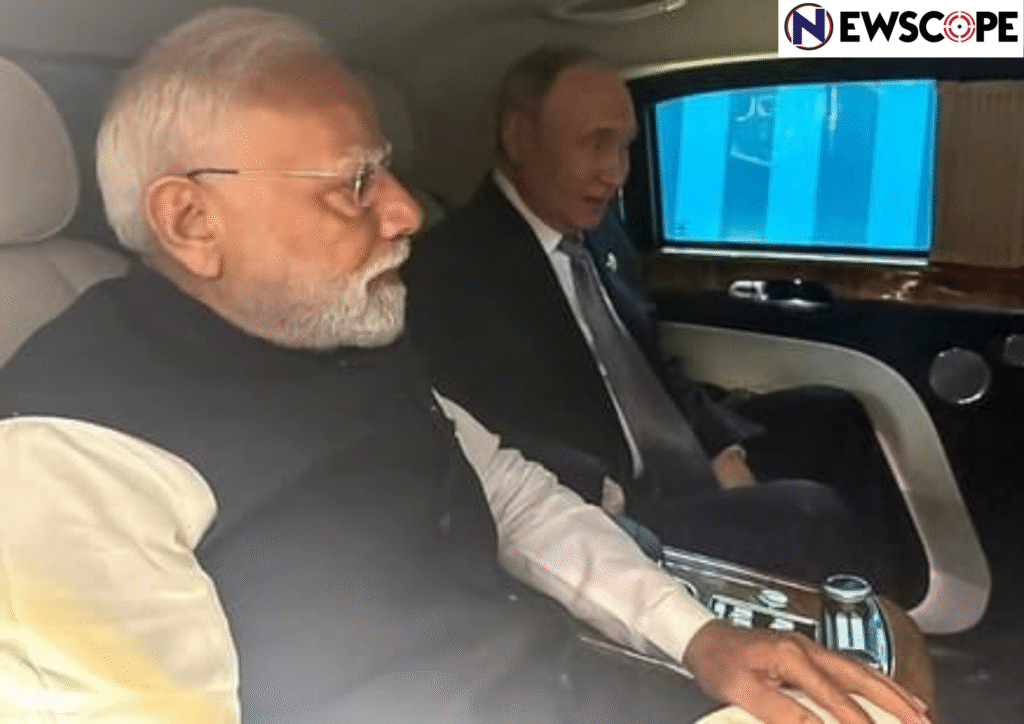
Prime Minister Narendra Modi met Russian President Vladimir Putin on Monday on the sidelines of the Shanghai Cooperation Organisation (SCO) summit in Tianjin, where he pressed for speeding up efforts toward a ceasefire in Ukraine.
The two leaders, who describe their partnership as a “special and privileged strategic” one, held extensive discussions on strengthening bilateral cooperation. Modi also conveyed that he looked forward to hosting Putin in India later this year for the 23rd annual India-Russia summit.
What made the meeting stand out was the personal rapport between the two leaders. Putin chose to travel with Modi in his own car, waiting nearly ten minutes for the Prime Minister to join him. The pair spoke one-on-one for close to an hour during the ride and continued their conversation for another 45 minutes after reaching the venue. Modi later described the exchange as “excellent,” noting that they discussed deepening cooperation across sectors and shared perspectives on global developments, including the Ukraine conflict.
Putin, addressing Modi as a “dear friend,” praised the decades-long trust between Moscow and New Delhi, calling it the bedrock for future cooperation. On Ukraine, he reiterated his long-held stance that NATO’s eastward expansion and Western involvement had provoked the crisis, framing Russia’s actions as a consequence rather than a cause.
The meeting came shortly after Ukrainian President Volodymyr Zelenskyy called Modi last week, urging him to send a strong message to Moscow. Modi’s push for a ceasefire also contrasted with U.S. President Donald Trump’s recent shift—after hosting Putin in Alaska, Trump dropped his earlier demand for an immediate ceasefire, instead suggesting Kyiv should strike a deal to end the war.
Adding to the tension, Washington has slapped a 25% penalty on Indian goods, in addition to existing tariffs, citing India’s continued oil trade with Russia. Indian officials, however, avoided mentioning U.S. trade disputes in their statement, which instead highlighted cooperation in “economic, financial, and energy sectors” and expressed satisfaction with the steady growth of ties.

