


Printmaking-one of the richest, oldest and democratic forms of art remains a sort of shrouded mystery when it comes to a large section of art appreciators. A print show takes one in an uncertain, almost uncomfortable territory unlike a painting, which can communicate and be understood. The print on the other hand, often arouses questions like originality, editions which linger on , yet remain unanswered. Printmaking is a process that is largely hidden from view as the public actually sees the finished image.The long hours of the labor of carving a design on a wood block, etching a plate of copper, preparation of lithographic stone or simply pulling each impression by hand remain unspoken and concealed paling it into a slight indifference and insignificance when compared to a painting.
One cannot deny that India has had a remarkably rich tradition of printmaking, yet it has been overshadowed by painting that has always taken centre stage .It is surprising in a way that some of the most artistic explorations and innovations have emerged through the printmaking process if one looks back at Krishna Reddy’s technical innovations to the deeply touching earthy paper pulp legacy in prints left behind by masters like Somnath Hore.
As galleries and art spaces increasingly resume focusing on these practices, printmaking is slowly making a louder impact among art followers not just as a section of art or secondary medium but as an intellectual and spirited chapter in the history of Contemporary Indian art.
Tri Art and Culture which has presented the city of Kolkata with several experimental artistic and cultural exercises has made a positive and educative step once again in association with Vadehra Art Gallery by bringing back printmaking in discussion with its landmark two –part retrospective “Hand Prints/Mind Prints “ that takes us on a trail of Gulammohammed Sheikh’s deeply intellectual engagement with printmaking.
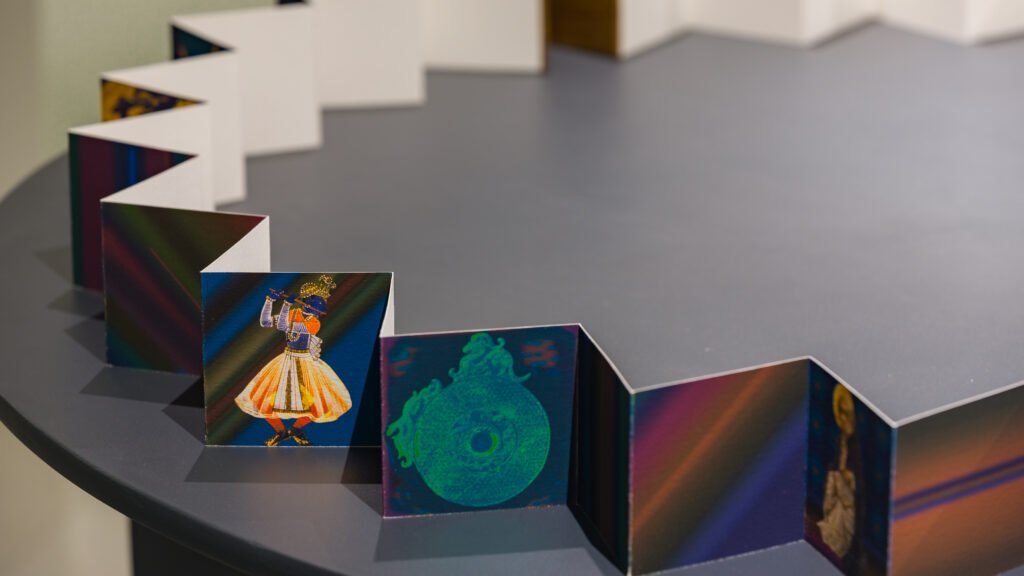
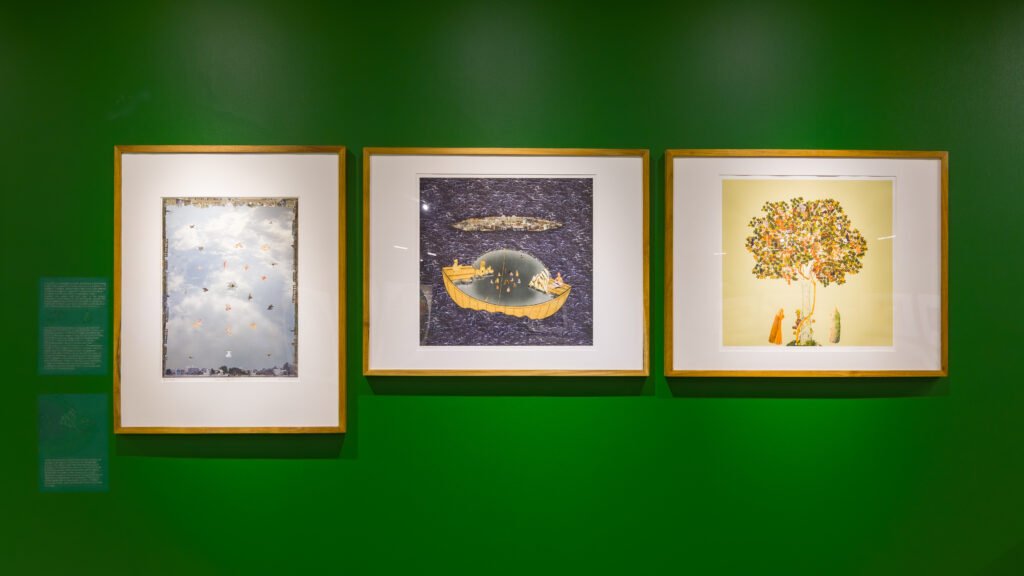
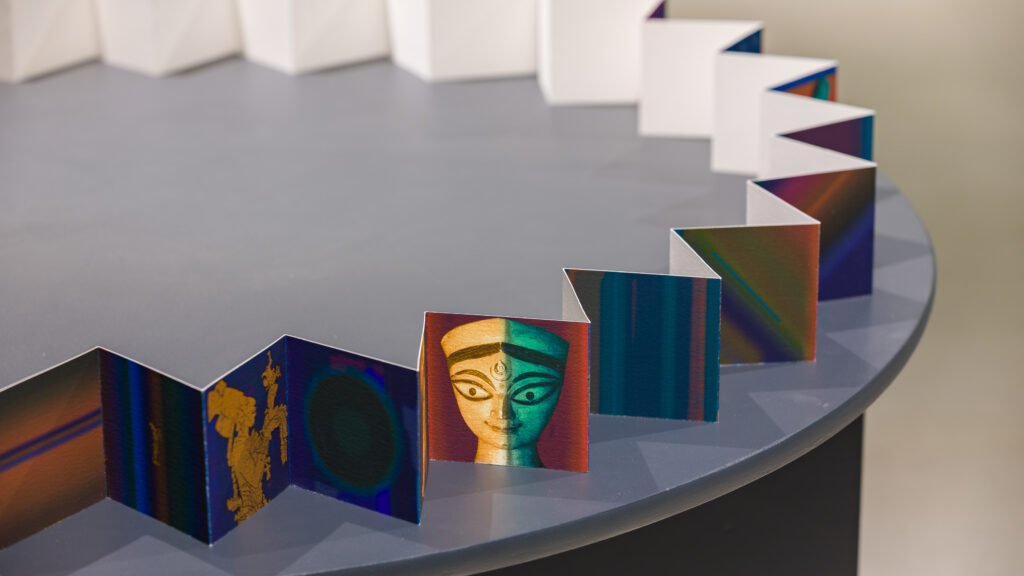
The show curated by visual artist Pushpamala N brings audiences up close with his multifaceted personality by exhibiting his works of over seven decades. The visual tour offers glimpses of the artist’s approach to printmaking not as a parallel exercise to painting but as an independent and evolving medium of expression tracing from handmade linocuts and lithographs to his pioneering larger format digital art, revealing the mastery of an artist who could refine and redefine print making.
Printmaking forayed in Sheikh’s life in his early years in school through a handwritten journal “Pragati” in 1952. In this he designed,and illustrated , penning poetry under the pseudonym Malaya, meant for public consumption , where print stepped in as a platform for idea exchange. His strength later matured in the later 1950s and early 60s through Kshitij, a literary journal, where artist linocuts were introduced into letterpress printing. Original prints of his own works as well as by acclaimed artists like Bhupen Khakhar, KG Subramanyan, Jyoti Bhatt expanded art and lifted it from the high walls of galleries to place it in the hands of readers making it a historical milestone no less.
His lithographic journey was sprinkled with recurring and metaphorical motifs like solitary horse carriage or tonga . The speaking tree inspired from Persian literature emerged as a symbol stitched in memory, poetry and mythology that shaped his own unique language.
In 1969 Sheikh co founded with Bhupen Khakhar a vibrant forum for writers , artists and filmmakers through Vrishchik, an English language journal. Through critical writing and original prints, it questioned artistic institutions and introduced reforms within art establishments in India.
His experiments with aquatint and etching following a landmark workshop conducted by Paul Lingren at USIS (Delhi) in 1970 inspired deeply sensitive and personal works like Unmoolan or uprooting which was derived from a Shloka from the Upanishads. The two 1971 untitled prints were autobiographical that exhibited the extent of the printmaking’s potential. In works like Man I and Days of the Dagger, and Riot one saw his poignant and intimate reflection on violence, discord and human fragility in the face of communal riots of Gujarat.
His printmaking journey bloomed in a unique narrative drawing on influences from architecture, autobiography, folklore and the world of cinema. Works like Mother India turned his artistic exercises into potent meditations on identity, memory and the complex existential realities of life in modern India.
In the section-Mind prints we find Sheikh has resorted to viewing technology not as a breaking away from tradition but as a natural evolution of weaving together memory , history and culture. Using reworked images from other artistic traditions in 2001 with the Talisman Twins the artist made layered digital compositions that induced new conversations around diverse cultures and time. By juxtaposing cinematic visuals with historical paintings and events in contemporary times in works like Cinema Still , Sheik tried to probe how violence is represented and recounted.
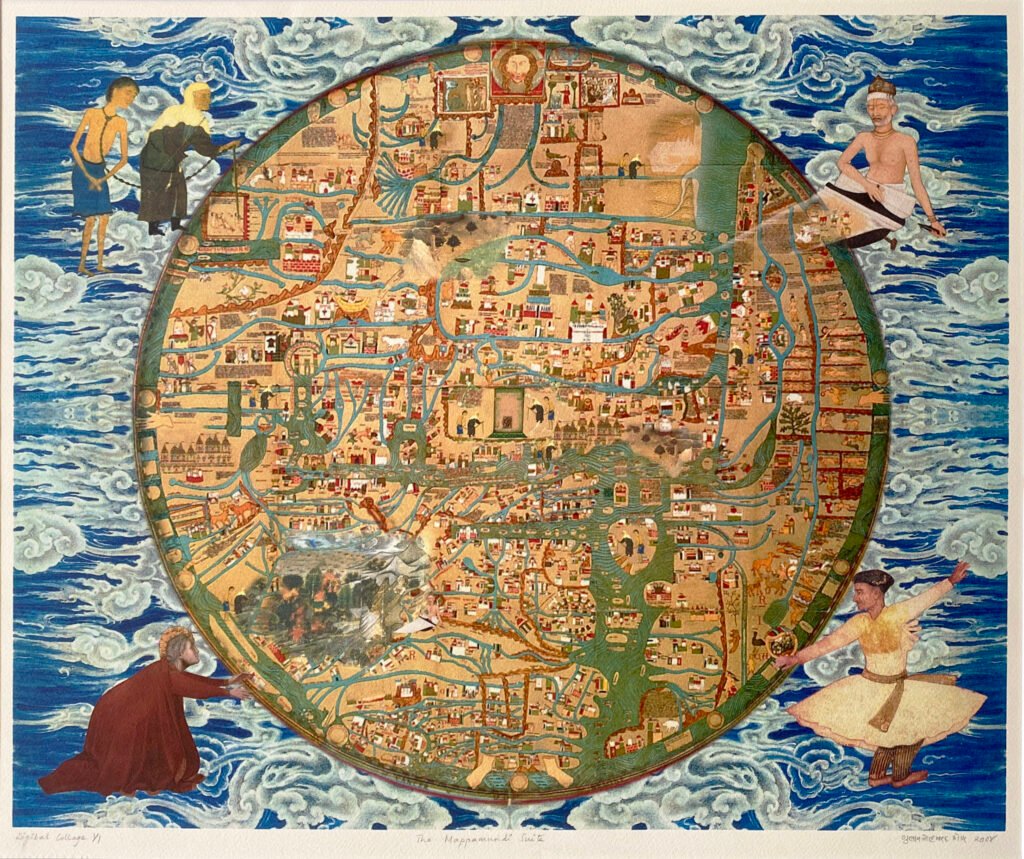
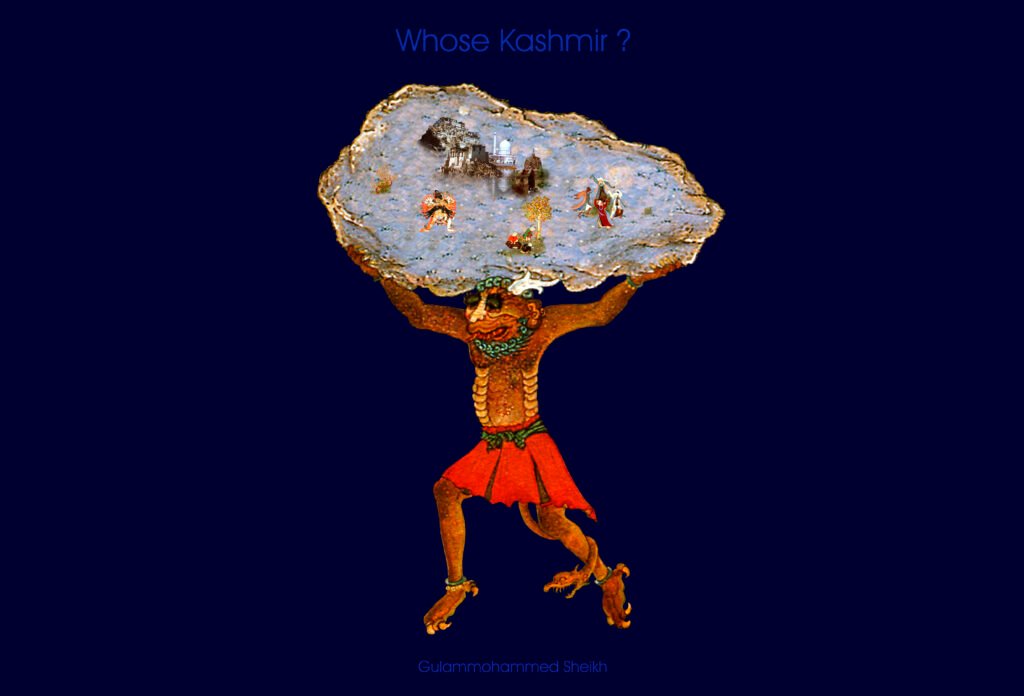
In Mappamundi Suite he amalgamates a shared cultural space in presenting a medieval global map that included figures like Majnu and Layla, Mary Magdalene, Kabir, Rama and St Francis. He tried to open dialogue across different timelines transcending history and geography in Portraits of Artists. In Kaavad: Home and Whose Kashmir , by combining digital technology with traditional storytelling Sheikh emphasized on the expanding possibilities of printmaking, as a powerful tool of inquiry and imagination.
In the end, shows like Hand Prints/ Mind Prints have the potential to reshape the audience’s understanding of printmaking and see it as an act of connection. and drive the fact that printmaking is far beyond digital reproductions, posters , photo enlargements or even wall embellishments. Highlighting the mastery of Ghulammohammed Sheikh , the intent seems towards dissolving and dismantling misconceptions by disclosing printmaking as a versatile, technologically demanding and intellectually driven artistic language . It leaves audiences with the gentle revelation that printmaking is an act of connection between people, ideas, time and tradition , stamping its rightful place at the core of contemporary Indian art practice.
The show has been on from 29th May, 2026 and continues on till 2nd August.

