


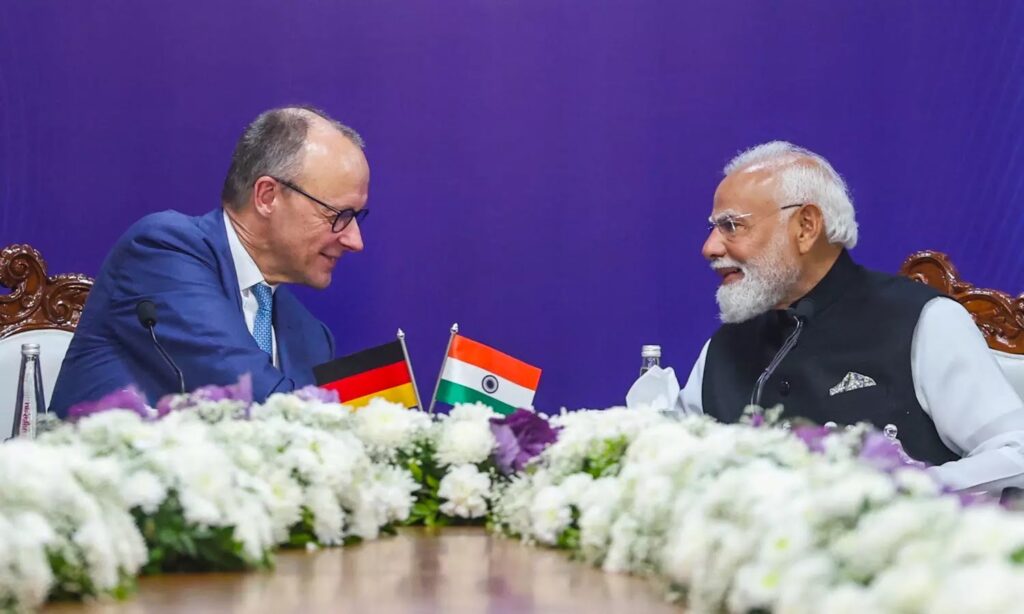
Prime Minister Narendra Modi and German Chancellor Friedrich Merz held talks in Ahmedabad on Monday morning and decided to strengthen ties in several sectors, including defence, trade, technology, renewable energy and education, following which the two sides finalised a staggering “27 outcomes”. These included 19 pacts that encompassed a joint declaration of intent to develop a defence industrial cooperation roadmap, as the two sides seek to strengthen co-development and co-production of defence platforms.
At a special MEA briefing later in Ahmedabad, foreign secretary VikramMisri said discussions on the proposed ($8 billion) deal between the two nations for construction of submarines for the Indian Navy “are proceeding positively” but have not yet been concluded. Noting that India “hopes for a positive outcome” on the deal, he mentioned how export clearance roadblocks from the German side have been cleared, reflecting the change in the German stand on its defence ties with India.
German Chancellor Friedrich Merz said in his media remarks that India and the European Union would sign a Free Trade Agreement by the end of the month and termed it a “central pillar for future engagement” and a chance that cannot be let go of. Modi too said the India-EU FTA would be concluded soon and would “open a new chapter”. The German Chancellor also said he wanted to “deepen the security and economic partnership with India”.
One of the 19 pacts inked was an “offtake agreement for green ammonia” between an Indian Company, AM Green, and a German company, Uniper Global Commodities, that Modi called a “new mega project in green hydrogen involving companies from both countries and said it will prove to be a game-changer for the energy of the future”. Apart from the 19 pacts, there were eight other announcements, including “new funding commitments (by Germany) of Euro 1.24 billion under the flagship bilateral Green and Sustainable Development Partnership (GSDP), supporting priority projects in renewable energies, green hydrogen, PM e-Bus Sewa, and climate-resilient urban infrastructure”. The two leaders welcomed the new joint declaration of intent on semiconductor ecosystem partnership”. Pacts on cooperation in critical minerals, global skills partnership and telecommunications were also inked, while announcements were made for the “establishment of bilateral dialogue mechanism on the Indo-Pacific” and the “launch of a battery storage working group under the India-Germany Platform for Investments in Renewable Energy Worldwide”.
The two nations also welcomed the move to establish Indo-German Centres of Excellence on Innovation (IG-CoE) focusing on Digital Convergence, Battery Technology, Green Transportation and Affordable Healthcare. Both nations also decided to draw up a comprehensive roadmap on education. Prime Minister Narendra Modi invited German universities to set up campuses in India and also thanked Chancellor Merz both for the visa-free transit facility for Indian nationals and also “for simplifying the processes related to defence trade”.
Pointing to the “shared ambitions, mutual trust, and steadily strengthening cooperation” between the two nations, Modi said, “India and Germany have always stood shoulder to shoulder. The strength of our friendship is visible on the global stage. … Close cooperation between the economies of countries like India and Germany is important for all of humanity. The growing trade and investment ties have infused new energy into our strategic partnership. Our bilateral trade has now reached its highest level ever and crossed $50 billion mark.”. He added: “India and Germany are working together to build secure, trusted, and resilient supply chains. The MoUs being signed today on all these areas will give new momentum and strength to our cooperation.” Taking a veiled dig at China, Modi also pointed out how critical technologies and capital machinery are being “weaponised” in the world (as part of export controls) even as he pressed for increased collaboration between German innovation and Indian skill.
On discussions between the two leaders on global hotspots and challenges, Modi said: “The Indo-Pacific is of high priority for both countries. To enhance our cooperation in this region, we are going to launch a consultation mechanism. Today, we discussed a range of global and regional issues in detail, including Ukraine and Gaza. India has always advocated for the peaceful resolution of all problems and disputes, and supports all efforts being made in this direction. We agree that terrorism is a serious threat to all humanity. India and Germany will continue to fight it together with full determination. India and Germany agree that reforming global institutions is crucial for addressing global challenges. Our joint efforts through the G-4 group to reform the UN Security Council are a testament to this shared belief.”
In his media remarks, Chancellor Merz hailed India as the fastest-growing economy of the G-20 grouping and termed the country “a desired partner of choice for Germany”. He also referred to ties with India as a “strategic asset” and said the country has “excellent young people who are well-trained”. He hailed the Indians working in Germany as the “most successful” immigrant group there. Merz also assailed Russia for its war against Ukraine. At the CEO forum later, Merz seemed to take a veiled dig at the United States for protectionist measures that are hampering free trade, even as he called for nations to protect themselves “against dependency and weaponisation”.

