


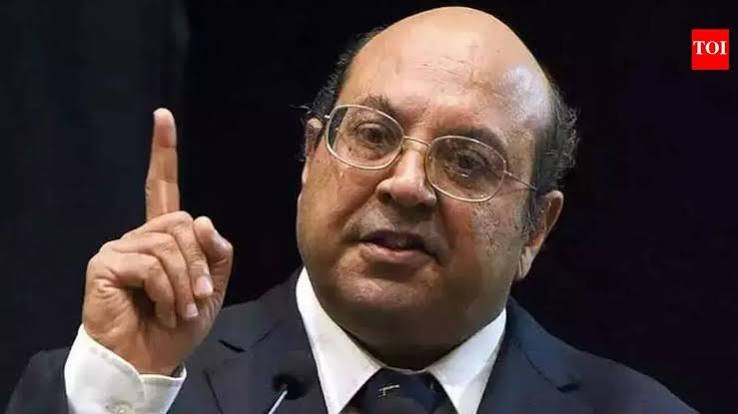
Former Supreme Court judge Justice Rohinton Fali Nariman has warned that democracy is in “great peril” as voters are illegally removed from electoral rolls, flagging what he called the “malfunctioning” of the Election Commission and questioning the process through which election commissioners are appointed
Nariman made the remarks on Sunday, a day before the Supreme Court scheduled pleas’ hearing linked to the Special Intensive Revision (SIR) of electoral rolls and a petition seeking the suspension of Chief Election Commissioner Gyanesh Kumar over alleged “unilateral decisions”.
Speaking on ‘The Constitution and the Common Man’ at Rajkumar College in Rajkot, Nariman said the deletion of voters in West Bengal had demonstrated the dangers of disenfranchisement on a massive scale. He said around 90 lakh voters had been disenfranchised in the state, of whom about 22 lakh had filed appeals, while those who did not challenge their deletion may have lacked the resources or access to justice to do so.
The report said that appellate tribunals in West Bengal had upheld the deletion of only 8,649 voters out of around 1.2 lakh cases decided at the time. This meant that roughly 93% of adjudicated cases had been decided in favour of voters challenging their removal from the electoral rolls.
Nariman said almost all of around 1 lakh appeals had been decided in favour of voters, arguing that the figures pointed to the illegal removal of ordinary citizens from the electoral rolls.
“So, you can imagine this was completely illegal — knocking out of the common man, the citizen of India in order that a government obtains what it wants,” Nariman said. He described the developments in Bengal as “very, very disturbing”, saying they had resulted in the government of the day being ousted and another government coming to power.
The former judge said the right to vote was at the heart of democracy and expressed hope that the Supreme Court would intervene to correct what he described as problems in the electoral system.
“I hope the apex court, the institution to which I once belonged, steps in immediately and rectifies these things. You can’t have an EC which functions or malfunctions like this,” he said.
Nariman also identified the appointment process of election commissioners as a key constitutional concern, arguing that it should not remain solely in the hands of the government of the day. He suggested that the selection process should involve the prime minister, the leader of the Opposition and the Chief Justice of India or his nominee.
“The first important red flag qua the Constitution and the common man is the appointment process of election commissioners,” he said.
His comments came as another Supreme Court judge, Justice Ujjal Bhuyan, separately raised concerns over the consequences of large-scale disenfranchisement. ANI reported that Bhuyan, speaking at the valedictory ceremony of the 19th NALSAR BRS Moot Court Competition in Hyderabad on Sunday, said any process that disenfranchised millions of citizens and left them without voting rights was “intrinsically arbitrary”.
“If any process results in disenfranchising millions and millions of Indian citizens, making them second-class citizens in their own country in the sense of being citizens without voting rights, such a process is intrinsically arbitrary,” Bhuyan said. “It strikes at the very heart of the Constitution.”
The remarks by both judges came against the backdrop of the continuing political and legal controversy over the Election Commission’s SIR exercise. Opposition parties have targeted CEC Gyanesh Kumar and demanded his resignation, while the Supreme Court is examining challenges linked to the electoral-roll revision process.
The apex court had earlier upheld the SIR exercise in Bihar. In May, a bench of Justices Surya Kant and Joymalya Bagchi held that the exercise was constitutional and legally tenable and could not be struck down merely because it differed from the ordinary process of revising electoral rolls.
The court had also clarified that the Election Commission’s powers in the exercise were limited to determining eligibility for inclusion in electoral rolls and did not extend to determining citizenship. Deletion of a person’s name from the voter list, it said, did not strip that person of citizenship, which could be determined only by the competent authority under law.

