


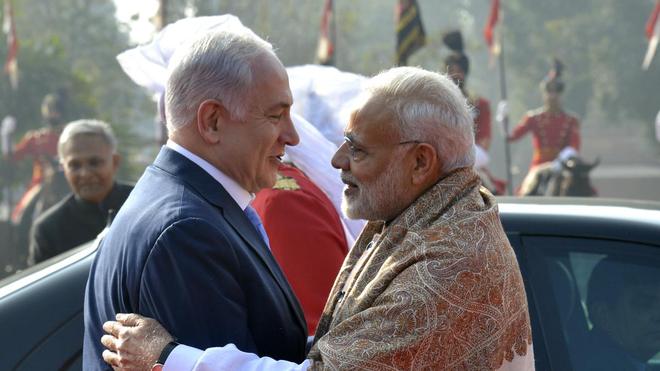
Prime Minister Narendra Modi’s high-stakes visit to Israel—his first in nearly a decade—is a masterclass in high-wire diplomacy, occurring at a moment when the Middle East is a literal and figurative powder keg.
While the trip aims to celebrate a “strategic partnership,” it is being buffeted by intense geopolitical headwinds that threaten to overshadow the bilateral agenda.
The most immediate challenge is the looming specter of a broader regional war. As the United States bolsters its military presence to counter Iran, India finds itself in an awkward position, proceeding with a high-profile diplomatic mission even as it issues travel advisories for its citizens to flee the surrounding areas.
Domestically, this has sparked criticism regarding the optics of a celebratory visit while the region teeters on the brink of a major escalation.Furthermore, the ethical landscape has shifted dramatically since 2017.
Prime Minister Benjamin Netanyahu’s government is currently under the lens of the International Criminal Court for its conduct in Gaza. For India, which prides itself on being a leader of the Global South, engaging in high-profile pageantry at the Knesset carries the risk of being perceived as a tacit endorsement of controversial military actions.
This tension is amplified by India’s recent vote against Israeli settlement expansions in the West Bank, highlighting a growing friction between New Delhi’s traditional support for a two-state solution and the current Israeli administration’s hardline policies.
Economically, the conflict has paralyzed the ambitious India-Middle East-Europe Economic Corridor (IMEC), a project India viewed as a cornerstone of its trade future. Despite these obstacles, the “realpolitik” of defense remains the visit’s bedrock.
With India still heavily reliant on Israeli missile and surveillance technology, the trip underscores a cold reality: New Delhi is prioritizing its long-term national security and defense co-production over the volatile and often contradictory currents of Middle Eastern politics.

