


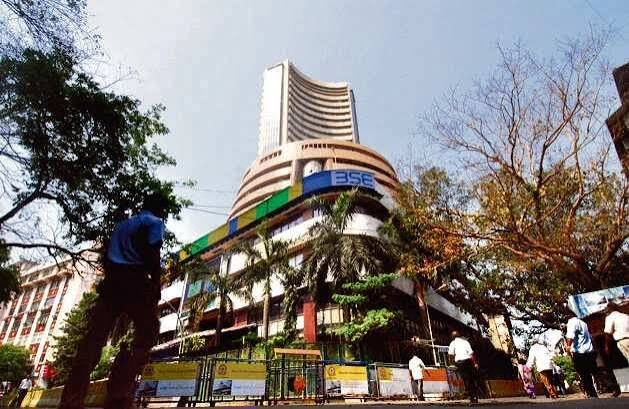
The two-day relief rally on Dalal Street proved short-lived on Wednesday, October 7. Indian benchmarks snapped their winning streak as the Reserve Bank of India (RBI) delivered its first interest rate hike since February 2023, while international crude prices climbed back above $101 per barrel, reviving stagflationary headwinds.
The Nifty 50 settled at 22,603.05, declining 173.05 points or 0.76% at 3:31 pm IST. The benchmark opened with a downward gap at 22,690.45 versus Tuesday’s close of 22,776.10, staged an early morning recovery to an intraday high of 22,717.65 by 11:00 am, and then fell sharply as the central bank announced the rate increase. The index slid to an intraday low of 22,546.30 by 1:00 pm before grinding sideways to close above the 22,600 mark. The 50-share barometer sits 420 points above its 52-week low of 22,182.55, but remains 3,770 points below its record high of 26,373.20.
The 30-share BSE Sensex dropped 429.11 points or 0.59% to finish at 72,638.70. Having opened at 72,965.38 against Tuesday’s finish of 73,067.81, the barometer touched a morning high of 73,018.82 before selling intensified, dragging it to a trough of 72,468.72 around midday. At its lowest point, the Sensex was down over 574 points.
The retracement paused a 558-point recovery in the Nifty from last Thursday’s trough of 22,217, as institutional desks moved to price in higher terminal borrowing costs and sustained margin pressures.
The Big Move: RBI Hikes Repo to 5.50%, Shifts Stance to ‘Calibrated Tightening’
At 10:00 am, RBI Governor Sanjay Malhotra announced that the Monetary Policy Committee (MPC) had voted unanimously (6-0) to raise the policy repo rate by 25 basis points to 5.50%—the central bank’s first rate increase in 44 months. The policy repo rate had stood at 5.25% across the previous four reviews following cumulative easing of 125 basis points in 2025.
Crucially, the MPC abandoned its ‘neutral’ stance in favor of ‘calibrated tightening’, signaling to bond and equity markets that near-term rate cuts are off the table.
Three macroeconomic pressures forced the central bank’s intervention:
- Sticky Inflation Prints: Headline CPI inflation accelerated to 4.82% in August from 4.45% in July, exceeding the 4.0% midpoint target for three consecutive months. The RBI projected FY27 inflation at 5.2%, though several market economists anticipate prints rising toward 5.8%–6.0% in Q3.
- Elevated Energy Basket: The Indian crude basket FOB price spiked to $120.50 per barrel, up from around $90 at the time of the previous MPC review, driven by physical shipping disruptions and insurance premia.
- Currency Depletion: The Indian rupee opened at 96.45 per dollar and weakened further to 96.70 following the policy announcement, hovering near historic lows against a buoyant US dollar.
Market & Industry Reactions:
- Borrowers and MSMEs: “For the common man, EMIs on floating-rate retail loans linked to the External Benchmark Lending Rate (EBLR) will climb, while depositors will see modestly higher FD rates. However, MSMEs face higher capital costs on working limits alongside input inflation,” stated Kinjal M Shah, President of the Bombay Chartered Accountants’ Society.
- NBFC Financing Margins: “The RBI decision is a measured response to macro developments. For non-banking lenders, higher interest rates will raise marginal borrowing costs, making disciplined pricing and diversified liability franchises vital,” remarked Abhimanyu Munjal, MD of Hero FinCorp.
- Investment Outlook: “We view this as a shallow tightening cycle, with terminal repo rates likely reaching 5.75% to 6.00% by the first half of 2027. Higher bond yields provide an attractive lock-in window for long-term debt allocators,” said Ashwani Dhanawat, CIO at Shriram General Insurance.
- Absorption Capacity: “With the RBI upgrading FY27 GDP growth to 7.1%, the broader economy has the capacity to absorb this hike to curb second-round inflation expectations,” added Sumit Singhania of Bajaj Broking.
Four Other Headwinds Dragging Equities Lower
- Brent Rebounds Past $101: Global crude prices gained 1.01% to reach $101.60 per barrel during morning trade. Kotak Securities noted that extreme tanker logistics—with VLCC charter rates exceeding $1 million—add a $25-to-$45 per-barrel premium, pushing actual physical clearing costs toward $145 despite $100 screen levels.
- Persistent FII Outflows: Foreign Institutional Investors offloaded ₹2,961.30 crore in equities on Tuesday, following net sales of ₹9,484.22 crore on Thursday and ₹10,148 crore on Wednesday. Cumulative year-to-date FII selling stands at $27.8 billion, with foreign desks maintaining heavy net-short positioning in index futures.
- Heavy Selling in Rate-Sensitives & Durables: Discretionary counters retreated sharply on expectations of higher borrowing costs. Titan Company emerged as the top Sensex loser, falling 4.33% to ₹4,343.50. Asian Paints shed 1.71%, Maruti Suzuki dropped 1.45% to ₹11,435, and Bharat Electronics fell 1.33%. Nifty Consumer Durables led sectoral declines (-1.55%), followed by Metals (-1.34%) and Autos (-1.0%). Banking and financial indices retreated 0.4%, with HDFC Bank, ICICI Bank, and Reliance Industries closing in the red.
- Elevated US Treasury Yields & Mixed Global Cues: While Wall Street logged overnight gains—the Nasdaq reaching an all-time high of 27,477.31—Asian markets traded lower across Tokyo, Seoul, and Hong Kong. The US 10-year Treasury yield held above 5.30% and the 30-year yield crossed 5.70%, continuing to draw institutional flows away from emerging markets.
Geopolitical Developments & Commercial Energy Costs
Regional energy dynamics remained complex:
- Houthi Strikes & Red Sea Clashes: Houthi forces launched projectile and drone attacks targeting installations across Saudi Arabia, including Rabigh and regional airports, prompting joint counteroffensives near the Yemeni port of Mokha along the Bab al-Mandeb strait.
- Saudi Pipeline Restarts & Price Cuts: Saudi Arabia resumed crude loadings from Yanbu after restoring operations along the East-West Pipeline. To defend market share against surging freight hurdles, Saudi Aramco slashed its November Official Selling Price (OSP) for Arab Light into Asia to a $5 discount against Oman/Dubai benchmarks—the widest concession since June 2020.
- OMC Under-Recoveries: Retail fuel pump prices remained unchanged across major metros on Wednesday (petrol at ₹102.12 in Delhi, ₹111.21 in Mumbai; diesel at ₹95.20 in Delhi, ₹97.83 in Mumbai), with state-owned OMCs absorbing widening marketing margins.
Technical Outlook: Key Levels Around 22,500
Derivatives data indicates that the Nifty’s immediate trajectory hinges on defending key technical floors:
- Nifty 50 Support & Resistance: The immediate technical cushion sits at Wednesday’s intraday low of 22,546, followed by the critical 22,500 psychological mark. A breakdown below 22,500 could trigger fresh algorithmic selling toward 22,400. On the upside, overhead resistance is pegged at 22,720 and 22,800.
- BSE Sensex: Immediate support is positioned at 72,460, with resistance remaining at 73,020–73,100.
“While the 25-basis-point repo hike was largely anticipated, the shift to calibrated tightening formalizes higher borrowing costs across the medium term,” noted Ponmudi R, CEO of Enrich Money. “Until Brent crude retreats durably below $95 and US yields soften, domestic bourses are likely to encounter selling pressure on sharp pullbacks.”

