


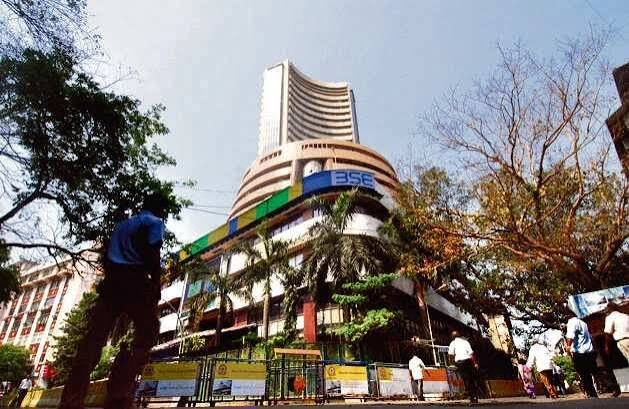
The optimism ignited by Friday’s robust relief rally faded quickly on Dalal Street as an upbeat opening was met with heavy institutional selling on Monday. A gap-up opening triggered by cooling crude prices was sold into aggressively as domestic bond yields spiked and foreign portfolio outflows extended into their eleventh consecutive session.
The 30-share BSE Sensex settled at 71,924.68, dropping 547.65 points or 0.76%, completely erasing an initial 400-point morning surge. Opening higher at 72,771.32, the index touched an intraday high of 72,884.25 in the first hour before cascading nearly 1,208 points to a session low of 71,676.10. The benchmark finished near the bottom of the day’s range, sitting just 632 points above its 52-week low of 71,292.88 (and well below its record peak of 86,159.02).
The NSE Nifty 50 closed down 157.10 points or 0.70% at 22,363.35. The index opened at 22,593.20 and touched a morning peak of 22,651.10 before reversing sharply to an intraday low of 22,304.45. The benchmark has now remained confined within an indecisive 22,180–22,850 range across nine consecutive sessions.
Despite the headline decline, broader market breadth held relatively resilient:
- Advance-Decline Ratio: On the BSE, 2,356 issues advanced against 1,911 decliners, with retail and mid-cap pockets absorbing some of the pressure.
- Volatility Index: The India VIX climbed 6.8% to 15.40, reflecting renewed hedging demand.
- Extremes: Out of 4,568 active counters, 128 touched fresh 52-week highs while 137 plumbed fresh 52-week lows.
The Anatomy of a Gap-Up Failure: Five Structural Drags
Market analysts identified five key drivers that derailed Monday’s early rally:
- Bond Yield Hardening: The Indian 10-year benchmark government security (G-sec) yield climbed to a 3-year high, while the US 10-year Treasury yield hovered around 5.23%, close to last week’s 24-year high of 5.33%. Higher sovereign yields continue to diminish equity risk premia. Furthermore, the Reserve Bank of India’s heightened oversight of foreign exchange derivatives and increased hedging compliance for commercial banks added to rate jitters.
- FII Exodus Hits Day 11: Foreign Institutional Investors (FIIs) offloaded ₹3,568.90 crore on Friday, stretching their net selling streak to 11 consecutive trading sessions. Cumulative foreign capital flight in 2026 has exceeded $30 billion—the steepest in emerging Asia—dragging the Nifty down over 7% year-to-date. Net purchases of ₹4,743 crore by Domestic Institutional Investors (DIIs) on Friday provided only partial support.
- Profit Booking in Friday Gainers: Traders utilized early gap-up momentum to lock in profits following Friday’s oversold bounce, with heavyweight defensives and frontline technology counters facing intraday liquidation.
- Crude Remains Anchored Above $100: Despite softening slightly, Brent crude held above $103 per barrel. For the Indian economy, every sustained $10-per-barrel increase widens the annual merchandise import bill by roughly $15 billion and adds 30 to 40 basis points to consumer price inflation.
- Divergent Asian Cues: Regional bourses delivered mixed sentiment. South Korea’s Kospi tumbled 3.38% on a global tech drawdown and Shanghai slipped 0.16%, while Tokyo remained closed for a public holiday.
Sectoral Movements: FMCG & IT Retreat; Autos & Pharma Outperform
Sectoral rotation defined Monday’s session, with FMCG and technology absorbing the bulk of institutional selling:
- Top Sectoral Decliners: The Nifty FMCG index slipped 1.67%, dragged down by ITC (down 2.8% to 3.0%) and Hindustan Unilever (down 2.5%). Banking indices eased 0.5% to 0.8%.
- IT Retreats on Telecom Drag: The Nifty IT index declined 0.79% following Friday’s surge. Tech Mahindra tumbled 3.5% to 4.0%, caught in a global telecom equity slide after SpaceX expanded direct-to-cell satellite coverage (impacting clients such as T-Mobile, AT&T, and Verizon). Telecom accounts for 32.3% of Tech Mahindra’s consolidated top-line. Larsen & Toubro, State Bank of India, NTPC, and Bharti Airtel dropped between 1.5% and 2.5%.
- Resilient Outperformers: Automobiles, healthcare, and select state-run defense counters showed strength. Bajaj Auto jumped 2.86% to ₹10,058, Dr. Reddy’s Laboratories gained 2.76% to ₹1,230, BSE Ltd rose 1.17% to ₹3,325, Mahindra & Mahindra added 1.14% to ₹2,828, and Bharat Electronics (BEL) advanced 1.13% to ₹372.30.
Corporate Radar: HCLTech Earnings, PERM Scrutiny, and RBI Rupee Window
- Q2 Earnings Radar: Following TCS’s forecast-beating quarterly profit of ₹13,884 crore, market attention turned to HCLTech’s post-market numbers, alongside releases from ICICI AMC, RBL Bank, and Swaraj Engines. Heavyweight reports later this week include Hero MotoCorp and Tata Elxsi (Oct 14); BHEL, Wipro, Tech Mahindra, and Jio Financial Services (Oct 15); and Axis Bank, HDFC Bank, and ICICI Bank (Oct 17).
- Infosys Responds to US PERM Suspension: Infosys clarified that the US Department of Labor’s temporary suspension of Permanent Labor Certification (PERM) applications across eight major technology companies—including TCS, Wipro, HCL, Cognizant, Microsoft, and Adobe—will not materially impact operations due to its localized American workforce and domestic delivery hubs. TCS echoed this stance, noting it had filed only two PERM applications in FY26 compared to 1,804 in FY24, while planning to hire 15,000 US employees over five years.
- Rupee Gains on Special RBI Window: In a notable counter-trend move, the Indian rupee strengthened 1% to 95.77 against the US dollar (from 96.73 on Friday). The recovery followed the RBI establishing a dedicated dollar liquidity window starting October 12 for three state-owned Oil Marketing Companies (IOC, BPCL, HPCL) to fulfill daily procurement needs, curbing speculative pressure in the spot market.
- Corporate & Macro Headlines: The Insolvency and Bankruptcy Board of India (IBBI) announced that 85% of jobs were preserved across 300 resolved corporate debtors. E-commerce platforms Flipkart, Amazon, and Meesho logged record festive sales (Meesho up 75% YoY), while Tonbo Imaging announced an IPO price band of ₹665–₹700 per share to raise ₹852 crore, opening October 15.
Geopolitical Dynamics: Energy Truce vs. Red Sea Hostilities
Crude benchmarks experienced volatile swings amid conflicting geopolitical developments:
- Russia-Ukraine Energy Halts & US Diesel Waiver: Brent crude futures fell $1.42 (1.36%) to $103.35 per barrel, while WTI dropped 1.42% to $90.55. The pullback followed statements by US President Donald Trump indicating that Moscow and Kyiv had agreed to pause strikes on energy infrastructure. This aligned with a bilateral supply agreement where Russia will deliver 300,000 metric tons of diesel immediately, backed by a US Treasury waiver on select Russian diesel shipments through April 2027.
- Red Sea & Gulf Disruption: Mitigating the downside, Yemen’s Houthis claimed responsibility for a missile strike on Riyadh International Airport over the weekend that caused casualties, prompting the White House to weigh joint operations with Saudi forces. The UKMTO reported a drone strike on a commercial tanker near Oman’s Sohar anchorage alongside another vessel damaged in the Strait of Hormuz, maintaining a firm $100 floor on crude.
Technical Outlook: The 22,180 Support Floor
Technical desks highlight that the market remains in a delicate holding pattern:
- Nifty 50 Support Levels: The 22,180–22,200 band represents crucial support. A daily close below 22,180 could trigger systematic unwinding toward 21,740. On the upside, overhead resistance remains firm between 22,600 and 22,850.
- BSE Sensex Levels: Structural support sits at the 71,292 52-week low, while 72,800–73,000 marks immediate overhead supply.
“Traders should avoid aggressive long exposures on gap-up openings until FII selling abates and indices clear the 22,650 hurdle with sustained volume,” noted PL Capital. “Investors should focus on accumulating quality large-cap names with resilient festive demand and earnings visibility.”

