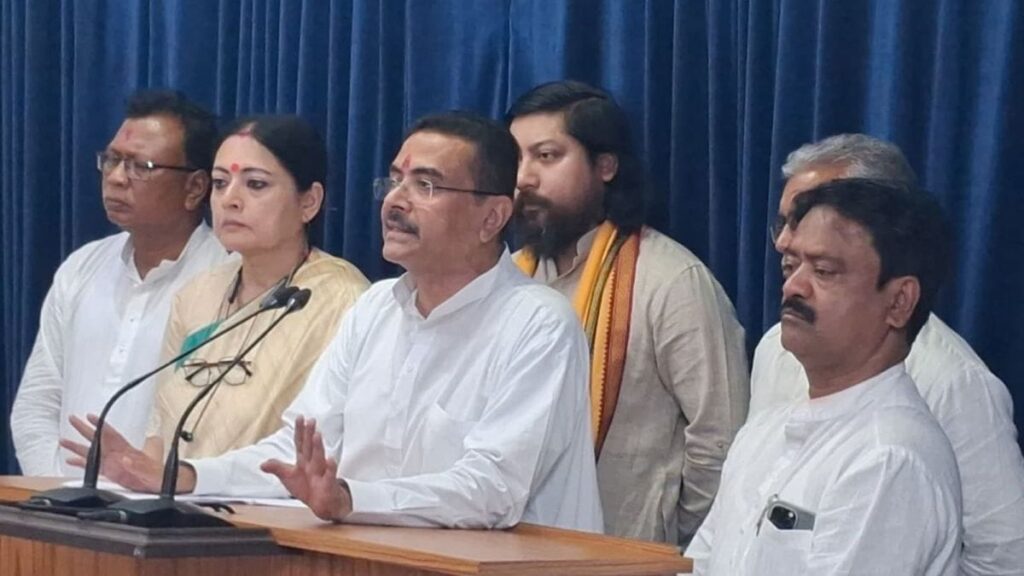
In a move signaling both administrative urgency and political consolidation, Chief Minister Suvendu Adhikari has unveiled the first phase of his cabinet, entrusting a lean “Core Five” with the task of steering West Bengal toward a new governance model. By keeping the heavyweight Home and Finance portfolios under his personal oversight, Adhikari has signaled a “command-and-control” approach as the state transitions into its first-ever BJP-led administration.
The Power Players: Who Governs What?
The initial allocation suggests a deliberate strategy to reward organizational loyalty while addressing key electoral demographics.
Minister Portfolios Allocated Political Significance
Dilip Ghosh Panchayat, Rural Development, Animal Resources Tasked with securing the BJP’s grassroots footprint in rural Bengal.
Agnimitra Paul Women & Child Development, Municipal Affairs Focuses on the “Nari Shakti” vote and urban infrastructure.
Nisith Pramanik North Bengal Development, Sports & Youth Services Vital for maintaining the party’s stronghold in the northern districts.
Ashok Kirtania Food & Supplies, Co-operation A nod to the Matua community and the state’s public distribution system.
Kshudiram Tudu Tribal Development, Backward Classes Welfare Aimed at consolidating the tribal and SC/ST vote bank.A “Direct-Drive” Administration
By retaining Home and Finance, Adhikari is not just filling a temporary vacuum before a full cabinet expansion; he is centralizing the state’s security apparatus and purse strings. This move mirrors his predecessor’s style but with a starkly different policy agenda. Immediately following the allocation, the CM greenlit the Annapurna Bhandar scheme, promising ₹3,000 monthly to eligible women—effectively doubling the previous administration’s direct cash transfer.
Bridging the Center-State Gap
The new cabinet’s first order of business was the rapid adoption of long-stalled central schemes. From Ayushman Bharat to the Ujjwala Yojana, the Adhikari administration is aggressively “saffronizing” the state’s welfare landscape.
The message from the Brigade Parade Grounds to the corridors of Nabanna is clear: the era of confrontation with New Delhi is over, replaced by a “Double Engine” philosophy where the first five ministers act as the frontline of a significant institutional overhaul. As the Assembly prepares to convene, all eyes remain on the CM to see when the remaining 39 ministerial slots will be filled to complete this administrative puzzle.